Opinion
LEARNING CURVE
Even when hate goes viral, Jews still don’t count




 Add EJP on Google
In Short
Jews are imagined simultaneously as powerless and omnipotent; that paradox makes antisemitism harder for some progressives to name because it does not fit neatly into the oppression frameworks we have learned to recognize.
When a post from our podcast about Black-Jewish dialogue, “Bringing It to the Table with Whit & Flo,” went viral in March, my cohost Flo Low and I were initially thrilled.
It all started when I posted a short about Flo’s experience as a recipient of reparations — as a descendant of a Holocaust survivor, she’s received Austrian citizenship — and the significance of her grandfather’s experience as a survivor. I had no idea the post would spread the way it did. But it spread for all the wrong reasons.
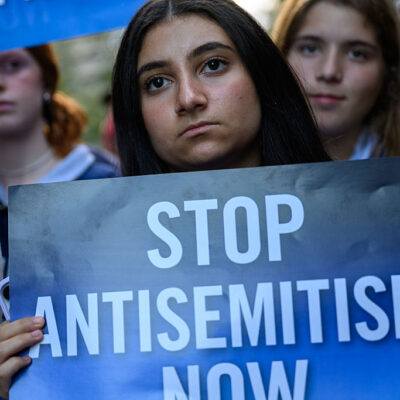
Getty Images
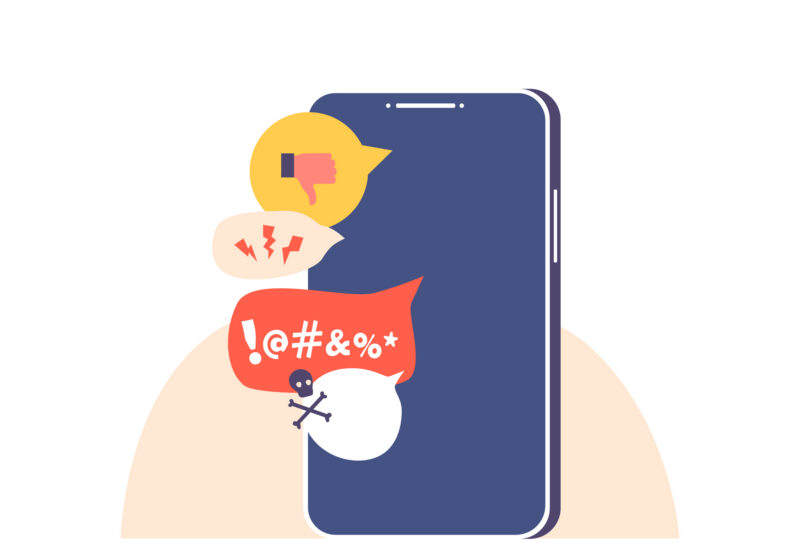
Hateful comments appeared almost instantly. Flo and I chose to engage with the commenters and not cede the space to hate, but what started as a principled stand became a numbers problem: over 40,000 views, more than 300 comments and a comment section that had become a vehicle for coordinated cruelty by chatbots and humans alike.
Jewish artist and writer E. Tzipora of Jewcy Couture recently wrote about this exact dynamic. In her piece “Towards a Jewish Renaissance,” she explains how the algorithm cannot distinguish between Jewish joy and Jewish conflict. She notes that the algorithm only reads engagement. So when a creator responds to a hate comment, even to defend their community or their friend’s community, the system registers activity and delivers the content to more hostile audiences. While she calls it a trap, I would call it a tax.
I knew before this experience that antisemitism existed, but what I did not know was how it moved: organized, automated and lying in wait. In my mind, antisemitism manifested as a hate crime or a slur spray-painted on a synagogue door; I’d forgotten that antisemitism was and is a part of the American societal fabric.
I also did not know there were bots disguised as humans operating as organized networks of coordinated cruelty. The bots, it seemed, were waiting for exactly this kind of content, and I walked into that comment section naively. Which begs the question: If bots are programmed by humans, who the heck is teaching bots to hate?
That ignorance is the thing I am still sitting with.
The gap between her shrug and my shock
What broke something open in me was not the volume of the hate or even its speed. It was Flo’s response: she shrugged.
To be clear, Flo’s shrug did not strike me as apathy. She has lived inside this world long enough that the hate no longer surprises her. For her, antisemitism simply is.
The gap between my shock and her steadiness opened something up. There is a weight Jewish people carry that I had not fully reckoned with before, and Flo’s shrug was the first time I felt the edges of it.
Anti-Black racism still undoes me every time it finds me. The vertigo of being targeted does not get easier. What I am realizing is that Flo has developed something I have not, and it did not come free.
Her steadiness is not resilience in the inspirational sense. It is not something to admire from a distance. Her resilience is what happens when a person has been given repeated,
clear evidence that their pain will not be acknowledged. The shrug is not peace; rather, it is survival.
Where I grew up, and where I am still growing
Growing up, relatives called me “white girl,” “Talking Annie,” even “motor mouth,” all because I loved words (and in true bibliophilic fashion, I felt words love me back). My fluency, my diction, my comfort with language were coded as proximity to whiteness, as if intellectualism has a racial home.
It wasn’t until I attended Tennessee State University, an HBCU, that I discovered there were other “blerds” — Black nerds — like me. I’d found my people: they devoured books, debated ideas and spoke in full paragraphs without apology. I needed that separate space to fully realize my Blackness. At my HBCU, I didn’t have to translate myself, and I definitely didn’t have to choose between being smart and being Black. More than anything, I didn’t have to shrink.
Which is why it was so telling when Yale, as Flo shared in our episode, declined to sanction a Jewish affinity space on the grounds that Judaism was a religion, not an identity category. The institution that had created a space for nearly every other community drew the line at Jewish people.
I know what it means to need a protected space to exist fully, and I know what it costs when that space is denied. I had that knowledge and still had not applied it to Flo’s experience until this moment, and that is the particular gap I am trying to name.
At Flo’s encouragement, I recently read Jews Don’t Count by David Baddiel. While I have critiques of the book (at times, Baddiel writes about Jewish people as though they are culturally homogeneous, flattening significant differences in origin, race and global experience), his book caught my attention as a self-proclaimed progressive liberal.
Baddiel writes:
“A sacred circle is drawn around those whom the progressive modern left are prepared to go to battle for, and it seems as if the Jews aren’t in it… Jews are the only subjects of racism who are imagined, by racists, as both low and high status.”
According to Baddiel, Jews are imagined simultaneously as powerless and omnipotent. That paradox makes antisemitism harder for some progressives to name because it does not fit neatly into the oppression frameworks we have learned to recognize.
As a diversity, equity, inclusion and justice (DEIJ) practitioner, I remember the first time I felt genuine shame about my work. A colleague asked how my work plan addressed antisemitism, and the honest answer was: it didn’t. The assumption underneath was that all Jews were white. And if they were white, then a focus on anti-Black racism, classism, sexism and ableism felt sufficient. Antisemitism wasn’t my lane, or so my thinking went.
But that assumption revealed something deeper. Jewish identity had been collapsed into whiteness. Synagogue access had been confused with safety (that Jewish people need armed guards to stand outside while they worship inside was lost on me entirely).
It took standing in a comment section watching hate move at the speed of infrastructure to understand how wrong I was. There was nothing random or episodic about the virulence of the hatred, and it was not a few bad actors. It was a whole darn system conspiring to replicate hate.
What I am still working through
I do not have a tidy conclusion to offer because I am not on the other side of this.
I am still grappling with the virulence of antisemitism and its unfortunate popularity. I watched as antisemitism hid behind questions and conspiracy theories under the guise of curiosity.
Antisemitism is not separate from other systems of oppression. On the contrary, antisemitism grows from the same soil as anti-Black racism. It feeds on the same conspiratorial logic that animates white supremacy, Christian nationalism and xenophobia. Problematically, to treat antisemitism as only a Jewish problem is to misunderstand how oppression works.
When we assume Jews do not need protection, solidarity or communal space, we replicate the very exclusion we, as progressive folk, claim to resist. Believing you are on the side of justice does not make you immune to gaps in your analysis or gaps in your work.
Justice work that excludes Jews is not justice work at all; it is, instead, a perpetuation of the idea that in the face of hatred, Jews still don’t count.
Whitney Weathers is an organizational consultant whose work sits at the intersection of theology, justice and institutional culture. She is the founder of Whitney Weathers Consulting and co-host of “Bringing It to the Table with Whit & Flo,” a podcast dedicated to honest dialogue across the Black-Jewish experience.