WHAT YOU SHOULD KNOW
As JFNA pushes $35M into fighting antisemitism, experts worry it’s doubling down on failing tactics
Jeenah Moon/Getty Images
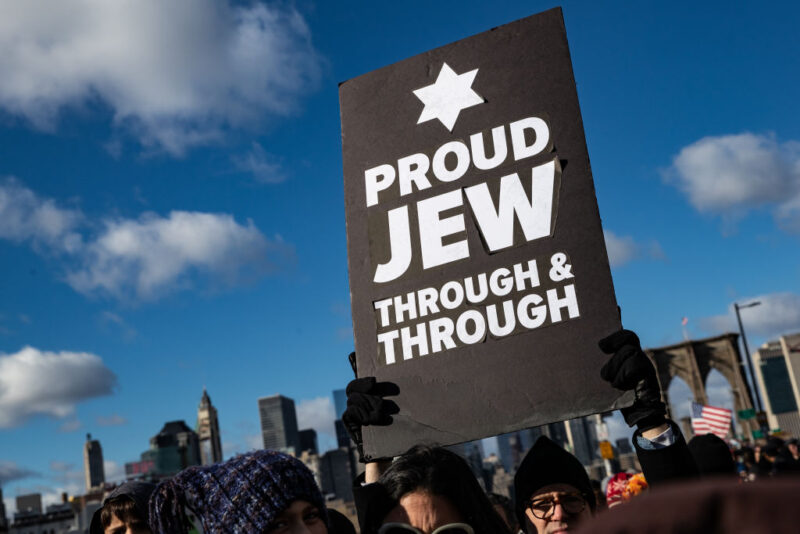
People participate in a Jewish solidarity march across the Brooklyn Bridge on Jan. 5, 2020 in New York City. The march was held in response to a recent rise in antisemitic crimes in the greater New York metropolitan area.


 Add EJP on Google
In February, New York Times columnist Bret Stephens called for the Jewish community to dismantle the Anti-Defamation League and funnel the tens of millions of dollars invested into fighting antisemitism initiatives into funding Jewish education and identity-building. It was a stance that was becoming increasingly popular, especially after a Jewish Funders Network study showed that the 160 programs that claimed to battle Jew hatred were redundant and provided no proof that they were moving the needle.
Eight months later, the Jewish Federations of North America announced a new $35 million initiative to combat antisemitism, dubbed Frontline, which calls for placing 100 new employees in local federations to advocate against antisemitism and cultivate community relations.
Several leading experts on combating antisemitism told eJewishPhilanthropy that they worry that Frontline is doubling down on interventions that have failed to meaningfully curb the marked rise in antisemitism over the past three years. With Jew hatred still soaring across the world, they all understood why JFNA and its donors want to push funds into combating antisemitism. However, they said, without new strategies that are studied for effectiveness, there is the potential that the initiative will stumble or even do damage.
For JFNA, however, this initiative is about providing critically needed resources to the smaller Jewish communities that have been struggling to deal with local antisemitism for want of them, investing in community engagement, interfaith work and other forms of outreach.
“The work of community relations is decades-old work for the federation system,” Shira Hutt, executive vice president at JFNA, told eJP. Currently, there are 141 Jewish federations in North America; 73 have staff already working on community building and combating antisemitism; 44 are specifically designated as Jewish Community Relations Councils, which have long served as local community relations and advocacy centers.
Following the Oct. 7 massacres that saw Hamas terrorists murder 1,200 people and kidnap 251 hostages, federation staff — especially in smaller communities that do not have their own dedicated JCRCs — were overwhelmed by the increase in advocacy and community relations work thrown at them.
After the war between Israel and Hamas in Gaza began, anti-Israel encampments proliferated across campuses, and public figures began calling for immediate ceasefires. The past three years have seen social media surge with conspiracy theories and Jewish students harassed by peers not only in universities, but in K-12 schools. The task of navigating this murky terrain often fell onto federation CEOs and other workers who were not trained for this work and didn’t have the networks needed to complete it, Hutt said.
Frontline is looking to fill that void, and federations have begun hiring based on their specific needs. The initiative aims for “concrete outcomes that keep our community safe,” especially in schools and the government, Hutt said. Those include pushing for bills related to security in Jewish communities as well as calling on school superintendents to set policy on how educators can discuss Israel and discipline students when, for instance, swastikas are found scrawled on lockers.
The program is the community-relations version of JFNA’s LiveSecure campaign, which infused $130 million into security for Jewish communities, Hutt said. Through Frontline, federations receive a grant that will cover the salary of a Frontline employee for two years, on the condition that federations sustain the role for at least three years. “We hope by then these roles are indispensable and [will] go on for longer,” Hutt said.
The “work of deepening civic engagement and focusing on community relations can’t just be about relationships for relationships’ sake,” Hutt said. “It really has to be about expecting something from our relationships, making sure that we’re clear about what matters to us.”
There is absolutely a need for increased community education to combat antisemitism, Dov Waxman, the Rosalinde and Arthur Gilbert Foundation Chair of Israel Studies at the University of California, Los Angeles, told eJP. Many people don’t even know how to define antisemitism — as the line between legitimate criticism of Israel and antisemitic tropes can be a blurry one — much less understand how it manifests or how to effectively address it.
“My big concern is that this is… really another way of spending money and supporting advocacy to counter BDS [the Boycott, Divestment and Sanctions movement] because that’s been basically what [federations have] been doing for a long time,” said Waxman, a prominent liberal Zionist voice. “And this is just another way of bringing in essentially Israel advocacy through the back door in terms of you calling it countering antisemitism, but really it’s the focus on countering anti-Zionism.”
A “red flag” flickered in Waxman’s mind when he read the press release and saw the inclusion of JFNA’s strategic messaging initiative Project Halo, which — among other things — aims to improve Israel’s image, as also receiving Frontline funding, he said. Earlier this year, JFNA cut a PR consultant connected to Project Halo after blowback for recommending that attendees at a federation conference avoid using the term “Zionism” as the word itself — and not the idea that it represents — has become divisive.
Even if Frontline is not focused solely on combating Israel criticism, the fact that federations are seen as being intertwined with Israel advocacy will hinder their potential to combat antisemitism where it matters and build bridges, Waxman said.
“Some organizations and groups and places will be wary about bringing in federations because of their work on Israel advocacy,” Waxman said. Community relations workers and educators are especially needed in “spaces where anti-Zionism can become antisemitic,” but federations won’t be allowed through the doors if they are perceived as pushing a specific view of Israel.
Waxman noted tens of millions of dollars have so far been poured into efforts to combat antisemitism in the conventional way, which has not proven itself effective. “One has to question how effective that vast amount of money has been,” he said.
“I don’t see the Frontline grant as necessarily pigeonholing us in just combating antisemitism in the old ways that we’ve done,” Samantha Silverman, the CEO of the Jewish Federation of Greater Santa Barbara (Calif.), which is receiving Frontline funds, told eJP. “I see JCRC as an incredible way to build connections with community, as a way to build those bridges of understanding, to promote dialog in times of peace ideally, so when we have issues come up, when we have incidents, we have a whole community gathering together with understanding of the richness and the beauty of Jewish tradition and all we’ve contributed.”
David Bernstein, CEO of North American Values Institute and a regular critic of progressive Jewish policies, told eJP that Frontline should not be focused on getting into rooms that don’t want Jews in them.
“The Jewish community should speak less about pursuing intergroup relations and more about strategic partnerships,” Bernstein said. “In other words, who’s going to help us achieve our fundamental goals and not who are we going to make peace with?”
Many of the progressive groups that the Jewish community has traditionally sought to partner with “have embraced the oppressor versus oppressed worldview, and may no longer share those basic commitments about American civic values and might not be the right partners in today’s world,” Bernstein said. Frontline’s focus needs to “go beyond advancing Jewish interests to defending American civic values that allow Jews to thrive. Values like freedom of expression, equality of opportunity, pluralism and the rule of law.”
But supporting partners only when it is strategically beneficial will backfire, Stacy Burdett, a consultant on antisemitism who worked for more than 24 years at the ADL, told eJP. Instead, she believes the only approach that works in today’s environment is an “engagement approach,” as used by the Jewish Council for Public Affairs, where she serves on the board. JCPA is formerly the umbrella organization for JCRCs and still works closely with them.
Using an engagement approach doesn’t mean Jewish advocates don’t criticize partners, but it means that they don’t use intimidation or harassment to instigate change and continue to have their partners’ backs if they come under attack, such as when Republican politicians pounced on the National Education Association — the country’s largest labor union.
Many politicians, employers and potential allies are trying to support Jews, Burdett said, but they are being criticized from all directions, especially on issues related to Israel. It’s confusing for them, she said, because the advocates screaming — from both the left and right — are often Jewish.
“Real community relations work gives back to allies, in addition to asking for support,” Burdett said. “Sticks-only tactics may attract funding, but they leave behind scorched earth, not relationships. If this is more money for one-way pressure, expect the same disappointing outcome.”
No matter the intervention, federations need to study Frontline’s effectiveness because it has the potential to propagate the very thing it aims to eradicate, Eran Shayshon, founder of the Israel-based Atchalta think tank, told eJP. “Oftentimes advocacy organizations are doing more damage than actually helping things,” he said.
Advocates can react to small incidents, especially around Israel, causing the incidents to gain headlines in mainstream media, said Shayshon, who views anti-Israel advocacy as seeped in antisemitism. “For example, the BDS campaign is primarily a negative branding campaign. The main goal of the BDS campaign is not to generate an economic boycott against Israel, not that they would mind, but primarily to associate Israel with the discourse of boycotts, because then when you have negative sound bites, your image or your brand is deteriorating, and rumors are associated with you.”
Many Jewish advocates are triggered by antisemitism at the fringes, especially online, where it gains traction, but the reality is, the voices bolstered by the algorithm don’t represent reality, Shayshon said, especially when it comes to disproportionate criticism of Israel.
To fight back against overlapping antisemitism under the guise of anti-Zionism, hasbara will not work, Shayshon said, referencing Israel’s public diplomacy strategy. This is because the movements to delegitimize Israel look different depending on the country someone lives in. In America, the anti-Israel movement is filtered through identity politics, where the Jews are seen as white and therefore privileged and colonial, while in Ireland the movement is filtered through the lens of the Irish struggle for independence from Britain.
Instead of pushing a one-size-fits-all American hasbara, advocates need to shatter the myth that the loudest online voices represent all American voices and show that anti-Israel beliefs are not the majority opinion, he said, pointing to a 2025 Harvard Harris study that showed that most people in the Western world favor Israel over Hamas. (That study, though, along with most others on the topic, shows that respondents’ views of Israel are becoming increasingly negative over time, especially since the war in Gaza began.)
Advocates should focus on the ways antisemitism undermines the values Americans cherish and work to empower those who Shayshon calls “the silent Jewish majority” who are afraid to speak up.
If interventions aren’t studied, “well-intentioned efforts can fuel [conspiracy theories],” Cynthia Miller-Idriss, a sociologist and professor at American University and the founding director of Polarization and Extremism Research and Innovation Lab (PERIL) at American University, told eJP. PERIL is one of 11 initiatives funded by the Har Initiative, a donor collective co-chaired by the heads of the Samueli and Blank foundations, which seeks to fund innovative initiatives combating antisemitism. “We have been very careful not to do interventions unless we test them first.”
PERIL creates 75-second videos that “pre-bunk” viewers for antisemitic conspiracy theories, which they believe is the foundation of Jew hatred; the videos feature a microdose of propaganda followed by teaching why the conspiracy theory is false. Each intervention undergoes large research trials to understand its impact and make sure it is not feeding into antisemitism.
One recent video failed the test, Miller-Idriss said. After watching the video, viewers predisposed to conspiracy theories were shown to have increased antisemitic views, so the intervention was pulled. That same state of mind, where every intervention is scrutinized, should be used for Frontline, she said.
Miller-Idriss also recommended looking to interventions that have been proven to work for other populations, such as bridge-building activities that have been shown to bond even the most discordant communities, she said, giving the example of pro-life and pro-choice advocates finding common ground over reducing unwanted pregnancies. “They work on that,” she said, “and then that builds trust and actually, there’s been provably less violence.”
Frontline does indeed focus, in part, on community engagement and bridge-building initiatives. JFNA specifically noted that the program would support Student to Student, a program that brings together Jewish and non-Jewish teens, as a program receiving Frontline funding, which Waxman was happy to see. Contact theory — the concept that face-to-face interactions between groups reduce hatred and bigotry — is a well-proven intervention. In past decades, grassroots community building with other groups and minorities was a massive strength for the Jewish community, exemplified by the Black-Jewish alliance during the 1960s, but in recent decades, it has been neglected in favor of Israel advocacy, Waxman said.
Similar to the surge in attendance at Jewish events post-Oct. 7, there’s been a surge of advocates in the Jewish community, many of whom emerged from grassroots initiatives and are now moving to the organized communal world, Hutt said. “There are people that want to lend their experience,” she said. “They may have worked in government or in other bridge-building spaces… grassroots organizing, that want to lend their experience outside the Jewish world to the Jewish world.”
Many of the new Frontline workers were hired based upon their Israel advocacy, including Laura Weisblatt, a grassroots organizer hired by the Jewish Federation of Northeastern New York, who co-founded the Israel advocacy organization Amidah Albany, which was absorbed by the federation, and Yoni Diller, a Nova music festival survivor hired by the Jewish Federation of Columbia, S.C., who was a fellow at the Israel advocacy nonprofit StandWithUs. But other Frontline employees were hired based on traditional community relations skills, coming from fields such as education and other Jewish organizations including Repair the World and BBYO.
The roles they serve seem to vary drastically from federation to federation, with some federations deeply focused on Israel advocacy and others rebuilding mothballed JCRCs and working to boost friendships with other minority groups. That is the case with the Jewish Federation of Greater Santa Barbara, which recently put on the exhibit, “Praying with Our Feet,” that highlighted local Black and Jewish roles in the Civil Rights Movement.
Other federations are using the grant to rework their JCRCs, such as at the Jewish Federation of Florida’s Gulf Coast, Maxine Kaufman, the federation’s executive director, told eJP. After Frontline was announced, the former JCRC position was reframed to have an “overarching countering antisemitism cloud above [the employee’s] head,” Kaufman said.
“One of the main things that we see is that the best way to counter antisemitism is through education, education from our youngest to our oldest,” Kaufman told eJP. The four-employee federation has not created a formal curriculum that will be used by the new hire, she said. Instead, the employee will learn tactics from JFNA resources and StandWithUs, so “if somebody tells [them] ‘Israel is an apartheid state,’ [they] can look at them and say, ‘Well, what makes you feel that way? Why do you say that? And turn the question back to them, and kind of let them talk themselves into a circle,’” Kaufman said.
There is no difference when it comes to combating antisemitism and anti-Zionism, Kaufman said, “Antisemitism and anti-Zionism are one and the same. Criticism for the State of Israel is not necessarily antisemitism nor anti-Zionism. Criticism is criticism.”
The November 2025 Jewish Funders Network study, titled “Fight Smarter,” served as a wake-up call for many. At the time, Andrés Spokoiny, the group’s president and CEO, urged funders to set goals. Instead of seeking to change hearts and minds, he felt that they should look towards concrete outcomes, similar to the LGBTQ community, which didn’t aim for unmeasurable goals like quelling homophobia and instead pushed for marriage equality.
Instead of all donors investing in campus antisemitism initiatives, Spokoiny recommended funders band together to target neglected areas, such as antisemitism in gaming and K-12 education. New initiatives, he said, need to be studied closely to make sure they are making positive change.
JFNA said that Frontline, which is chaired by Julie Platt, JFNA’s immediate past board chair, prioritizes concrete outcomes. “We want to make sure that the focus is always about leading to outcomes that make our community safer,” Hutt said. “It is safer to live in Pittsburgh when BDS does not win at the local food co-op. It is safer for students to go to a public school when the school doesn’t tolerate swastikas in schoolbooks and on school walls.”
When it comes to the debate on whether funding should go towards combating antisemitism initiatives or ones supporting Jewish identity, “We just don’t think we have the luxury to do one or the other,” Hutt said.
Correction: An earlier version of this report incorrectly described the genesis of Project Halo; the earlier version also gave an incomplete picture of Frontline, insufficiently noting its focus on community engagement and interfaith work.