HUNGER PANGS
Ahead of Rosh Hashanah 5786, experts predict another year of food insecurity in Israel
Five years of continuous emergency deepen inequalities that have led to widespread food insecurity in the Jewish state, experts say
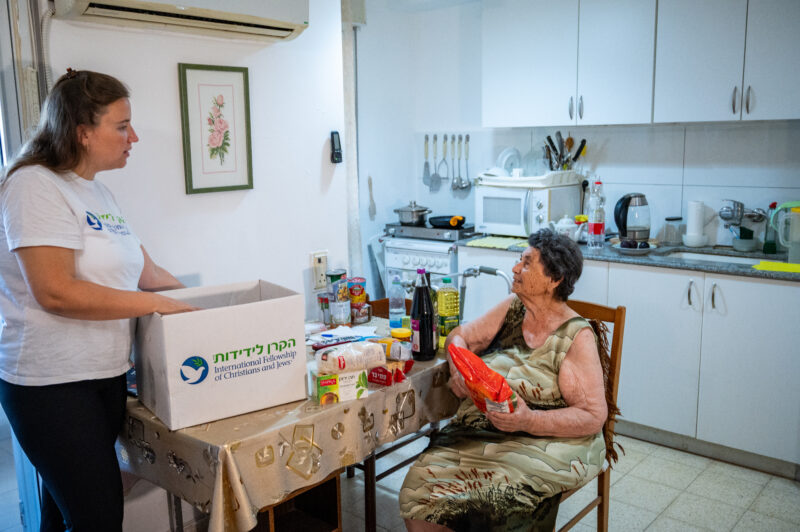
COURTESY/IFCJ
Batya Kaplan, right, receives a box of holiday food and supplies from an International Fellowship of Christian and Jews volunteer, in an undated photograph.




 Add EJP on Google
Even before the upheaval of Oct. 7, 2023, Israel was grappling with poverty and the hunger that frequently accompanies it. According to the Israeli National Insurance Institute’s latest report, 20.7% of Israel’s population — nearly 2 million people — lived below the poverty line in 2023, including 872,400 children. This placed Israel second-to-last among OECD nations in poverty rankings, ahead only of Costa Rica.
Now, as Israelis prepare for their Rosh Hashanah celebrations just weeks before the second anniversary of Oct. 7, five years of continuous emergency — from the COVID-19 pandemic to the judicial overhaul to the current war — have deepened the inequalities that have led to widespread food insecurity in the Jewish state, experts say. According to statistics from the Leket Israel food bank, families are spending a record NIS 3,900 ($1,050) on holiday meals — a 20% increase since before the war — yet they are expected to waste food worth approximately NIS 1.4 billion ($380 million), equivalent to 260,000 tons.
“This year, we are meeting more families than ever in need of assistance,” Joseph Gitler, Leket Israel’s founder and chairman, told eJewishPhilanthropy. “People who can’t afford to waste also waste. It’s disturbing, but it seems to be a worldwide phenomenon.”
Rabbi Mendy Blau, Israel director of Colel Chabad, which provides food, medical care and support to Israel’s needy, offered stark figures: “250,000 homes are suffering from extreme food insecurity in Israel. That means these families are experiencing actual food shortages — such as skipping meals, or having less food at meal times.” Of these, he said, 45,000 are elderly, with the remainder being families with children.
Yael Eckstein, president and CEO of the International Fellowship of Christians and Jews, a relief organization for Israel’s needy, agreed that the crisis is acute. “Over the past two years of ongoing conflict, many new groups of Israelis have found themselves in need of support,” she said. “These include families who have been evacuated from their homes, army reservists reporting for tour after tour of duty, and the very victims of the war itself — the injured, the traumatized, the bereaved families.”
Ran Rovner, head of marketing and organizational knowledge at the American Jewish Joint Distribution Committee, observed how war creates new pathways into poverty. “A lot of reservists, people who lost their business — if not for the war, they would have gone on with their lives,” he said.
The timeline for those in need is critical. “All studies in the field have shown that if you don’t reenter the employment cycle within a year from the time of your vulnerability, your chances of remaining in the employment sector plummet by 90%,” Rovner noted. This is particularly urgent considering the massive impact of trauma following the Oct. 7 attacks. “Take Nova survivors — if we don’t assist them now, they will become forever embroiled in the cycle of poverty.”
Julie Fisher, associate executive director of The Good People Fund, which funds grassroots organizations in Israel and the United States, said the prolonged crisis has a cascading effect: “Even if an organization is not about food insecurity or poverty, they are being impacted by increasing economic consequences of the situation. After constant emergencies, we’re seeing residual effects on families who are serving, and their ability to keep their businesses alive.”
Adding to the crisis is the exodus of talent from the social sector. “Rising social visionary stars are turning to jobs in the high-tech sectors,” said Fisher. “How sad that we are losing social visionaries in the field and they are abandoning high-needs places. Which of these initiatives will be sustainable?”
Blau said that he believes that these issues will eventually be addressed by the state. “At the end of the day, the government will need to take responsibility for those experiencing food insecurity,” he said.
John Gal, who heads the Welfare Policy Program at the Taub Center in Jerusalem, is less convinced. He noted that the government’s food security committee leadership has disbanded, and $90 million allocated for food vouchers sits undistributed. “That’s really not on the agenda of the government,” Gal said. “If there is an overlap between poverty and food insecurity, the problem is that we’re not doing a good job dealing with poverty, which is why we have one-fifth of the population living below the poverty line — higher than any comparable country in the world. If we provide better programs and more resources, then food insecurity will be less of a problem.”
Gal identified three systemic barriers: “We spend our resources on other things, we have a government that insists on not raising taxes to provide better services and we have a mindset in government that says that if you give people too much money, they will not move into the labor market.” But he argued this mindset is flawed: “There are so many reasons why they can’t get into the labor market. Often there is discrimination, and wages are low. The role of the government is to step in and provide support.”
The war has also created regional disparities. “Productivity in the north and south is lower than in the center,” Rovner said.
Despite these overwhelming challenges, there are reasons for cautious optimism. JDC’s comprehensive approach includes economic resilience building, maximizing rights and benefits access, debt assistance and employment training. They focus on both traditional vulnerable populations — with Arab communities experiencing 38.4% poverty rates and Haredi communities 33% — as well as on new war-affected groups.
“One of our most significant focuses is in training — employment skills, digitization, human resources — to create a shift in productivity,” Rovner explained.
Yet he remains optimistic: “There are so many good forces working, so I believe the challenge is all of ours and we will succeed.”
As Israel enters the Jewish year 5786, whether the country can transform this crisis into an opportunity for structural change may depend on collaborative efforts across the social sector.
“We have a job to do and [we] need to focus on that,” Leket’s Gitler said. “I think it’s important that we just do our job and do it as well as we can and grow as much as we can.”
Related News

PRESIDENTIAL REBUKE
Israel’s Herzog: Mamdani ‘makes no effort’ to hide disdain for Israel, Jews must fight back
ADVANCING A VISION
N.Y. federation donates $1M toward building shared-society center named for peace activist killed on 10/7
HIGHER EDUCATION
As Jewish donors reconsider academia, Jan Koum doubles down, endowing Israel studies at Stanford
CLOSING WORDS
In AZM address, Cosgrove links communal ‘orthodoxy’ on Israel to rising anti-Zionism among young Jews

MAGICAL EXPERIENCE
Shefa launches psychedelics retreat for Jewish professionals suffering burnout