BRIDGING THE GAP
JFNA confab opens with Blinken, Pompeo agreeing on support for Israel, diverging on everything else
Former secretaries of state debate Israel’s potential for peace with neighbors post-Oct. 7 as General Assembly kicks off in Washington
Courtesy/JFNA
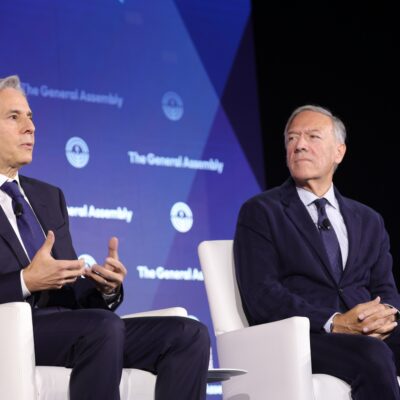
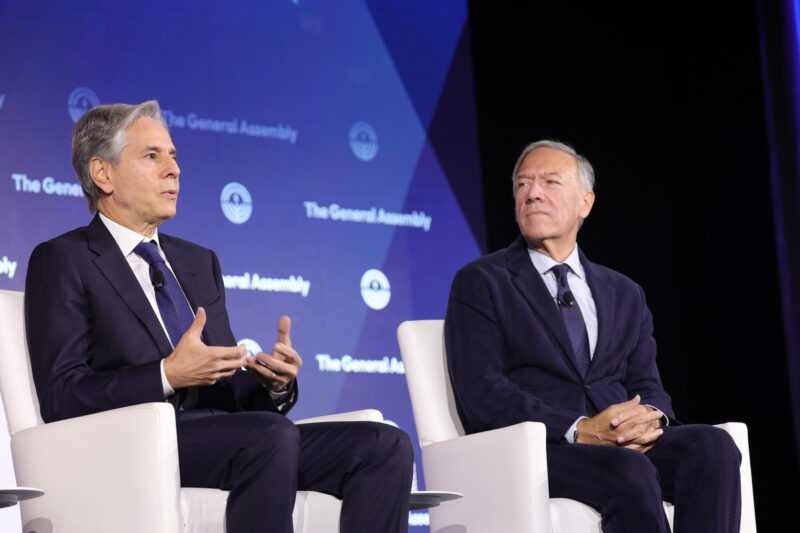
Former Secretaries of State Mike Pompeo (right) and Antony J. Blinken speak at the opening plenary of the Jewish Federations of North America's General Assembly in Washington on Nov. 8, 2026.


 Add EJP on Google
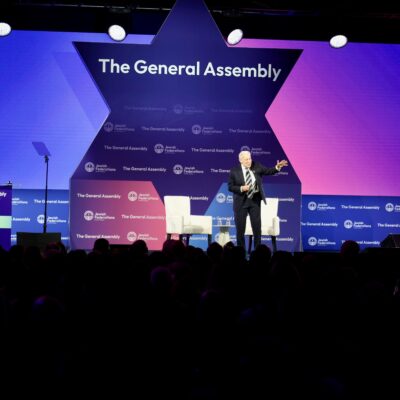
The stage at this year’s Jewish Federations of North America annual General Assembly was bathed in red, white and blue lighting, with a massive Magan David painted in the colors of the American flag.
The decor was a celebration of the 250th anniversary of the founding of the United States and recognition of the prosperity that the country has offered to its Jewish community, even if — for some Jews — it may feel as though the golden era of American Jewry has ended.
The Washington conference is set to run from Sunday through Tuesday with some 2,500 attendees trekking in from across North America, Israel and even Australia.
The gathering opened with the first joint public appearance of former Secretaries of State Mike Pompeo and Antony J. Blinken since they left office. Moderated by ABC News journalist and co-anchor of Nightline Juju Chang, the conversation between Pompeo and Blinken showcased divergent views on Israel and America’s Middle East politics. Pompeo served as the 70th secretary during President Donald Trump’s first term, helping usher in the Abraham Accords, while Blinken served as the 71st secretary under President Joe Biden, playing a key role in the American government’s response to the Oct. 7 terror attacks and the resulting wars in Gaza and Lebanon.
“Israel has had a number of remarkable achievements over the last few years in the midst of the horror of Gaza, setting back the Iranians, setting back Hezbollah, setting back, but not eliminating Hamas, and so on,” Blinken, who is Jewish, said. “Their ability, or sometimes inability, to translate those tactical military successes into strategic gain is the real problem.”
Blinken said that he had been involved in negotiations between Saudi Arabia and Israel prior to the Oct. 7 terror attacks. “The missing piece in getting the Saudis on board,” he said, was Israeli recognition of a Palestinian state. The massacre destroyed any progress made, but to re-enter talks of normalizing relations between Israel and Arab neighbors, “requires a resolution of the Palestinian question.”
The tension between sides when discussing Israel and a Palestinian state has become, “so violent, so polarized and so dehumanized,” Blinken said, recognizing his stance is not popular at the moment. “To those who are advocating from the river to the sea, who want Israel to go away, guess what? It’s not. For those who are advocating for a greater Israel, who want to continue to build settlements, who want the Palestinians to go away? Guess what? They’re not. There are 7 million Jews. There are 7 million Arabs and Palestinians. No one is going anywhere.”
Pompeo, meanwhile, took an opposing view, saying that the resolution of Israel’s conflict with the Palestinians was not in the offing. “We are further from this notion of a two-state solution; we are further from that today than we have been in a long time as a result of Oct. 7,” he said.
Instead, he pointed to what he felt was “One of the keys to success of the Abraham Accords [which was] not letting the conflict between the Palestinians and the Israelis get in the way of what the Gulf Arab states actually know needs to happen, and that’s recognizing Israel’s right to exist.”
The GA conversation was held a week after what Chang called “a blue tsunami, blue-nado,” in which Democrats swept the midterms, followed by Vice President J.D. Vance blaming the Republican losses on the war in Iran and skyrocketing gas prices, implying that Israel was the reason for both. The conversation also followed President Trump announcing on an episode of Fox News’ Fox & Friends that U.S. aid to Israel would end by December 2026.
“I don’t know exactly how this administration will follow through on that,” Pompeo said. “There’s an agreement. I think it’s still got several years to run on the agreement.”
But Pompeo said, “Whether we provide the $4 billion a year, which… mostly goes to buy U.S. weapon systems from Lockheed Martin and big defense contractors, is much less material than the nature of the relationship between the United States and Israel.”
Blinken, 64, said he grew up at a time when Israel was seen as David fighting Goliath, but that has flipped.
At one of Blinken’s meetings with Israeli Prime Minister Benjamin Netanyahu that took place between Oct. 7 and when Biden left office in January 2025, Blinken said he warned Netanyahu that he was acting in ways that were not only going to alienate Israel from Democrats, but from young Republicans and conservatives, too.
“You’re seeing a recognition on the part of the Israeli government that [receiving U.S. aid] is not going to last forever,” Blinken said. “And [the government is] attempt[ing] to make it clear in the body politic to Israel that ‘No, we can pay for our own stuff. We don’t need the amount of assistance that we get in the United States in terms of paying for what we’re acquiring.’ You’re obviously hearing that in the United States, and I think we’re heading clearly in that direction. President Trump is now saying it, that only puts an exclamation point on it.”
The topic of how to view Israel’s war in Gaza also caused division between the speakers — as it frequently does throughout the Jewish community. “We have to be able to acknowledge the rightness of Israel’s imperative to respond after Oct. 7,” Blinken said. “We also have to be able to acknowledge the horror of the suffering of Palestinians in Gaza in the many days thereafter.” While the Israeli army may not have intended to eliminate the Palestinian people, “There was a certain amount of disregard, a certain amount of disdain for the well-being of the Palestinian civilians.”
Meanwhile, Pompeo viewed Israel’s actions in the war as “so fundamentally in the right,” while Hamas’s “evil” was “so one-sided and so clear” that he feels that the only way to discuss the war and push against critics is “you tell the story over and over, and you rinse and repeat about the fundamental decency of the Israeli military and how they fought this war.”
The opening plenary kicked off with a performance by Pizmon, the co-ed Jewish a cappella group from Columbia University, Barnard College and the Jewish Theological Seminary, which sang a mashup of Simon & Garfunkel’s “Bridge Over Troubled Water” and the Hasidic song “Kol Ha’Olam Kulo Gesher Tzar Me’od” (“The whole world is a very narrow bridge”).
“There could not be a more important moment for us to come together because the world in which we are leading our communities has changed dramatically over the past several years,” Ronnie Pertnoy, who co-chaired the convention with his wife, Susan Shulman Pertnoy, said.
When Pertnoy and his wife strolled onto the stage, they were greeted by a cheering entourage from Palm Beach, Fla., where they have held leadership roles in the local community for decades. The devotees, holding up massive cutouts of the couple, filled nearly one-tenth of the ballroom, which welcomed almost 2,500 people for the conference — nearly every seat in the football-field-sized room was filled.
“Oct. 7 changed Israel and the Jewish world,” Pertnoy said. Over the past several years, Jews have lived through war, loss, uncertainty and rising antisemitism. “The challenges do not exist in isolation; they are unfolding in profound geopolitical shifts, changing political dynamics here at home and questions about the future of America’s role in the world and its relationship with Israel. The assumptions that shaped our lives and our leadership for decades are being tested. The choices being made today will have consequences for years to come.”
The rest of the plenary session focused on the specific issues that JFNA is zeroed in on: supporting Jews amidst the continued surge into Jewish life post Oct. 7, taking advantage of the $1,700 tax rebate that will reduce private school tuition costs, facing antisemitism, rebuilding Israel, supporting Jewish summer camps and running volunteer trips to Israel in partnership with Birthright.
A large segment of the plenary also forced attendees to face the continued struggles of Ukrainians. “We are still here,” Inessa Nosenko, director of the JCC Mazal Tov in the southern Ukrainian city of Zaporizhzhia, near the border with Russia, said, as images flashed on screens of half-standing buildings, glass shards and nets covering cities to keep drones out.
Years after the war started, Nosenko said, sirens continue to ring, and missiles rain down. People are living in shelters, and there isn’t enough medicine to care for the sick. But still, she said, Jews meet weekly for Shabbat. They were together, celebrating Rosh Hashanah and Sukkot. Winter is coming, and the war grinds on, yet Hanukkah will burn bright, she said. “We keep Jewish life alive.”
The plenary ended as it began, with college kids singing a cappella. Wrapping up the weighty first day, Pizmon sang “Nachamu,” a traditional one-line tune of consolation and hope: “Be comforted, be comforted, my people, says your God.”
Related News

ADVANCING A VISION
N.Y. federation donates $1M toward building shared-society center named for peace activist killed on 10/7

EXCLUSIVE
Detroit-based philanthropists Nancy, James Grosfeld donate $8M to renovate JDC’s Israel campus

MAJOR GIFTS
Center for Jewish History celebrates 25 years with a $25M matching grant

EXIT INTERVIEW
Elizabeth Sokolsky, longtime EVP of Birthright Israel, to retire next year
CLOSING WORDS
In AZM address, Cosgrove links communal ‘orthodoxy’ on Israel to rising anti-Zionism among young Jews