Opinion
WHAT COMES NEXT
Remaining a community across political divides


 Add EJP on Google
Imagine two Jewish families arriving at the same synagogue this Shabbat. One is celebrating Tuesday’s election results. The other is deeply unsettled by them. One sees a victory for democracy and the values they believe will protect their family’s future. The other sees troubling signs of a political climate in which antisemitism may become increasingly acceptable.
Both care deeply about being Jewish. Both worry about the future. And both need to feel that they belong in the same Jewish community.
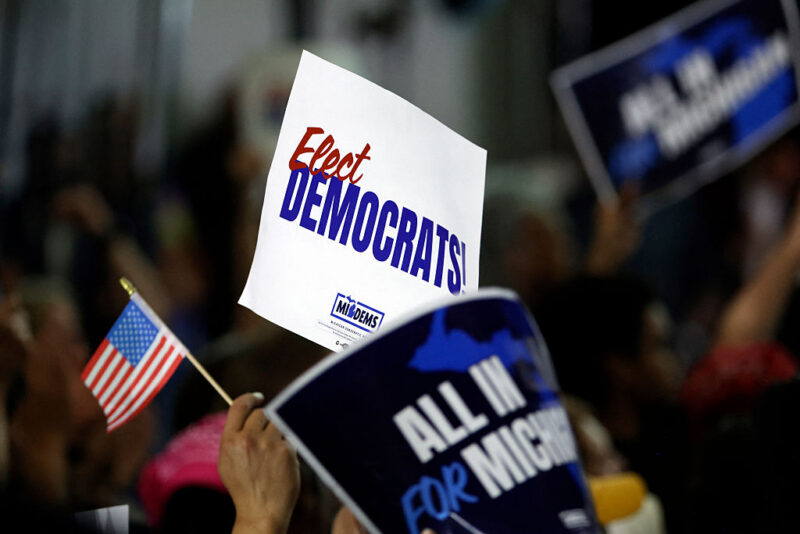
Jeff Kowalski/AFP via Getty Images
Democratic Party supporters hold campaign signs during the Michigan Democratic Party's general election kickoff rally at Renaissance High School in Detroit on Aug. 7, 2026.
As clinical psychologists, we help people navigate relationships, conflict and the complicated emotions that emerge when people see the same situation differently. This election has us thinking about what happens when those differences move beyond individual relationships and into the institutions that hold our communities together, because the challenge facing American Jewish leadership isn’t simply how to respond to the election results — it’s how to keep our communities from fracturing over them.
When disagreement becomes a question of belonging
American Jews have never been politically uniform. We’ve debated candidates, policies and Israel for generations.
But something about our current political climate feels different. For years, political positions have been increasingly understood not simply as opinions but as reflections of someone’s morality and values. When the stakes involve antisemitism, Israel, democracy and the safety of our families, those disagreements become particularly charged. A vote that one person sees as an affirmation of democratic values may feel to another like an endorsement of someone who has minimized antisemitism.
These differences are real and shouldn’t be dismissed with vague calls for unity. But when disagreement becomes the belief that people who see things differently no longer deserve a place in our communities, political polarization threatens Jewish communal life itself.
There is an important psychological distinction between belonging and agreement. Healthy relationships don’t depend on two people seeing the world identically. They depend on the ability to tolerate differences without automatically interpreting them as rejection or betrayal. Communities are no different. Consider the college student who feels politically out of step with their Hillel community, the parent who hesitates to attend a synagogue event because they fear being judged for their views or the Jewish professional who avoids communal conversations because every disagreement risks damaging relationships. These situations raise a fundamental question: Are we creating communities where Jews can bring their full identities, including their questions and contradictions? Or are we communicating that there is a correct way to think, vote and belong?
We can establish clear communal values without demanding political uniformity. We can refuse to tolerate antisemitism, racism or other forms of hatred without assuming that every political disagreement represents a moral failure. Listening is not endorsement, understanding is not agreement and making room for disagreement doesn’t require abandoning our principles.
What Jewish communal leaders can do
Synagogues, federations, JCCs, campus organizations and other Jewish institutions are more than places where people gather. They are places where we learn what it means to belong to a people. But creating a culture of belonging requires more than issuing statements about unity. It requires intentional leadership.
Jewish organizations can create opportunities for respectful conversations across political differences, establish expectations for civil discourse and ensure their programming reflects the diversity of perspectives within Jewish life. They can also ask uncomfortable but necessary questions: Who feels represented? Who has quietly stopped showing up? Are we creating environments where certain Jews feel they must conceal their political beliefs to remain welcome?
These questions are especially important for younger Jews navigating complicated relationships among Jewish identity, Israel, politics and the communities in which they were raised. If they come to believe that Jewish communal participation requires passing a political test, we risk pushing away precisely the people we hope will shape its future.
Jewish philanthropy also has a role to play. Supporting dialogue, leadership training and programs that bring Jews with differing perspectives into meaningful relationships isn’t simply an investment in civility. It’s an investment in the long-term strength of Jewish communal life.
Our future depends on more than agreement
Judaism has a long tradition of argument, interpretation and disagreement. The Talmud preserves opposing viewpoints rather than erasing them. There is wisdom in that: the goal has never been for every Jew to think alike.
We can acknowledge that antisemitism is a serious threat without agreeing on every political solution. We can disagree about Israel without denying one another’s Jewish identities. And we can care passionately about democracy and our families’ safety while recognizing that other Jews may prioritize those concerns differently.
None of this is easy, particularly when our fears feel personal and the stakes seem so high. But the alternative is a Jewish community increasingly divided into smaller groups of people who agree with one another, each convinced that theirs is the only legitimate expression of Jewish values. That is not the Jewish future we should be building.
As Jewish leaders reflect on this election, we hope they’ll consider not only what the results mean for their institutions, but whether the people within those institutions still feel that there is room for them. Because our greatest challenge may not be learning how to agree with one another, but learning how to remain a community when we don’t.
In this political moment, that is a responsibility Jewish leadership cannot afford to overlook.
Jessica Zmood and Shelly Steinwurtzel are licensed clinical psychologists and co-founders of Gesher Community Care, a nonprofit organization dedicated to supporting Jewish mental health through culturally responsive care, professional education and community partnerships.