GIVING BETTER
Marking first anniversary, Jewish Climate Trust releases inaugural Guide to Climate Philanthropy
The guide's creators hope it spurs funders into action. 'You're not required to complete the task, but neither are you free to desist from it, JCT CEO Nigel Savage says
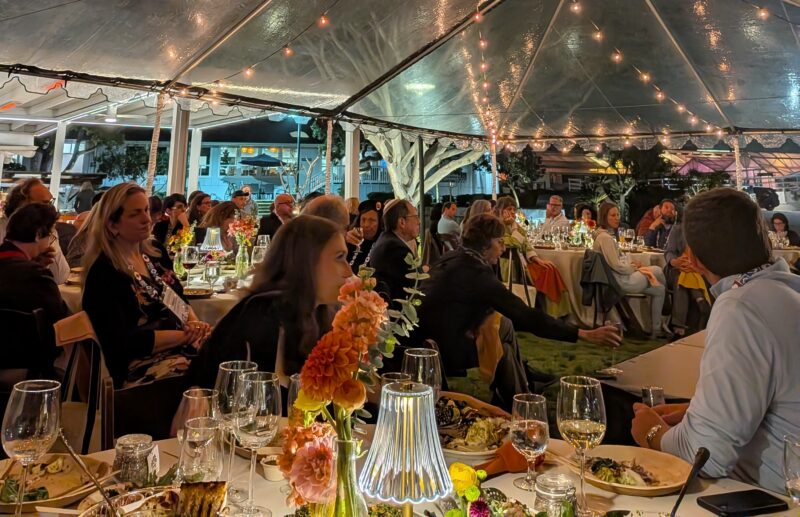
Jay Deitcher/eJewishPhilanthropy
Attendees of the Jewish Funders Network eat dinner at an event marking the release of the Jewish Climate Trust's 'Jewish Guide to Climate Philanthropy' on March 16, 2026.




 Add EJP on Google
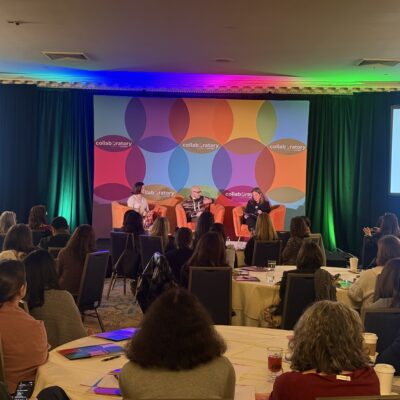
ENCINITAS, Calif. — The second day of this year’s Jewish Funder’s Network International Conference, held in San Diego from March 15-17, was not only the longest of the three-day gathering, but also the most intense, full of plenaries, workshops and discussions. Still, over 100 of the 600 conference attendees shed their blazers to trek to nearby Leichtag Commons, a Jewish community farm and education center, for a farm-to-table dinner under the stars, co-hosted by the Jewish Climate Trust and the Leichtag Foundation, celebrating the one-year anniversary of the launch of the JCT and the unveiling of its Jewish Guide to Climate Philanthropy.
The event, titled “Gather Around a Sunset: Honoring a Philanthropic Legacy and Connection to Land,” welcomed attendees representing over 70 funders and foundations, including the Mizrahi Family Charitable Fund, the Abramowitz-Silverman Fund and the Claudine and Stephen Bronfman Family Foundation.
The organization was the brainchild of Canadian businessman and philanthropist Stephen Bronfman and entrepreneur and philanthropist Michael Sonnenfeldt, who continue to serve as JCT’s co-chairs. Many of the dinner attendees have been invested in the JCT from its inception, and the guide offers on-ramps for new funders into the field, focusing on how climate action connects to their interests across the board.
“We live in this slightly dark moment in the world right now, and one of the things that we all need is hope and inspiration,” Nigel Savage, CEO of JCT, said at the beginning of the event. The programming included a conversation between Savage and Jim Farley, a former lawyer and the Leichtag Foundation executive chair, who, since 2007, has used Leichtag Commons, which includes a 17-acre farm, as “an agriculturally inspired laboratory for Jewish life and community development.”
“The Jewish people did not enter human history in a synagogue or a JCC or a day school,” Savage said. “We entered human history as an indigenous people in relationship to land, language, life cycle, climate. The Torah is a record of that.”
At one point in the interview, Farley held his hand aloft and pinched his fingers, leaving less than a centimeter between his index finger and thumb. “In Jewish history, we’ve been off the farm for this long,” Farley said.
The 62-page guide is an exercise in navigating the doom and gloom of global warming alongside the hope that things can change for the better. The front cover features a photo of the Pacific Palisades, a Los Angeles neighborhood less than a two-hour drive from the dinner, immediately after last year’s wildfires, which caused several billion dollars in damage to the community, costing many Jewish families their homes. On the back cover of the guide is a photo of a raincoated Jewish 9-year-old on a rain-drenched street at the 2021 UN Climate Change Conference in Glasgow, Scotland, holding up a sign quoting Hillel the Elder: “If not you. Who? If not now. When?”
“The front cover is a real fire that did real damage, but the United States is still here, and the world is still here, and L.A. is still here, and the Palisades are still here,” Savage said in an interview with eJewishPhilanthropy later in the week. “It is saying that the challenge now is real. It’s not abstract. But these are challenges that, if we are thoughtful, we can address.”
The back cover was chosen to remind funders about the lessons of Jewish history, he said. “However complicated we may feel this moment is, our grandparents and their grandparents and their grandparents, they faced some pretty complicated, difficult times, and in all of those times, the Jewish community, a), stood up for Jewish life and sought to strengthen and renew Jewish life and, b), every country we found ourselves in, we wanted to make it a better place.”
The reason the guide — and JCT — exists is “to help the Jewish people raise our game on the climate crisis,” Sarah Indyk, managing director of JCT, told eJP.
After serving various leadership roles at Denver’s Rose Community Foundation for nearly 17 years, Indyk joined the JCT in January 2025. Her last name means “turkey farmer” in Polish. “I’m returning to my roots,” she said at the dinner, laughing.
The week of the event, temperatures in California blazed past 100 degrees. A 2025 study published in Nature Geoscience showed that the durations of heatwaves are lasting longer than scientists expected this soon from global warming.
With the antisemitic attacks on Jewish institutions across the world and the war with Iran on the forefront of everyone’s minds, it’s “completely understandable” that “climate is not on the front page for Jewish funders right now,” said the Jerusalem-based Savage, who was only able to attend the conference because he made the trek to the Egyptian border and flew out of the Sinai Peninsula as Israel’s airspace was closed due to the war.
Still, Savage and Indyk said, climate philanthropy overlaps with most funders’ existing priorities. In Israel, JCT works with The Net ZerO Emissions project at the Heschel Center for Sustainability, Aclima, the Arava Institute for Environmental Studies, the Green Building Council and other environmental organizations to rebuild Israel’s North and South to the best contemporary standards environmentally, “a generational opportunity,” according to the guide, and to build connections between Israelis, Palestinians and neighboring countries using common environmental goals.
“What matters to you as a funder? Do you care about food insecurity and access? Do you care about next-gen Jewish engagement? Do you care about the organizational sustainability of your grantees?” Indyk said. “The Middle East is hotter and drier than most of the world, and the shared environment in Israel, in the region, is a huge opportunity to begin conversations, to build relationships and trust.”
Eventually, the war with Iran will end, Savage said, and people in the Middle East — Jews, Muslims, Christians — will need to share the land and learn to care for it, together. While post-Oct. 7, “many of what were quote, unquote, peace-related programs have just fallen by the wayside,” Savage said, but those in the climate world, despite vast differences, are still united to care for the shared environment. “The people working on these projects today, in their 30s and 40s, are leaders of their communities. They’re going to be more senior leaders in their 50s and 60s.”
Savage and Indyk hope the guide spurs funders into action. “You’re not required to complete the task, but neither are you free to desist from it,” Savage said, quoting from Pirkei Avot, Ethics of Our Fathers. “The best should not be the enemy of the good. Do something.”
The JCT plans to amend the guide in the years to come, responding to additional questions funders might have. While everyone has a carbon footprint, some are larger than others, and funders can invest in organizations to offset damage, Savage said. “If you are doing things that you know are bad for the world, if you’re getting on and off a plane, pick an organization, pick Good Energy Initiative in Israel, pick Jewish Solar Challenge in the United States, pick something that is basically sequestering carbon and put some money into it.”
The dinner programming ended with Savage raising a toast to the philanthropists and leaders working to heal the environment, including Eric Robbins, who served as executive director from 1989-1995 of the Isabella Freedman Jewish Retreat Center, which the JCT funds through Adamah. During his tenure, he established the Teva Day School Program, teaching students environmentalism through a Jewish lens.
“There are now several 1,000 kids who’ve gone through Teva,” Savage said. “There are hundreds and hundreds of Teva educators for whom it’s been a life-changing experience, who’ve met and married each other, who’ve become rabbis, who’ve become Jewish leaders. We live in a world that’s so fast, and we lose a sense of how one person, one institution, starting slowly, starting with whatever resources they happen to have in that moment, can actually make a difference.”
Related News
CLOSING WORDS
In AZM address, Cosgrove links communal ‘orthodoxy’ on Israel to rising anti-Zionism among young Jews
PRESIDENTIAL REBUKE
Israel’s Herzog: Mamdani ‘makes no effort’ to hide disdain for Israel, Jews must fight back
EXIT INTERVIEW
Elizabeth Sokolsky, longtime EVP of Birthright Israel, to retire next year
ADVANCING A VISION
N.Y. federation donates $1M toward building shared-society center named for peace activist killed on 10/7

EXCLUSIVE
Detroit-based philanthropists Nancy, James Grosfeld donate $8M to renovate JDC’s Israel campus