Opinion
WORKING UNDER FIRE
‘If the siren sounds, we’ll end the call’: The dilemmas of a fundraiser in wartime




 Add EJP on Google
“If an alarm sounds, we will have to end the session in order to get to our shelter.”
This has become the opening line of almost every Zoom call we at the Taub Center have hosted in the past month.
Yossi Aloni/Flash90
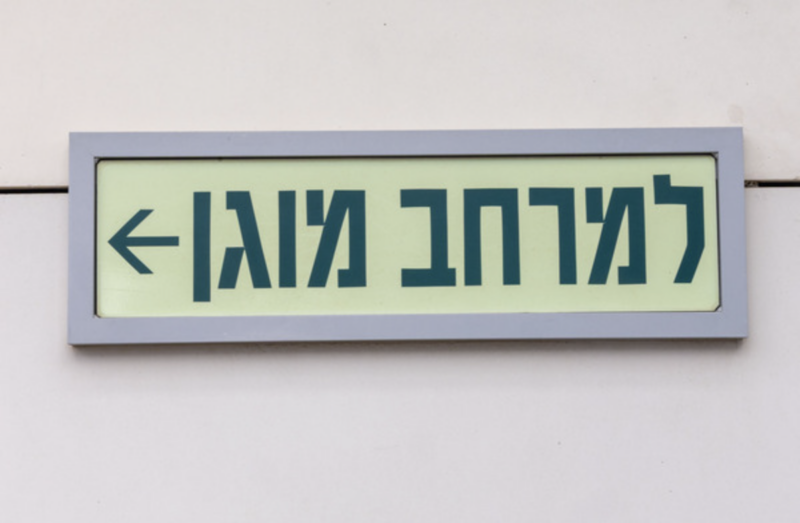
Illustrative. A sign pointing to a protected space (bomb shelter) is seen inside a shopping mall in central Israel, March 23, 2026.
The war with Iran started on Feb. 28, and the very next day we held a webinar for our board members and supporters. We wanted them to hear directly from our researchers about what was unfolding — economically, socially, geopolitically — but we also wanted to do something simpler: to check in and let them know that we were safe and continuing our work.
Since then, we have held these webinars every week.
Each time, before the presentations begin, I repeat the same sentence: “If an alarm sounds, we will have to end the session in order to get to our shelter.” Our supporters, most of them thousands of miles away, nod to indicate their understanding. For them, it is a reminder of the reality we are living in. For us, it has become part of the strange routine of working during wartime.
Challenging at the best of times, fundraising has now become even harder, particularly in global Jewish and Israeli circles.
There is increasing competition for philanthropic dollars from an ever-growing number of nonprofits seeking to meet an ever-lengthening list of needs. A month into the war, most workplaces have not returned to full capacity. Schools and childcare frameworks are closed, children are home, and parents — especially those with young kids — are trying to juggle work, parenting and getting to the shelter throughout the day and night. And all this in a country where people have more kids and work more hours than in pretty much any other high-income country — all while navigating two and a half years of emergency situations.
Here are some of the questions I find myself asking:
How do I continue working toward fundraising goals when reality itself feels distorted? Should I focus only on emergency-related issues, or stick to the work plan, knowing the long-term work still matters?
How do I plan when the ground keeps shifting beneath our feet? What should I tell existing donors about our ability to continue delivering the work they support? How should I explain that the work that I raised money for — policy-related research and long-term social investment — is still essential, even in wartime?
How should I reach out to new donors when the country is flooded with urgent appeals? How can I “compete” with organizations responding to immediate and heartbreaking needs?
How do I stay focused when there is so much pressure and conflicting needs? And how do I remain relevant?
Sometimes the dilemmas in these questions become very concrete.
For example, the Early Childhood Initiative at the Taub Center recently decided to launch a survey on the impact of the current U.S.-Israeli war with Iran. The urgency is clear: policymakers and the public need reliable data on how families and young children are coping. We’re also the right people to do this because we fielded three waves of a survey on families with young children following the post-Oct. 7 war with Hamas.
And yet, this new effort inevitably deviates from the original work plan and pulls researchers’ attentions away from what they’re “supposed to be doing.”
What should we tell the foundations that are supporting this work? Do we explain that reality has changed and priorities must shift? Do we ask for flexibility? How much should we worry about drifting away from what they originally agreed to fund? These are not abstract questions; they reflect the everyday decisions fundraisers and nonprofit leaders are making right now.
And perhaps the hardest question of all: After years of continuous crisis — the pandemic, political instability, war and now war again — how do organizations sustain both emergency response and long-term work?
And right here, before I share some insights, I want to stop and acknowledge our board members, supporters and funders. They have stuck with us throughout these past years and made it possible for us to continue with the important work of the Taub Center.
Because society cannot survive on emergency response alone. Someone must still be thinking about the day after, and the year after that.
This is my key dilemma as a fundraiser. We sit in the uncomfortable space between urgency and patience, between the immediate cry for help and the slower work of building resilient institutions and policies. Wartime sharpens the tension between those roles.
But perhaps wartime is also where the role matters most. Over the past weeks, moving in and out of my safe room with my two teen sons, I have come to realize that there are no perfect answers, only guiding principles.
First, communicate. In times of crisis, silence creates uncertainty. Donors, partners, and colleagues want to know what is happening, what you are seeing, and how your organization is adapting.
Second, be transparent. If your work is affected, say so. If plans are shifting, explain why. Honesty builds trust — especially when everything else feels unstable.
Third, find ways to be relevant without losing direction. Emergencies demand attention, but organizations that abandon their mission entirely risk losing the very reason they exist. The challenge is to connect your long-term work to the reality of the moment.
Fourth, remember that the long term still matters. Wars end. Crises evolve. The social, economic, and policy questions that shape a country’s future do not disappear simply because the present is overwhelming.
And finally, take care of yourself. Fundraisers, like everyone else right now, are living inside the same crisis. Staying sane is not a luxury; it is a condition for being able to support your family, your colleagues and the work you believe in.
In the end, fundraising in wartime is not only about raising money. It is about maintaining the fragile bridge between the urgent needs of today and the possibility of a better tomorrow.
Even in wartime, someone has to keep building tomorrow.
Michal Ben-Dov is the vice president of strategic partnerships at the Taub Center. Previously, Ben-Dov worked for JDC Israel; she also founded Camp USA, facilitating opportunities for Israeli teens to attend Jewish summer camps in North America, and served as a Jewish Agency shlicha(emissary) with the JCC Association. She is a graduate of the Mandel Leadership Institute and a member of the Schusterman ROI community.