COLLABORATION NATION
‘Collaboratory’ aims to boost post-10/7 innovation, connecting grassroots activists to legacy groups
Spearheaded by Natan Fund, UpStart and a number of other grantmakers, the Louisville, Ky., gathering was meant to help 'professionalize' an emerging sector of new organizations
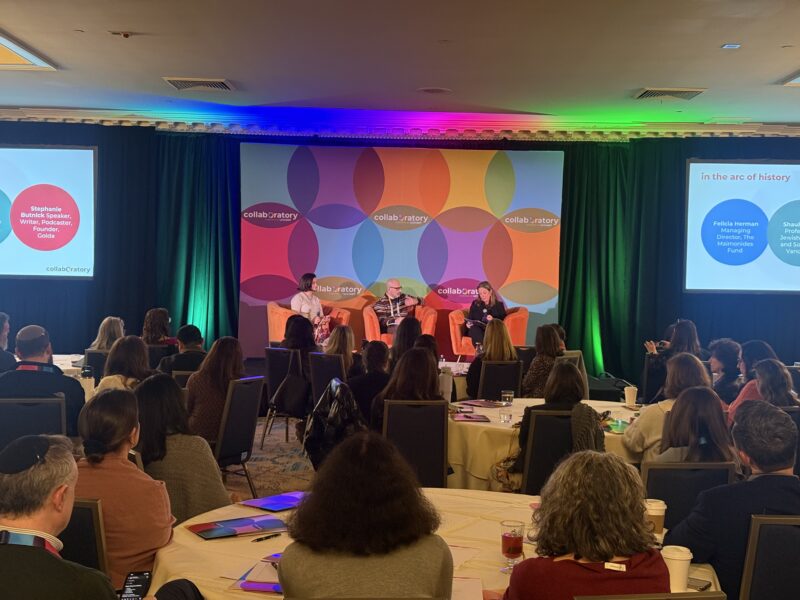
Adina Poupko
Panelists address an audience of grassroots leaders at UpStart's 'collaboratory' last month.




 Add EJP on Google
One of the many consequences of the Oct. 7 terror attacks and subsequent global rise in antisemitism has been the emergence of a host of new grassroots Jewish organizations and initiatives, led by a new generation of Jewish leaders.
Last month, a group of grantmakers brought approximately 100 of those emerging leaders to Louisville, Ky., for a “Collaboratory,” aimed at helping the new sector “professionalize” and connect them to more established Jewish organizations, Adina Poupko, executive director of the Natan Fund, which helped spearhead the gathering, told eJewishPhilanthropy.
After the Oct. 7 attacks, as grassroots campaigns arose to combat antisemitism in education, local governments and arts spaces, the Natan Fund started issuing microgrants to help those efforts with their immediate needs, like printing costs and location rentals. UpStart was simultaneously supporting some of the new “social entrepreneurs,” and with the support of several funders, the two organizations decided to partner to collect more data on the burgeoning sector, Poupko said.
“This emerged as a desire to understand who had become activated since Oct. 7, what they’d become activated about, and to give them a place to network, learn skills, come together, see what they could do to work better and avoid duplication of effort and learn from each other,” Aliza Mazor, UpStart’s chief philanthropic engagement officer, told eJP.
“Collaboratory” gatherings — a portmanteau of collaboration and laboratory — where leaders in a given sector can learn from each other, has been a model that UpStart has used to foster cross-field collaboration for years. More recently, said Mazor, they’ve been using them in a more targeted way as the Jewish communal world faces a number of major shifts and challenges.
Last month’s “collaboratory,” the second of these “targeted” gatherings, was structured into six “bubbles,” each focused on an area of innovation: K-12 educators and advocates; campus organizers; workplace and employee resource group leaders; civic and political organizers; organizers in arts and culture; and Jews involved in secular foundations and nonprofits.
Shortly after Oct. 7, in “WhatsApp groups and chats,” said Ellen Simon, a lawyer and alumna of Brown University, “a lot of people sort of started naturally coalescing, finding each other very organically.”
For Simon, her career in compliance and law led her to start helping Brown students navigate how to report instances of discrimination or harassment. As that became a common experience for a number of Brown alumni, Brown Jewish Alumni, a forum was formed through which Jewish alumni, faculty, students and parents can provide each other support.
At the collaboratory, said Simon, sessions about how to communicate with legacy organizations and apply for grants, and “elevator pitch” workshops, were especially helpful. For many of the grassroots organizers who attended the event, it was also “validating” to hear about others who had had similar experiences since Oct. 7, she said.
“Typically, when you go to conferences, you’re going for work and you do the same thing professionally as everybody, but in terms of who you are as an individual, you’re all very different people,” said Simon. “It was like the opposite. Everybody does different things with their life professionally. It has a different background, but we all were coming at this with very similar emotional reactions, about what was going on, you know, political perspectives, feelings, attitudes, traumas from the last couple years.”
Along with the Natan Fund and UpStart, last month’s gathering was also supported by Maimonides Fund, Jewish Heritage Fund, the Jim Joseph Foundation, the One8 Foundation and UJA-Federation of New York. Grassroots groups that participated — all founded after Oct. 7, 2023 — included the Jewish Alumni Council, Blue Compass, the Red Tent Fund, BACCA, Artists Against Antisemitism, American Jewish Medical Association and Jewish Parent Leadership Council.
In addition to providing activists with access to each other to increase cross-field collaboration, the event was part of a larger effort to develop more structured relationships and understanding between newcomers to Jewish communal leadership and existing institutions to reduce misunderstandings and animosity, Felicia Herman, Maimonides Fund’s managing director, North America, told eJP.
“The thing that we wanted to forestall was too much animosity between the grassroots and the established organizations that, in my view, tends to come from a lack of awareness of what the other is doing and why,” Herman said. “I really believe that the grassroots organizations and the established organizations each have their own role to play.”
According to Herman, the new wave also bears a resemblance to a previous wave of innovation in the late 2000s, when a raft of organizations focused on new approaches to Jewish communal life formed as the community grappled with increased assimilation and intermarriage.
“We’ve seen this cycle before. A new wave of entrepreneurs-slash-activists comes up, maybe first with critiques of the community, and the community doesn’t understand why you need these new organizations when you have all of the existing ones. It’s a cycle of ‘creative destruction,’ [which] is the way they talk about it in the private sector,” Herman said. “Now that we’re seeing the cycle again, we can be smarter about it than maybe we were 25 years ago, when it might have been one of the first times that we were talking about innovation and startups and entrepreneurship and challenges to the established community.”
The difference, said Herman, is that this is happening on a larger scale. The collaboratory drew some 100 participants (another 20 couldn’t come because of a snowstorm), but this is just the “tip of the iceberg,” Herman said.
“[In the previous innovation wave,] there were not mass movements; there were a handful of entrepreneurs, people with pretty strong Jewish backgrounds, who could look out at the community and say, ‘We’re missing this,’” she said. “What the convening really brought home was that this new wave is a mass movement happening in so many different areas of our lives.”
Related News

MAGICAL EXPERIENCE
Shefa launches psychedelics retreat for Jewish professionals suffering burnout

EXCLUSIVE
Detroit-based philanthropists Nancy, James Grosfeld donate $8M to renovate JDC’s Israel campus
HIGHER EDUCATION
As Jewish donors reconsider academia, Jan Koum doubles down, endowing Israel studies at Stanford

PRESIDENTIAL REBUKE
Israel’s Herzog: Mamdani ‘makes no effort’ to hide disdain for Israel, Jews must fight back
CLOSING WORDS
In AZM address, Cosgrove links communal ‘orthodoxy’ on Israel to rising anti-Zionism among young Jews