MERGERS
Two leading Philadelphia Jewish day schools announce ‘unification’
Jack M. Barrack Hebrew Academy and Perelman Jewish Day School will join to create one K-12 day school
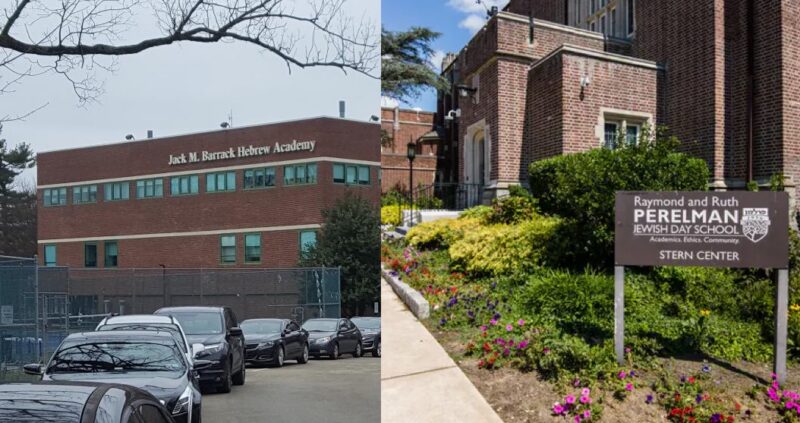
Moriah Levin/Wikipedia and Homes[dot]com
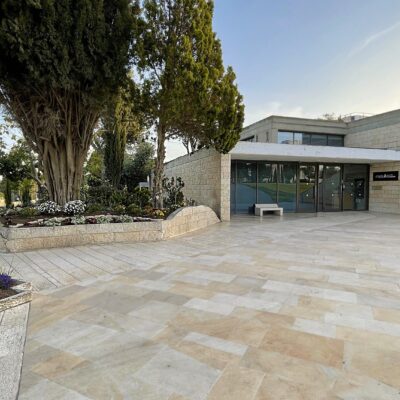
Jack M. Barrack Hebrew Academy in Bryn Mawr, Pa., and Perelman Jewish Day School's Stern Center in Wynnewood.




 Add EJP on Google
Jack M. Barrack Hebrew Academy and Perelman Jewish Day School, two leading Philadelphia-area Jewish day schools, will merge to create a single pre-K-12 pluralistic community school in time for the start of the 2027-2028 school year, the organizations shared with eJewishPhilanthropy.
The two schools are located a couple of miles apart, with JBHA in Bryn Mawr and Perelman at facilities in Wynnewood and Melrose Park. JBHA runs from sixth through twelfth grade, while Perelman is a pre-K-5 school. The unified school, yet to be named, will become the only community day school in the immediate Greater Philadelphia area (though another community pre-K-8, Abrams Hebrew Academy, is located 40 minutes away in Yardley, Pa.).
This year, JBHA, which boasts alumni including CNN anchor Jake Tapper and Pennsylvania Gov. Josh Shapiro, celebrates its 80th birthday. Founded in 1946 as Akiba Hebrew Academy, the school changed its name in 2007 after a $5 million donation from the Barrack Foundation. In 2025, a $10 million gift from the foundation allowed the school to purchase part of its longtime campus.
Perelman, previously part of the Solomon Schechter Day School Network, was founded in 1956 and operates two campuses in the Philadelphia suburbs. In 2012, the two campuses merged their programs for sixth through eighth grades, citing decreased enrollment.
According to Rabbi Marshall Lesack, who currently serves as JBHA’s head of school, discussions about merging the two schools started two years ago. He emphasized that the decision was not driven by enrollment concerns, though he expressed hope that the unification will draw more students to Jewish education. Lesack is set to lead the unified school beginning in fall 2027.
“We are both strong independently, and I think that we will be stronger together,” Lesack told eJP. “We’re also excited and committed to bringing more students into the Jewish day school system and keeping more students in the Jewish day school system, and we think that we can do that even greater and more impactfully as a single pre-K-12.”
Lesack added that joining the two schools creates the opportunity for more investment in programs, faculty, staff and facilities, and a bigger draw for potential faculty and families considering Philadelphia. He also hopes it inspires other communities and institutions to consider merging when it benefits the community, he said.
“I hope that it will serve as a model both for us in Philadelphia of what it means when two outstanding educational institutions see that the future of our community is stronger when we build it together, and I hope that it will also be a model nationally, for other communities to look to us and what it looks like when institutions work together to build something for the future,” he said.
In a statement, the new school’s board chair, Daniel Eisenstadt, emphasized that bringing the schools together will best position the institution to sustain Jewish learning in Greater Philadelphia.
“Jewish education has never been more critical than it is now, and it is clear to us that a unified school will put us in the strongest position to ensure that Jewish education thrives in Greater Philadelphia and beyond for generations to come,” he said.
While JBHA has historically been a pluralistic, or community school, with its roots in the Schechter Network, Perelman is historically affiliated with Conservative Judaism. According to Lesack, the unified school will be a community day school.
“With this announcement, we will have even more opportunity to bring our educational teams into the conversation and others into the conversation to expand and even deepen those conversations about Jewish practice within the school, but it is within a larger context of seeing ourselves as a Jewish community day school, as a place for Klal Yisrael, as a place for the broad spectrum of the Jewish community,” he told eJP.
Nearly 700 students are enrolled in the two schools — just under 370 at JBHA, and just under 330 at Perelman, said Lesack. JBHA and Perelman will maintain their current operations for the 2026-2027 school year while they begin to unify their admissions and development programs.
The decision for the two schools to join comes after many Jewish day schools have cited a temporary increase in enrollment since the COVID-19 pandemic, and following Oct. 7. Earlier this month, a day school in the Boston suburb of Framingham announced its intention to shutter, citing decreasing enrollment.
Related News

MAJOR GIFTS
Center for Jewish History celebrates 25 years with a $25M matching grant
HIGHER EDUCATION
As Jewish donors reconsider academia, Jan Koum doubles down, endowing Israel studies at Stanford
EXCLUSIVE
Detroit-based philanthropists Nancy, James Grosfeld donate $8M to renovate JDC’s Israel campus

EXIT INTERVIEW
Elizabeth Sokolsky, longtime EVP of Birthright Israel, to retire next year

MAGICAL EXPERIENCE
Shefa launches psychedelics retreat for Jewish professionals suffering burnout