IN THE ROOM
Atop a Tel Aviv tower, Israeli tech leader Yasmin Lukatz reflects on philanthropy, entrepreneurship
Lukatz stresses importance of maintaining Israeli tech prowess for economy, diplomacy and to combat antisemitism
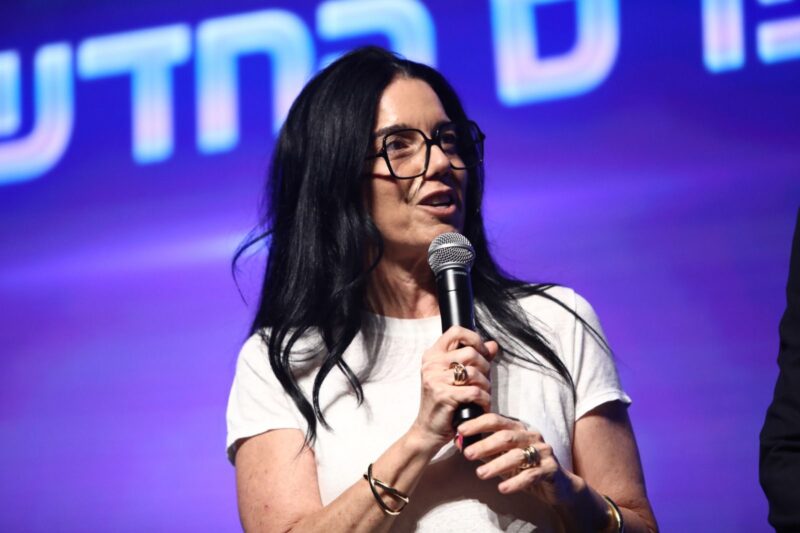
courtesy
Yasmin Lukatz




 Add EJP on Google
On the 61st floor of the Sorona Azrieli tower in Tel Aviv, Israeli tech leader and donor Yasmin Lukatz offered a master class of sorts on philanthropy and entrepreneurship last night, charting her time in the Bay Area, her return to Israel in 2014, her efforts to bolster Israel’s tech scene and how she has more purposefully directed her charitable giving in recent years.
Lukatz held this discussion at the TLV Convening, a salon series launched in 2023 by Orfin Ventures founder Adam Finkel. The roughly a dozen attendees were a mix of Americans and Israelis, many of them representing family foundations and investment offices, as well as tech entrepreneurs and philanthropy experts (and one journalist).
Speaking to the group, Lukatz, the daughter of Dr. Miriam Adelson, described her process of developing her own independent philanthropy strategy with help from the Israel office of the Jewish Funders Network, selecting key areas to focus on, such as technology and gender equality, as well as core values like collaboration and metrics.
Lukatz, 53, the founder and director of Israel Collaboration Network (ICON), which supports the Israeli startup scene, stressed the importance of Israeli technology and innovation not only in the economy but in the country’s diplomacy, particularly in the wake of the Oct. 7 terror attacks.
“Oct. 7 made me realize how important the business connections are for the well-being of the country,” she said. “Because when the country wanted to speak with TikTok, they called us. We introduced them to the CEO of TikTok. We introduced them to the founders of Google. We introduced them to [investor] Peter Thiel. We introduced them to the government relations of Google, of YouTube, to the CEO of YouTube.”
She added: “I think just the fact that we continue to do business globally is a great antidote to antisemitism because once you get to know a person, you understand we’re not the devil. We’re just great people. We’re talented. We’re good. It becomes harder to hate us.”
While she noted the importance of this kind of public diplomacy work, Lukatz said that she does not currently support any “hasbara” activities, believing the field to be ineffectual, with too many figures and not enough collaboration. “Everybody wants to be the CEO. Everybody knows better than the other person. They got it all wrong. This is why I’m not funding any hasbara efforts… because I think it’s a mess,” she said.
Lukatz also discussed her concerns regarding Israel’s future, particularly as it relates to most of the Israeli Haredi community’s refusal to teach core secular subjects in its schools. “I think what bothers me most is actually the ultra-Orthodox now, that they’re not willing to serve [in the military], but also — something we’re ignoring — that they refuse to study math and English while becoming a bigger chunk of the population. What’s going to happen in 20 years? Our biggest asset now is our talents, is the brains,” she said.
Lukatz, who earlier in the day spoke in the Knesset about the alliance between the United States and Israel, particularly as it relates to military intelligence and technology, reiterated that this prowess is therefore a national security priority.
“If we don’t think about the future, we’re gonna lose this asset,” she said. “We’re going to have less people starting to learn math, less people graduating, less people becoming engineers, less people going through those elite cyber AI units in the military that form so many great companies today. For some reason, we focus on the short term of joining the military just because the burden now is so painful. But it all starts at school.”
Lukatz, who also works as a venture capitalist, said that her work in the nonprofit space through ICON, which — among other things — incubates new startups, has been critical to her work. “The fact that we did it as a nonprofit, really allowed us a foot in the door in many places that would have never taken part of it. By being a nonprofit you can get things that you can’t buy because you never ask for yourself, you ask for the community and people want to be part of it,” she said.
“We don’t ask people to pay for what we give them, instead we ask them to pay forward. So you got something from an event you came to, all we ask you if somebody approaches you and asks you for help, asks for advice, just be open-minded about it. If you have the time, if you have the means, if you have the way, think positively about helping them,” she said.
Lukatz also noted that she had created an investment fund that supports her nonprofit, which in turn supports the companies she invests in, generating more income for the fund. “So it’s like a pinwheel,” she said.
As a prominent figure in the Israeli tech scene, Lukatz said that she has also encouraged others in the field, particularly those whose companies have recently had an “exit” and been bought out for large amounts of money, to consider getting more involved in philanthropy. “We hosted a session for them with a group of entrepreneurs, with Sigal [Yaniv Feller] from the Jewish Funders Network,” she said. “We invited them all. Many came with their spouses. It was actually a great night. We have to do another one.”
Asked by eJewishPhilanthropy how she aims to both bolster the Israeli tech scene while also ensuring that the opportunity that it represents is offered to Israelis of all backgrounds, Lukatz said her organization does specifically look out for minority applicants and that she is also supporting educational initiatives in the country’s geographic and economic periphery.
“I don’t think we should not help the tech because it creates [economic inequality], I think we should see how the tech can lift other sectors with it as well,” she said.
“We’re also working on a program about English studies in the periphery. I think once you know English, you can teach yourself anything,” Lukatz said. “I think philanthropy should be a greenhouse for many initiatives, that if proven successful at a small scale, should be adopted by the government and run at scale. It is our job to start those experimental new programs.”
In addition to ICON, Lukatz also highlighted other nonprofit endeavors, including a volunteer group Code for Israel, which pairs technology experts with nonprofits, and an initiative that assesses how well businesses treat their reservist employees, known as Tav Miluim. Both Lukatz and the Adelson family are also major supporters to HaShomer HaChadash, a group that aims to combat agricultural theft, primarily in Israel’s periphery.
While Lukatz discussed her personal philanthropic goals and beliefs, she noted the many lessons that she learned both from her mother and from her stepfather, casino magnate Sheldon Adelson, who died in 2021. This included her focus on collaboration and early-stage involvement.
As a person with self-described “occupational ADHD,” Lukatz said that she is most interested in getting involved philanthropically when her contributions are most valuable. “I personally like to come in at the early stage where every dollar that I give has more significance, every hour that I give has more significance. But that is a preference,” she said.
“I was a board member of the [Oshman] JCC in Palo Alto,” Lukatz recalled. “One day, I said, ‘I want to resign.’ And they asked why. I said, ‘Because we’re really good.’ So they said, ‘Then why are you resigning?!’ I said, ‘Because we’re really good!’ I want to give those hours to somewhere that’s not yet really good. I’ll continue to give money [to the JCC], but I’m not giving my time there anymore.”
While she expressed concern about certain areas in the Jewish world, Lukatz said she was buoyed by the younger generation in Israel.
“What makes me optimistic these days is that I see the younger generation waking up, caring like they haven’t before. The war changed them. I see what they have done, how hard they work now to rebuild the country, how much they care,” she said.
Related News
ADVANCING A VISION
N.Y. federation donates $1M toward building shared-society center named for peace activist killed on 10/7
CLOSING WORDS
In AZM address, Cosgrove links communal ‘orthodoxy’ on Israel to rising anti-Zionism among young Jews

MAJOR GIFTS
Center for Jewish History celebrates 25 years with a $25M matching grant
HIGHER EDUCATION
As Jewish donors reconsider academia, Jan Koum doubles down, endowing Israel studies at Stanford

EXCLUSIVE
Detroit-based philanthropists Nancy, James Grosfeld donate $8M to renovate JDC’s Israel campus