EXIT INTERVIEW
Outgoing B’nai B’rith CEO calls for caution in Israel critiques: ‘People look to Jews for cues’
Daniel Mariaschin, who has served as CEO of the organization for 37 years, is stepping down this summer
courtesy
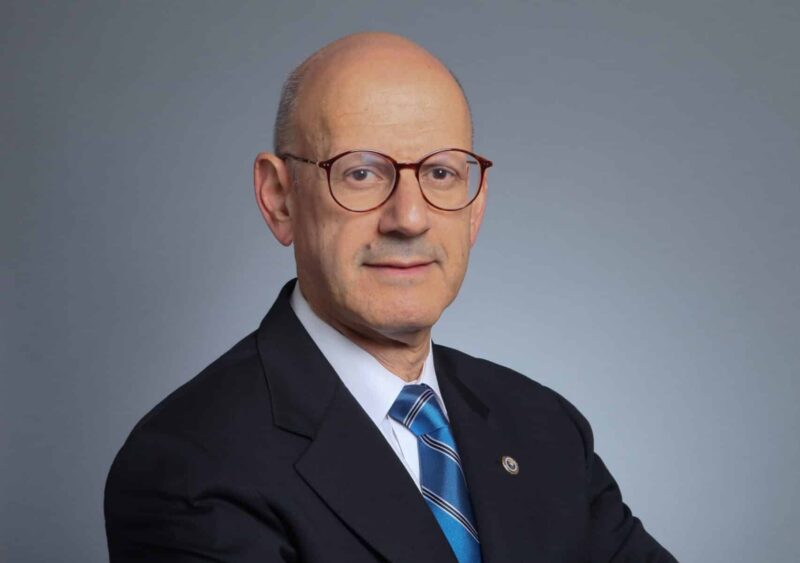
Daniel Mariaschin, CEO of B’nai B’rith International.




 Add EJP on Google
When Daniel Mariaschin was in third grade, his teacher asked him to do a presentation on Hanukkah in front of his entirely non-Jewish classmates. Until that moment, he had done his best to blend into the New Hampshire town he grew up in, where his family was one of four Jewish families during the 1950s, but suddenly, he was center stage.
Mariaschin looks back at that moment as a formative experience, one that would propel him to 53 years of professional work in the Jewish world, including as a leader at the Anti-Defamation League, American Israel Public Affairs Committee (AIPAC) and, for 37 years, B’nai B’rith International.
He sees his former teacher as a non-Jewish ally and a friend, one of many who impacted him during his youth — teachers who offered him a platform to teach peers about his community, leaders who called out antisemitism, elders who checked in with him after a swastika was scrawled on the wall of the boy’s bathroom.
“There’s a world out there that does care,” Mariaschin told eJewishPhilanthropy. “We don’t have as many friends and allies as we’d like. We have a lot of folks who have abandoned us in recent years.”
With Mariaschin at the helm, B’nai B’rith International has fought antisemitism, advocated for Israel, supported seniors and offered disaster relief around the globe. Born out of the Lower East Side of Manhattan by a dozen German Jewish immigrants in 1843, B’nai B’rith is the nation’s oldest Jewish aid organization, and Mariaschin has been a part of the organization for over one-fifth of its 18 decades, serving as CEO since 1999, but on June 30, he’s handing back the mantle, with no successor publicly announced.
eJewishPhilanthropy spoke with Mariaschin about the importance of staying in the conversation across political lines, his plans post-retirement and why he feels American-Jewish organizations should never publicly criticize Israel’s government, even as many within the Jewish community debate the term Zionism.
The interview has been lightly edited for clarity.
Jay Deitcher: What are you proudest of during your time with B’nai B’rith?
Daniel Mariaschin: There are a few things. We’ve been accredited to the U.N. since 1947. B’nai B’rith was actually invited to the founding of the U.N. in 1945. In ‘47 we received our first NGO credentials. Over the years, particularly over the last 3 ½ decades, since the “Zionism is racism” resolution, [I’m proud of having] the opportunity to be able to speak truth to power to the secretariat of the United Nations and to speak to the heads of so many missions to the U.N. on the question of bias against Israel, on the very fact, for example, that Israel has been a member of the U.N. since 1949, the year after it became a state, yet Israel has never been a member of the U.N. Security Council.
The second thing is that I’ve had an opportunity to work on Holocaust restitution issues. I’ve been on a negotiating team through the World Jewish Restitution Organization, of which B’nai B’rith was a founding member, [and I’m proud] to be able to press for restitution to victims and to their families for the immense amount of property that was confiscated. There’s a tendency out there for folks to forget. Those who are in government positions in some of these countries in Europe, whether as prime ministers, foreign ministers, justice ministers, finance ministers, all the folks that we meet with, these are younger people, they are three generations removed [from the Holocaust], and their view is that was then, and this is now. That is not our view. This was the biggest robbery in history, in addition to being the biggest murder in history.
Third thing [is that] B’nai B’rith is an international organization founded here in the United States [in] 1843, we’re the oldest [Jewish service organization in the world]. One-hundred-and-eighty-three years old this coming October. We became a widespread international membership organization towards the end of the 19th century, and then it just grew everywhere there were Jews in Europe – for example, up until the time that Hitler came to power, we were all over Europe – throughout Latin America, Canada, Australia, New Zealand. The opportunity to interact with Jewish community leadership in some of these iconic communities has been a tremendous gift to me.
JD: In our modern society, it feels as if people have stopped talking to one another across the political aisle. What lesson would you impart to people from what you’ve learned from being involved with the U.N. and not stepping away from tough conversations?
DM: We need to look at this from a matter of, if nothing else, self-respect. We’re living in an era where we have an opportunity to weigh in on the issues that affect us. For instance, the rapporteur at the U.N. Human Rights Council for the Israeli Palestinian issue is Francesca Albanese, and Francesca Albanese is an unabashed antisemite. She talks about Israel as an apartheid state. She talks about genocide. She talks about the war crimes.
We’re 15 million or 16 million people, but we’re an important part of the fabric of international demography and certainly history, and to be able to sit across the table [at the U.N.] and raise these issues and say, ‘Listen, Albanese is X, Y and Z. She should be removed.’ Or, or [to bring up] the biased resolutions that we’ve seen at the Human Rights Council or in the General Assembly, it’s an extremely important thing. Particularly at a time when what you can say can resonate, and it can resonate through social media, and we should take advantage of that. The driving force behind this should be, ‘We are Jews, this is important to us for these reasons, and to make the case, as we have done many times, against the antisemites, in favor of Israel, at the U.N. and in other fora as well.
JD: What was the toughest lesson you learned during your time at B’nai B’rith?
DM: It’s a lesson that was self-evident, really from the beginning. Not everybody sees the world as we do, and it’s our job, those of us who work in the community, those of us who are professionals in the community, those of us who are lay leaders in the community, who care, each of us has a role to play.
I go back to the small population that we are in the world. We need all hands on deck, convincing, persuading. Making the case is not always easy. It’s not only because of traditional antisemitism. It’s because of the new antisemitism. It’s facing new challenges all the time, including on social media. How do we deal with, for example, a phenomenon that I never expected in Congress, that we would have members of Congress who would say “It’s all about the Benjamins” and that we would have a debate in Congress during a war in Gaza about conditionality on sending weapons to Israel?
I would put it another way: These are my frustrations. But at the same time, it’s also an incentive to continue the work that we’re doing. I always tell people, even if they’re not working in the Jewish community, you’ve got a neighbor, you’ve got a friend, you’ve got a coworker, you’ve got the mailman. There are so many different ways to be able to stand up and to interpret and to defend your people and to speak out against antisemitism.
JD: You told i24 that you hope to write a book now after you retire. In your life story, what do you hope your biggest message is for people to learn about you?
DM: I was raised by two immigrants to America. They came here as children, but their worldview is that of immigrants.
My mother always told the story that they arrived in Bangor, Maine, which is where they settled, on the Fourth of July, and her first memory as a young child was the fireworks. They loved this country, but they loved their people. They loved the State of Israel. Half of their lives were lived without a state of Israel. They weren’t on the left or on the right [politically]. They were simply people who loved the idea that there was a State of Israel, and their messages to me clearly informed the career choices that I made. I would say that’s the most important thing.
JD: You mentioned to i24 that you plan on staying connected to B’nai B’rith after you retire. What are the plans?
DM: I’ll be staying on as a senior advisor on projects that mean a lot to me. I hope to continue to be involved in negotiations that I’ve been a part of with countries that still need to come up with [Holocaust] restitution agreements. I’m also very interested in working to promote friendships. I’ll just give you an example. We have a project coming up that we’re doing together with two Hellenic American organizations, two Greek American organizations, to support the growing relationship amongst Israel, Greece and Cyprus.
[It is] extremely important to work with the Hellenic community, an ethnic community here [in the U.S.]. We share many things in common: two ancient civilizations, two immigrant groups, two groups of people that care very much about peace and stability in the eastern Mediterranean, the Middle East.
When you’re a CEO, you have a lot of things that you have to think about, a lot of things that are on your plate, and I think that the opportunity to do more writing is going to be very high on my list of priorities.
JD: Are you nervous about giving up the helm?
DM: I’m not nervous about it. There’s no stop sign here in terms of my interest in writing and speaking out on the issues that we care about. I looked at my parents, and they weren’t in this field, and until each passed away, this is what they talked about.
JD: You told the Jerusalem Post that you are worried about the attachment young people have to Israel because they don’t remember the existential threats that were posed to Israel in 1967 and 1973.
DM: I do worry about it. There’s not much you can do about the passage of time, but 1967 and 1973 were, for my generation, benchmark moments. Sometimes we talk about Jewish education as an institutional throwaway, and it should not be a throwaway. If you have an 18-year-old who’s going off to university, the parents of an 18-year-old are probably [in their] mid-40s, and so neither of the parents have that frame of reference either. We’re now in the third generation, where the frame of reference for those benchmark moments — it’s just not there, and there’s not much we can do about that.
JD: B’nai B’rith, historically, does not criticize Israel. There’s been a lot of talk in Jewish spheres about whether not allowing more nuance into the conversation around Israel was a mistake, especially in the Jewish education world, where a lot of Jews that have come out and said that they felt that they were lied to about Israel. As this new generation pushes to be more critical of Israel, does the way you teach about Israel and talk about Israel as an organization need to shift along with the times?
DM: I don’t think the basics need to change. This is a lesson that I learned as a professional working in the community: What we say matters. How we say it matters. It matters to whom? It matters to the non-Jewish world, which is out there.
I’ll just give you an example from early in my career when I was working for the Anti-Defamation League [in] 1979 and I attended a meeting of the Conference of Presidents [of Major American Jewish Organizations], and the speaker that day was a senator from South Carolina, Ernest Hollings, who was thinking about running for president the next year.
He had just been on a trip to Israel, and he came back to report about this trip, and in the Q-and-A that followed, there was a question, I think it was from the then-director of AIPAC. America had just gone through a big debate about the sale of advanced fighter aircraft to Saudi Arabia, and it was a very close vote in the Senate to approve the sale, and [Hollings] was asked the following question: “Senator, why did you choose to vote for the sale and not against it?” And [Hollings] said, “Because my good friend, Senator Ribicoff, voted for it, and [so] I voted for it.”
Senator Abraham Ribicoff, [who was Jewish,] was a distinguished senator from the state of Connecticut. He had been governor of Connecticut. He was John F. Kennedy’s first secretary of health, education, and welfare. The point is that many people do look to [Jews] for their cues about what to say and do about Israel, especially now.
I’m not saying there shouldn’t be discussion, there shouldn’t be debate. We know that Israel itself is a is a fractious democracy that we love, but we’re here [in America], and we’re living in the Diaspora, and especially these days, on issues relating to arms sales, support for Israel, all the things that go into the relationship between the United States and Israel, we need to be careful about how we frame our views.
B’nai B’rith’s position, traditionally, is: “We support the democratically elected governments of Israel.”
Israelis have elected these folks, and that’s their system. Yes, [Jews in the Diaspora] are an important part of the life of Israel, and they are [an important part] of us. We need to always keep in mind that we have only one Israel, and we waited a long time for it. We have to do everything we can to be supportive of it.
Related News

MAJOR GIFTS
Center for Jewish History celebrates 25 years with a $25M matching grant

MAGICAL EXPERIENCE
Shefa launches psychedelics retreat for Jewish professionals suffering burnout
CLOSING WORDS
In AZM address, Cosgrove links communal ‘orthodoxy’ on Israel to rising anti-Zionism among young Jews

ADVANCING A VISION
N.Y. federation donates $1M toward building shared-society center named for peace activist killed on 10/7

EXCLUSIVE
Detroit-based philanthropists Nancy, James Grosfeld donate $8M to renovate JDC’s Israel campus