EXPLAINER
A new federal tax credit could reduce Jewish day school costs — how does it work?
By offering rebates for donations to ‘scholarship-granting’ organizations, the program potentially skirts some issues related to school choice and church-and-state separation
Courtesy
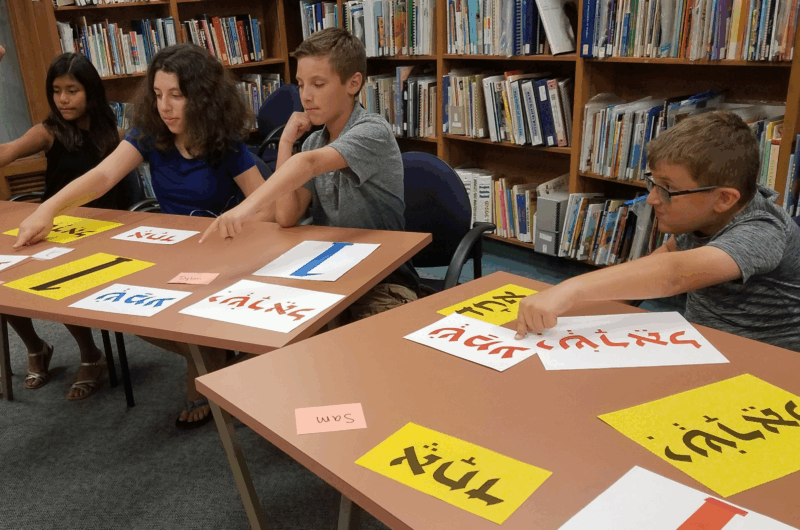
Illustrative. Children in a synagogue Hebrew school.




 Add EJP on Google
A growing number of Jewish groups are pushing states to adopt a federal tax credit that would relieve some of the financial burden on Jewish day school tuition and other educational costs, while skirting many of the issues related to school choice and church-and-state separation that those organizations have traditionally opposed. Advocates told eJewishPhilanthropy that the credit could have a “transformative” effect on Jewish day schools, as well as other Jewish education-related initiatives.
The so-called “Education Freedom Tax Credit” was created when the One Big, Beautiful Bill Act, was signed into law in July and goes into effect next year. Unlike other voucher systems or tax rebates for private school tuition, this indirect federal tax credit would be in exchange for donations to qualified nonprofits that fund scholarships and other “education-related services and products.” Taxpayers will be eligible for a credit of up to $1,700 on their federal income taxes for donations to these organizations that offer tuition assistance to public, private or charter schools.
Several Jewish nonprofits have thrown their lobbying weight behind the credit, most recently the Jewish Federations of North America, which lobbied governors to opt into the program over the weekend at the National Governors Association summit. So far, the credit has been adopted by governors of 23 states, almost all of them Republican, though a number of Democratic governors have expressed interest in the program as well.
“It has the potential to be transformative,” Paul Bernstein, founding CEO of Prizmah: Center for Jewish Day Schools, told eJewishPhilanthropy. “If we can mobilize a large part of the Jewish community to take advantage of this tax credit and to direct their giving towards Jewish day schools and yeshivas, then we could be talking about making a real dent in affordability for families.”
The credit is estimated to draw over $3 billion in funding annually, according to The Wall Street Journal, though how much of that would be directed to Jewish Day Schools specifically is unclear.
The credit hinges on the existence of state-approved nonprofit organizations (SGOs), which dispense scholarship funds for any qualified elementary and secondary school expense. SGOs are required to meet several criteria to qualify, including spending 90% of their income on scholarships to eligible students, namely those from households whose income does not exceed 300% of the area’s median.
According to David Goldfarb, managing director of public policy and strategic health at JFNA, qualified expenses include tuition, tutoring, support for students with disabilities, including occupational and speech therapy, transportation and uniforms, at both public and private schools. “The common one is obviously tuition for Jewish day school, but it’s actually much broader than that,” he told eJP.
Debates over similar legislation have been ongoing for decades in the United States, often centering on school choice, church–state separation, and the risk of drawing funds away from public school systems. On the state-level, there are several programs that allow individuals to fund private schools, through vouchers, education savings accounts and tax-credit scholarships.
According to Goldfarb, in the case of the Education Freedom Tax Credit, the distinction is that the program is federal, and it’s not a direct use of government funds for schools, so the tax incentive does not inherently come at the expense of public schools.
“This is not in the normal sense, literal state government funds being used to fund public schools. This is private money that is attached to a tax incentive to give to a nonprofit that may give scholarships to individuals attending religious school,” he said.
Bernstein described the credit as having the potential to substantially improve the accessibility of Jewish day schools, as well as bring more private money into education overall. “This isn’t just something that’s accessible to our community. It’s there for public schools. It’s there for other private schools,” he said. “This could be a major investment in education in the United States overall, and allows our community to really, to really seed the path to elevate Jewish day schools.”
According to Goldfarb, while many Jewish organizations are spending the next year preparing for the onset of the credit in 2027, several details remain uncertain, including whether married couples will be able to file for $1,700 or $3,400 jointly, clarity on what meets the criteria of “qualified expense” and the degree to which states can influence and control which schools the funds go to.
“We want to make sure that those criteria are objective, non-discriminatory, and comply with all applicable state and federal laws,” said Goldfarb. “A lot of the Democratic governors in particular are waiting on that guidance before they make a determination on how we’re going to move forward. So that guidance is really going to be critical from the IRS.”
Related News

MAGICAL EXPERIENCE
Shefa launches psychedelics retreat for Jewish professionals suffering burnout
CLOSING WORDS
In AZM address, Cosgrove links communal ‘orthodoxy’ on Israel to rising anti-Zionism among young Jews

PRESIDENTIAL REBUKE
Israel’s Herzog: Mamdani ‘makes no effort’ to hide disdain for Israel, Jews must fight back

EXCLUSIVE
Detroit-based philanthropists Nancy, James Grosfeld donate $8M to renovate JDC’s Israel campus

MAJOR GIFTS
Center for Jewish History celebrates 25 years with a $25M matching grant