Opinion
WAR-FORGED
What we built in Ukraine, and why it still matters




 Add EJP on Google
Four years ago, I started sending messages. Russia had just launched its expanded invasion of Ukraine. Across multiple trusted networks, I knew people — in every bordering nation and well beyond — who knew people who could help. Within days, those messages became a network. Within weeks, that network was moving people out of combat zones and supplies into them. It became something none of us planned: a grassroots humanitarian operation spanning 20 countries and linking nearly 400 volunteers who, in many cases, had never met face to face. We called it UA Support Teams (UAST).
By late 2022, one UAST team had evacuated more than 4,600 women and children from under air and ground attacks in Ukraine and delivered hundreds of pallets of food, medicine and medical supplies to people, including Holocaust survivors, isolated in or displaced from their homes. As refugees scattered across Europe, Israel and North America, UAST members connected them with local assistance, sometimes housing them or helping them find jobs. All without incorporating, without fundraising within the network and without a single paid staff member.
Adobe Stock
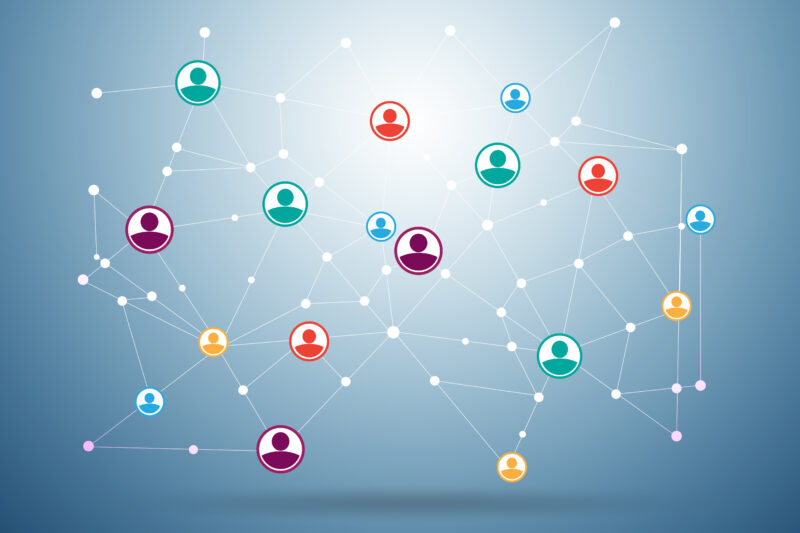
UAST is not an organization, because that is not what I set out to build. It is a humanitarian coordination platform for people who share a refusal to stand idly by— a way for people with trusted relationships, useful skills and relevant resources to find each other and act. The ground rules were simple: confidentiality, no solicitation, no fundraising, no military aid. Anyone wanting to join needed an existing member to vouch for them, and everyone had to agree to the ground rules. The operating principle was coordination without consensus — people pursuing overlapping goals through complementary actions, without waiting for anyone’s permission.
This was not how most people understood crisis response. The conventional model assumes institutions lead and volunteers follow. What Ukraine revealed, as OLAM’s subsequent research confirmed, is that grassroots networks and large organizations are complements, not substitutes. Institutions bring scale, sustained funding and technical expertise. Networks bring speed, trust and granular knowledge of conditions on the ground. The institutions with staying power and broad fundraising reach were indispensable; so were the message threads where someone could type “bus to Moldova needs a translator at the border” and get confirmation within minutes from a translator a continent away.
The real lesson is not that one model is better, but rather that no firm methodology exists connecting the grassroots networks that arrive first, the institutions that bring enduring capacity and the permanent local and regional agencies that administer over the long term. We improvised the handoffs in real time. Four years later, Jewish communal and broader humanitarian infrastructures still lack a deliberate framework for integrating them.
That absence becomes most visible when a network built for one crisis pivots to another. Within hours of the Oct. 7 attacks, a Ukrainian activist posted on UAST asking whether Israelis needed medical aid from abroad. Two days later, we had Israeli-focused subgroups verifying requests, arranging travel and assisting foreigners in crisis. We could move that fast because 18 months of prior collaboration had built the trust, the operational habits and the volunteer base. Leaders like Karyn Grossman Gershon and Vlada Nedak at Project Kesher, Kristen Ali Eglinton at the Footage Foundation and dozens of others had already proven the model — not because anyone planned a transferable system, but because the relationships held. In the years that have followed, we stepped back as soon as Ukrainian and Israeli institutions regained capacity, but other demands remain, whether for power generation supplies or for people who still fall through the cracks. And so, too, UAST remains.
What did we build? Not an organization with a letterhead and a board. We built proof of concept that trust-based, decentralized coordination can outpace institutional response times, complement institutional responses rather than compete with them and transfer across conflicts and borders. We built relationships that held under pressure and continue to this day; the most recent requests are for assistance to a Ukrainian family relocating to Israel and for participants in a reconstruction delegation to Kyiv.
Many of those relationships trace back to the ROI Community, whose breadth and depth across Jewish leadership worldwide made it a critical network source for UAST. ROI is now sunsetting, which means the next emergency may not have the same immediate access to a refreshed roster of connected leaders ready to mobilize.
The question now is not whether to formalize networks like UAST — formalization would likely destroy what makes them work. The question is what the rest of the communal infrastructure can learn from the funders who did step in, some at critical moments when the network had no track record and the only evidence was the relationships themselves. They made a bet on trust-based coordination, and it paid off. The next step is making that bet less ad hoc: helping funders and institutions recognize these networks early, validate them efficiently and resource them fast enough to matter. The relationships have always already been there.
Shawn Landres is a strategy advisor whose work in network and ecosystem alignment has generated insights on design, trust-building and cross-sector collaboration at scale.