Opinion
CRITICAL ARCHITECTURE
A frontline response to antisemitism: Jewish education through a counter-extremism lens




 Add EJP on Google
I spend my days working on laws and policies that protect democracy from extremism and strengthen national security. Through that lens, antisemitism is never a side issue; it is a warning sign, evidence that something in a society’s moral and civic immune system is failing. Yet when Jews are the ones raising the alarm, a familiar dismissal often follows: Of course they would say that — they’re Jews. As if self-interest makes the threat less real rather than more urgent.
In a climate where the Jewish experience is often minimized within broader anti-racism conversations, immense energy in the Jewish world is understandably being dedicated to outreach and coalition-building. That impulse also reflects a recognition that the social consequences of antisemitism are dangerous for society as a whole. Antisemitism is both a product and a propellant of a virulent extremism that is increasingly visible in our streets and institutions. It should be clear by now that this extremism is not a threat only to Jews, and certainly will not stop with targeting only Jews.
Jeenah Moon/Getty Images
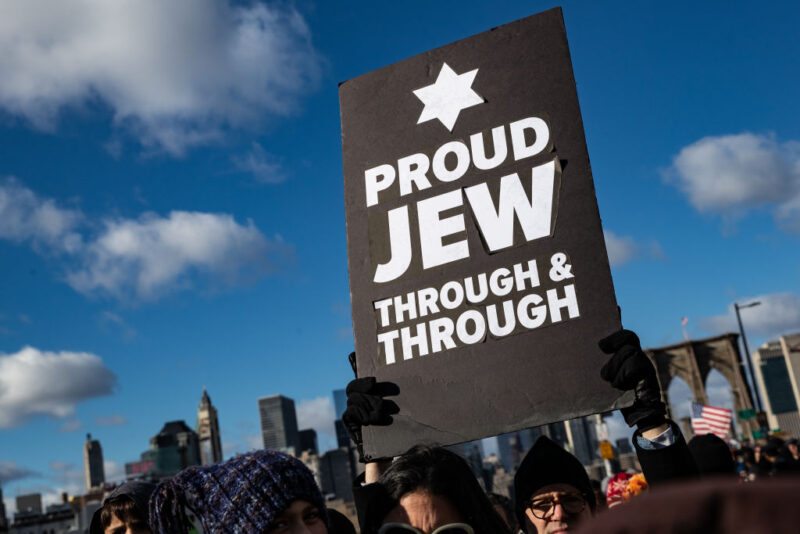
People participate in a Jewish solidarity march across the Brooklyn Bridge on Jan. 5, 2020 in New York City. The march was held in response to a recent rise in antisemitic crimes in the greater New York metropolitan area.
No doubt we must continue pushing outward — for better policing, clearer hate laws and stronger enforcement, for vocal allyship from supporters beyond our community and moral clarity from political leadership. But we also need to seize the opportunity to look inward and recognize that there are limits to what we can control about the world around us. Our own communities, our families, the next generation — that is where we can make a formative impact.
And that means preparing Jewish children to thrive as Jews in the world as it is, not as we wish it to be.
For a long time, many North American Jews lived inside what felt like a historical exception. My childhood in Toronto coincided with something close to a golden age: confidence in liberal institutions, broad public sympathy after the Holocaust and the assumption that “Never Again” was a permanent achievement rather than a fragile promise. We were privileged to believe that thousands of years of Jewish vulnerability had ended with us.
That illusion is gone. Jewish students are learning, often painfully, that acceptance can be conditional — that belonging may be offered only at the price of shrinking their Jewishness. Sometimes the pressure is explicit: Take off the Jewish symbols. Hide the hostage-solidarity pin. Don’t mention your family’s trip to Israel. Sometimes it is more subtle: Keep quiet. Don’t provoke. Don’t make people uncomfortable. At times, the ultimatum is ideological: One can participate in the moral community, but only on condition of rejecting core aspects of Jewish identity.
This is why Jewish education is an imperative of Jewish Peoplehood in 2026.
Jewish education may be many things — a religious commitment, a cultural immersion, a vehicle for continuity — but today it is also an essential response to antisemitism. If advocacy and outreach are how we confront hate externally, Jewish education is about the home front: protecting and strengthening our children.
In the kinds of ideological environments many students now face, facts alone don’t carry the day. Belonging, social pressure and the fear of being cast out can matter just as much. When the social cost of being openly Jewish or Zionist becomes high, some students will feel pressure to mute, dilute or disavow parts of who they are.
The same psychological and social mechanisms that make people vulnerable to extremist recruitment are operating on Jewish students — not to recruit them into terror groups, but to draw them into ideological ecosystems that normalize antisemitism, anti-Zionism and Jewish shame. Strong Jewish education helps by giving students deeper grounding, a source of confidence and clarity for when they encounter coercive or simplistic narratives.
We see the consequences when Jewish identity is thin and fragile. Some Jews can be pulled into ideological ecosystems that portray Jews as the central villains of global history; at times, they even become participants in enforcing those norms. If Jewish identity is poorly transmitted, one becomes not only more susceptible to internalizing hostile narratives but to helping advance them as well.
We have already seen how this can play out. This past year, a widely reported case out of Cornell University involved a professor who was disciplined after pressuring an Israeli student to leave his class based on his identity and presumed views. What made the case especially jarring was that the professor himself was Jewish. It illustrated how deeply certain ideological frameworks have penetrated elite spaces, and how they can enlist even members of the community being targeted to legitimize exclusion and enforce new moral boundaries.
For many Jewish students, Israel has become the point of maximum social heat. Some communal voices argue that Jewish education should de-emphasize Israel because young people feel ambivalent, but I believe this gets things exactly backwards.
Israel is not an optional political add-on to Jewish identity. It is embedded in Jewish history, liturgy, language and collective memory. Opinions around Israel do not require political uniformity — Jewish education should cultivate critical thinking, ethical seriousness and debate — but one cannot understand Judaism as a civilization and the Jews as a people while treating Jewish connection to the Land of Israel as inconsequential or too controversial.
When young Jews are vulnerable to the idea that Israel is uniquely evil or fundamentally illegitimate, the solution is not accommodation or changing the channel. The solution is deeper inquiry, learning from trusted sources and authentic engagement with challenging issues: Jewish and Arab history, indigenous Jewish presence, the diversity and complexity of Israeli society, the context of regional conflict and the difference between moral critique and delegitimization.
We are living in a post-truth era in which entire historical narratives are being rewritten in real time, often with great confidence and minimal connection to primary sources. Someone has to know what actually happened. Jewish students should.
And so I find my world of national security unexpectedly intersecting with Jewish education. Security policy protects people physically through intelligence, enforcement and deterrence. Education protects something else: the internal architecture that determines whether a student can stand upright under pressure, distinguish argument from intimidation and resist coercive or immoral demands. Strong Jewish education is not about withdrawal from the world. It is about preparation to engage it with confidence and conviction.
At its best, Jewish education does a few essential things:
First, it builds a rich identity that is far more than a checkbox on the census. When students seriously study Torah, Jewish history, Hebrew and the great debates of our tradition, they acquire anchoring. They are less likely to outsource their moral reasoning to whatever ideology dominates elite spaces.
Second, it builds pattern recognition. Jewish history is not a catalogue of trauma but a record of how minority scapegoating works, how respectability can mask ancient hatreds and how demands for Jewish self-erasure escalate. The goal of learning about this is not fear but clarity.
Third, it builds civic courage. We should want Jewish students who can participate confidently in wider society — who can build coalitions, argue ethically and contribute meaningfully without treating their Jewishness as a liability. Rabbi Lord Jonathan Sacks often reminded us that to defend a country you need an army, but to defend a civilization you need education. A people that wants a future invests in teaching its children who they are and why it matters.
Finally, it builds communal resilience. When the outside world becomes unstable, internal infrastructure matters. Communities with strong schools, camps, youth movements, campus organizations, trained educators and coordinated support systems are better equipped to absorb pressure, support students in crisis and respond collectively rather than reactively. Jewish education does not only shape individuals; it creates networks of knowledge, trust, leadership and responsibility that determine whether a community can withstand sustained ideological and social hostility.
North American Jews have a long history of building what we need. Today, while we press authorities and government leaders to confront extremism, enforce the law and protect Jewish citizens, we must also continue doing what Jewish communities have always done: invest in ourselves.
And here is the good news: in many places, we already do. Jewish day schools, supplementary schools, camps, synagogue life, youth movements and the educators who animate them are among the strongest assets our community has built. They are not peripheral. They are protective infrastructure, forming young Jews with knowledge, moral confidence and the capacity to withstand social pressure without surrendering who they are.
The task now is to sustain it, strengthen it and treat it as a top communal priority — not only in words, but in budgets, philanthropy and strategic planning. If Jewish education is central to Jewish resilience, it must also be accessible. That means making serious philanthropic and communal choices that expand affordability, reduce barriers and ensure that strong Jewish education is within reach of every Jewish family that wants it.
We cannot control what the world demands of Jewish students, but we can ensure that, when those demands come, our children meet them as Jews who know what they believe, where they come from and why their identity is worth carrying proudly.
A lawyer by training with a strong background in fundraising, Sheryl Saperia is CEO of Secure Canada, a nonprofit organization dedicated to combating terrorism and extremism and to strengthening Canada’s national security and democracy.