DONE DEAL
World Zionist Congress approves left-right power split; no roles offered to Israeli PM’s son
World Zionist Organization, Keren Kayemeth LeIsrael-Jewish National Fund will be split between the two blocs
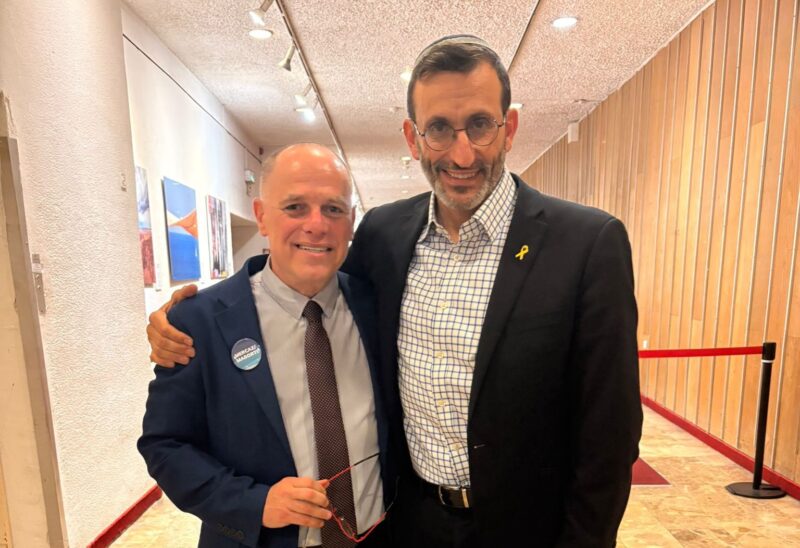
Courtesy/Yizhar hess
World Zionist Organization Vice Chair Yizhar Hess and presumed WZO Chair-to-be Rabbi Doron Perez embrace at the World Zionist Congress in Jerusalem on Oct. 29, 2025.




 Add EJP on Google
The executive body of the World Zionist Congress approved a power-sharing agreement between the left-wing and right-wing blocs for the so-called National Institutions on Sunday, following weeks of negotiations and controversies, the organization announced.
Israeli Prime Minister Benjamin Netanyahu’s controversial son, Yair — whose nomination last month caused an initial agreement to collapse — was not put forward by his father’s Likud party for any positions in the deal, signifying that he will not serve in a senior role in the World Zionist Organization.
Under the agreement, the details of which were first reported last Friday by eJewishPhilanthropy, the leadership of the World Zionist Organization and Keren Kayemeth LeIsrael-Jewish National Fund will be split between the two blocs, with each having a representative serve as chair for half of the five-year term.
Yaakov Hagoel, of World Likud, will serve the first half-term as chair of WZO, followed by an as-yet-unnamed representative of the center-left bloc.
Rabbi Doron Perez, chair of the religious Zionist World Mizrachi party, will serve as president of the WZO for the full five-year term. Under the deal, his office will be given expanded powers and budgets, including an additional $600,000 annually for three initiatives: a “Unity of the Jewish People Taskforce”; “initiatives to strengthen Jewish-Zionist identity among young people in the Diaspora”; and to support the celebration of Israeli national holidays around the world, such as Yom Ha’atzmaut and Yom HaZikaron.
Perez will succeed Steinhardt Foundation CEO Tova Dorfman, who has served as WZO president since January 2023.
Under the agreement, WZO Vice Chair Yizhar Hess, who represents the Conservative movement’s Mercaz Olami party and who led the negotiations for the center-left bloc, will retain his position for the full five years and gain additional powers.
Unresolved in the agreement is the leadership of KKL-JNF, which controls more than 10% of the land of Israel and has an accordingly large budget and political influence.
The KKL-JNF position will be voted on in the coming weeks, Perez told eJP.
Under the deal, the center-left bloc will select the first chair of the organization, though no specific names have officially been proposed. Initially, this was supposed to go to a representative of the centrist Yesh Atid party, Israel’s largest opposition party. However, last week, Yesh Atid announced that it was withdrawing from the so-called National Institutions, describing them as irrevocably corrupt. This has left the position up for grabs in the center-left bloc.
The two senior positions that could be filled by Netanyahu’s ally, Culture Minister Miki Zohar, went to Likud party members Itay Vana and Benny Safra, leaving no role available for the younger Netanyahu.
The 16-page agreement, written in Hebrew, was kept closely guarded by the negotiating teams, with even some members of the Vaad Hapoel not receiving the document, despite having to vote on it. Critics of the agreement told eJP last week that this was likely to avoid scrutiny and pushback ahead of the vote.
For the center-left bloc, the arrangement represents a significant victory compared to the agreement that was reached following the 2020 World Zionist Congress elections, in which World Likud held the chairs of both the WZO and KKL-JNF for the full five-year terms.
The deal also significantly expands the number of departments within the World Zionist Organization from the current 14 to at least 21, though this may expand to 24. The purposes of the new WZO departments are not included in the deal, and their names do not clearly indicate their missions or how they differ from existing ones. The heads of these departments receive compensation similar to an Israeli government minister —roughly $200,000 pretax — and with an assistant and driver. In addition, the deal allows the heads of certain departments and other senior roles to hire additional senior staff members.
Though its supporters tout the deal as a bipartisan effort — splitting power between the right and left — in addition to excluding the far-right Otzma Yehudit party, which was a prerequisite for the center-left, the agreement also keeps out the centrist Kol Israel-General Zionists faction. Insiders told eJP that this was a form of punishment by the center-left bloc over the faction’s opposition to an earlier proposed deal.
In an opinion piece in Israel’s Maariv newspaper, Kol Israel Chair David Yaari, who currently serves as a vice chair of KKL-JNF, wrote that the latest congress represented a “crisis of faith” and called for the National Institutions to undergo fundamental reform.
“It is not too late to bring back the Jewish People’s faith in the congress, which is supposed to represent it, all of it — from all sides, directions and opinions,” he wrote. “If we know how to execute a real pivot, we will be able to return to Zionist what has been taken from it: direction, value and soul.”
The agreement substantially increases the budget for the World Zionist Organization by $22 million annually, with the potential for further increases based on a consumer price index. It also allocates significantly higher budgets to Zionist federations around the world, including doubling the budgets of the largest ones — U.S., France, Canada, U.K. and Argentina — and increasing the rest by 75%. Zionist youth movements will also see their funding increased by 50% under the deal. It calls for an unspecified amount of greater funding of other educational activities for Israeli youth, including for informal education programs, pre-army preparatory programs, student villages and military yeshiva programs (hesder yeshivot).
In a win for progressives, the agreement demands equal funding for all Jewish denominations, including a newly recognized “humanist-cultural stream” of Judaism.
Related News
EXIT INTERVIEW
Elizabeth Sokolsky, longtime EVP of Birthright Israel, to retire next year
ADVANCING A VISION
N.Y. federation donates $1M toward building shared-society center named for peace activist killed on 10/7

MAGICAL EXPERIENCE
Shefa launches psychedelics retreat for Jewish professionals suffering burnout

EXCLUSIVE
Detroit-based philanthropists Nancy, James Grosfeld donate $8M to renovate JDC’s Israel campus

MAJOR GIFTS
Center for Jewish History celebrates 25 years with a $25M matching grant