NEXT STEPS
With half already raised, Weitzman Museum launches $100M campaign to modernize, expand efforts
The new goal was launched at the institution's gala in New York City that honored shoe designer and donor Stuart Weitzman and his wife, Jane
Nira dayanim/ejewishphilanthropy
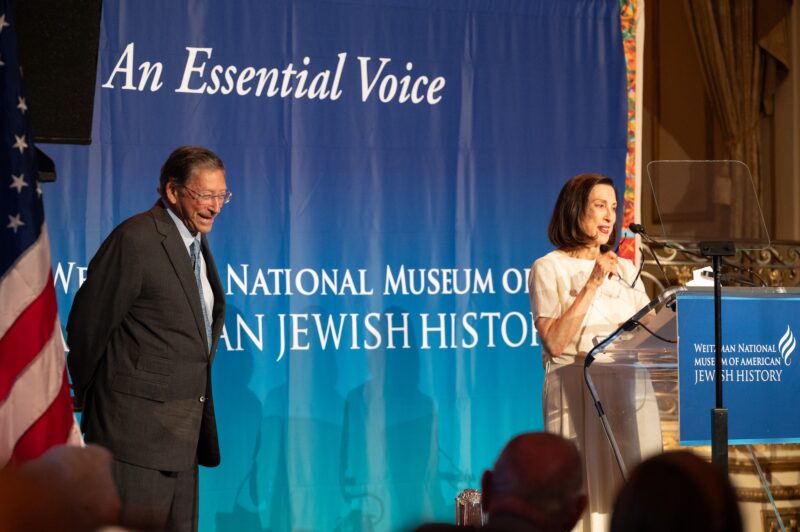
Philanthropist Jane Weitzman speaks alongside her husband, Stuart, at a gala honoring them that was put on by Weitzman National Museum of American Jewish History at the Plaza hotel in New York City on May 28, 2026.




 Add EJP on Google
Floral shoe sculptures topped the tables at the Weitzman National Museum of American Jewish History’s gala in New York City on Thursday night — a whimsical tribute to footwear designer Stuart Weitzman, who was honored by the museum alongside his wife, Jane, for their philanthropic contributions to the institution. The creative centerpieces also served as an apt, if unintended, metaphor for the museum’s next step: a new $100 million fundraising campaign to transform and expand its mission.
More than half of the $100 million goal has already been raised, according to the museum. The funds will go toward updating its exhibitions and strengthening day-to-day operations as it expands educational programs and public outreach across the country. Instead of adding new space, the museum plans to rethink its existing galleries and redesign its permanent exhibition with more technology-driven storytelling, Jackie Glodstein, the museum’s chief development officer, told eJewishPhilanthropy.
“We understand that people learn differently now, and they take in information differently, and we need to be responsive to the current times, the current issues and the current technology that is available to us to really get messages out,” Glodstein said.

Another key part of the fundraising campaign is building up the Philadelphia-based museum’s endowment as it adapts to a changing landscape, leaders say. Sixteen years after its founding, Dan Tadmor, the museum’s president, told eJP that the context for American Jews has shifted significantly, with rising antisemitism and widespread gaps in understanding Jewish history shaping the urgency of its work.
“It’s the only museum that tells the American Jewish story in its entirety, geographically, historically, thematically, which is a tall order. It means that we need to excel,” Tadmor said, speaking on the sidelines of the event, which was held at the Plaza Hotel. “It’s been a very tumultuous 20 years, and thematic museums, which are museums that tell a story, they evolve, they need to evolve, because our stories change, narratives change, technology changes.”
According to Tadmor, who led a similar $100 million fundraising campaign to overhaul the Anu Museum of the Jewish People in Tel Aviv, the Weitzman’s evolution will unfold in two “phases.” The first is already underway and includes three new exhibitions: one marking America’s 250th anniversary; a family-focused show for children ages five to 11 called Colors of Creation; and a third exhibition focused on contemporary antisemitism. The second phase will involve the Weitzman “reimagining” its core exhibit and building a bigger endowment to support the museum over time.
“One of the challenges that museums have is sustainability. How do you maintain a museum year after year after year? A big museum like ours should have a significant endowment. Now, we have one, but it’s not significant enough, and one of the targets of this campaign is not only to build a new museum, but also to make sure that it’s sustainable,” he said.
The campaign also follows earlier congressional discussions about bringing The Weitzman, currently a Smithsonian-affiliated museum, into the Smithsonian Institution as an official museum focused on the American Jewish experience — a move Tadmor said could bolster its work addressing antisemitism.
“Just two weeks ago, we announced with the JCPA, the Jewish Council of Public Affairs and the American Federation of Teachers, a resource guide offering our materials, the materials from the Weizman Museum curriculum for grades 6-12 to teach children across the country about who Jews are, using our narrative created by Jews,” said Phil Darivoff, chair of the campaign, during his speech. “It is hard to reject a curriculum and material from the Weitzman Museum. It is harder still to reject the curriculum and material from the Smithsonian Museum of American Jewish History.”
Related News
PRESIDENTIAL REBUKE
Israel’s Herzog: Mamdani ‘makes no effort’ to hide disdain for Israel, Jews must fight back
HIGHER EDUCATION
As Jewish donors reconsider academia, Jan Koum doubles down, endowing Israel studies at Stanford

EXIT INTERVIEW
Elizabeth Sokolsky, longtime EVP of Birthright Israel, to retire next year

MAJOR GIFTS
Center for Jewish History celebrates 25 years with a $25M matching grant

ADVANCING A VISION
N.Y. federation donates $1M toward building shared-society center named for peace activist killed on 10/7