Opinion
BY THE NUMBERS
Israel’s democracy gets talked about. It doesn’t get funded.




 Add EJP on Google
In Short
A new mapping of Israel’s democracy-strengthening sector reveals striking gaps.
There is no shortage of passionate debate about the state of Israeli democracy. In the streets of Tel Aviv, in the halls of the Knesset, in op-ed pages from Jerusalem to New York, the conversation is loud, urgent and constant. But a new independent research project by Eylam Leshem, mapping Israel’s democracy-strengthening organizational ecosystem using data sourced from the Israeli Ministry of Justice and Israeli Corporations Authority, reveals something that rarely surfaces in those conversations: when it comes to actually funding the organizations working to strengthen Israeli democracy, the money tells a very different story than the rhetoric.
The sector raises approximately $282 million annually — a figure that sounds substantial until you consider that it represents just 6.5% of the roughly $4.5 billion donated each year to Israeli nonprofits. For a country whose democratic institutions are under sustained pressure, and whose citizens’ trust in government has fallen below 20%, that share of philanthropic attention is striking.

Narvo Vexar/Getty Images
A lot of protest — but protest has a point of view
Nearly half of all Israeli democracy-focused organizations (45%) belong to the Protest Movement. That surge reflects real civic energy: 49% of the 100 NGOs in the report were founded after 2019, with 35% launched since 2021 alone. Israelis have shown up. They have organized, marched and mobilized in remarkable numbers.
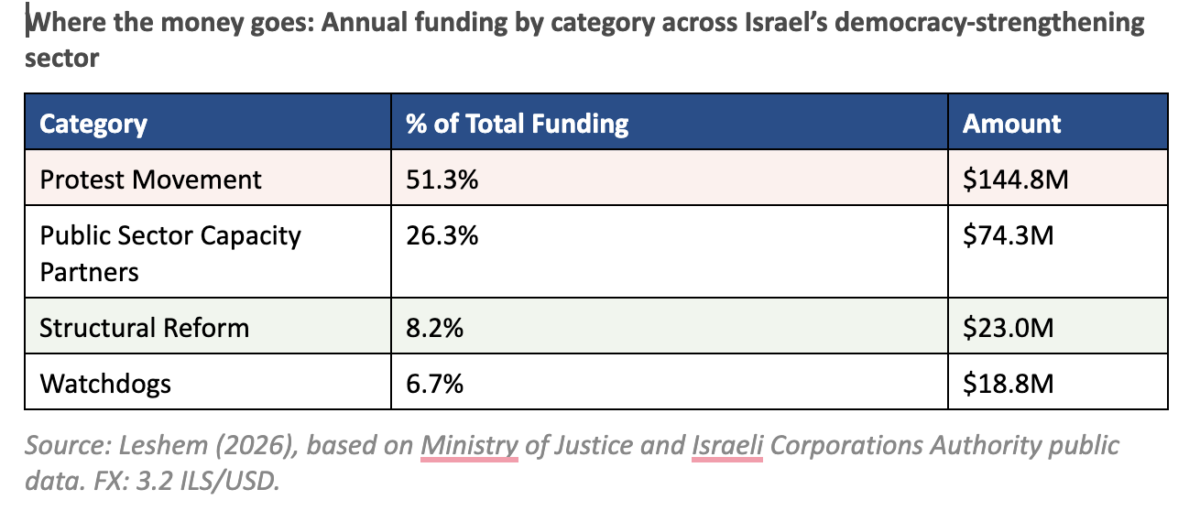
But there is something important to acknowledge honestly about the protest movement: it has a political perspective. That is not a criticism; protest movements are inherently responsive to perceived threats, and the organizations within this category have done meaningful work in galvanizing public attention. The issue is that when the Protest Movement absorbs nearly $145 million — more than half of all democracy funding in Israel — it highlights what is getting much less funding: the nonpartisan, cross-cutting infrastructure that should be relevant and credible to Israelis across party lines and political orientations.
Democratic infrastructure — constitutional design, parliamentary capacity-building, electoral reform, civic education — is not a left-wing project or a right-wing project. It is a shared institutional foundation. The organizations doing that work need to be, and largely are, politically neutral. They are also, as the data shows, profoundly underfunded, and this is likely for several reasons. Most people don’t know about these organizations because they work within complex ecosystem of national governance, work behind the scenes and are not in the street. These organizations get less natural exposure to potential funders and many funders do not have the working knowledge or bandwidth to seek out critical gears for change.
One organization, 88 cents of every dollar
Zoom into the structural reform category — the organizations working on the foundational rules that govern how Israeli democracy actually functions — and the picture becomes even more stark. Of the $23 million in annual funding for structural reform, 88% goes to the Israel Democracy Institute. The remaining 10 organizations working in this space (Shita; The Israeli Movement; Israel Strategic Futures Institute; Israel 2050; Democracy 3.0 Initiative; Israeli Institute for Thought; Shoresh Institution; Takhlit – Israeli Policy Institute; The Center for Judaism and State (under the Shalom Hartman Institute); and the Anachnu Movement) collectively operate on less than $6 million per year. Each of them runs on a budget under $1 million. A healthier ecosystem would include more money to the vastly under-resourced organizations.
This is not a critique of any individual organization doing rigorous and valuable work. It is a critique of a funding ecosystem that has, by default rather than design, placed the entire weight of structural democratic reform on a single institution’s shoulders.
The gaps nobody is funding
To understand why this matters, consider what structural reform actually means in the Israeli context. The report identifies six foundational gaps in Israel’s democratic framework: the absence of a written constitution, religion-state entanglement, undefined final borders, weak parliamentary oversight of the executive, a hyper-centralized electoral system, and closed party mechanisms that lack transparency or public participation. These problems require sustained policy work, constitutional design, legislative capacity-building and long-horizon institutional efforts to educate those governing, running for office and the voting population. These efforts can also be hard to explain to funders and hard for funders to research, identify and engage with the smaller but important organizations in the field.
Watchdog organizations — those monitoring government activity and using legal tools to uphold accountability — receive the least funding of any category, just $18.8 million annually. Within that category, 67% of budgets go to legal advocacy, which is reactive by nature. Only 12.3% funds go to proactive policy development, and less than 1% goes to research. The sector is better equipped to fight fires than to prevent them.
Public sector capacity partners, which work directly with government institutions to strengthen policy design and human capital, are the best-funded category on average, with organizations averaging $5.3 million in annual budgets. But here too, more than 60% of funding is concentrated in just three organizations, and the emphasis leans toward top-down policy influence rather than broad civic engagement. The pattern repeats across every category: concentration at the top, scarcity everywhere else.
The real opportunity: Small organizations, outsized leverage
Here is what makes this situation both urgent and, counterintuitively, hopeful: the organizations that need support are small. Not small in ambition — but small in budget, in a way that makes the math genuinely compelling for philanthropists who want their dollars to matter.
Ten organizations working on structural democratic reform are each operating on under $1 million per year. Many are well under that. These are groups focused on constitutional design, electoral reform, parliamentary capacity, and cross-sector civic alliance-building — the unglamorous, essential scaffolding of democratic resilience. Doubling or tripling the budget of any one of them is not a eight-figure ask. It is the kind of investment that mid-sized philanthropic foundations, diaspora giving networks, and impact-focused individual donors can make meaningfully.
A healthy democracy sector is not a monoculture. It is a field — plural, resilient, distributed — where the failure or stagnation of any single organization does not collapse the whole enterprise. It is an ecosystem where multiple organizations, each with different approaches and areas of expertise, can grow to a scale where they reinforce rather than duplicate each other. Constitutional expertise should sit alongside civic education. Policy development should connect to legislative capacity-building. Cross-sector alliances should have the resources to sustain multi-year commitments rather than lurching from grant to grant. Israel does not have that field yet. It has a handful of grassroots organizations that are, by necessity, building it from the ground up with almost no financial runway.
What it will actually take
The conversation about Israeli democracy is not going away. If anything, it will intensify. But conversation without investment in infrastructure will not drive change. The organizations that can build something durable — something that serves Israelis across the political spectrum, that strengthens institutions rather than just defending them — are out there. They are small, they are serious, and relative to the scale of the problem they are trying to solve, they are remarkably inexpensive to support.
Rafi Musher is a business and social impact entrepreneur and sits on multiple nonprofit boards.
Eylam Leshem is an expert in the field of Israeli governance and democratic institutions. Leshem is the author of “Mapping Israel’s Democracy — Organizational Ecosystem,” an independent research project completed Spring 2026.