ON THE SCENE
In fiery address, Rabbi Ammiel Hirsch rails against HUC ordaining anti-Zionist rabbis
Speaking at the third Re-Charging Reform Judaism conference at the Stephen Wise Free Synagogue, Hirsch stressed the centrality of Zionism, while also condemning parts of the Israeli government for 'closed-minded chauvinistic particularism'
nira dayanim/ejewishphilanthropy
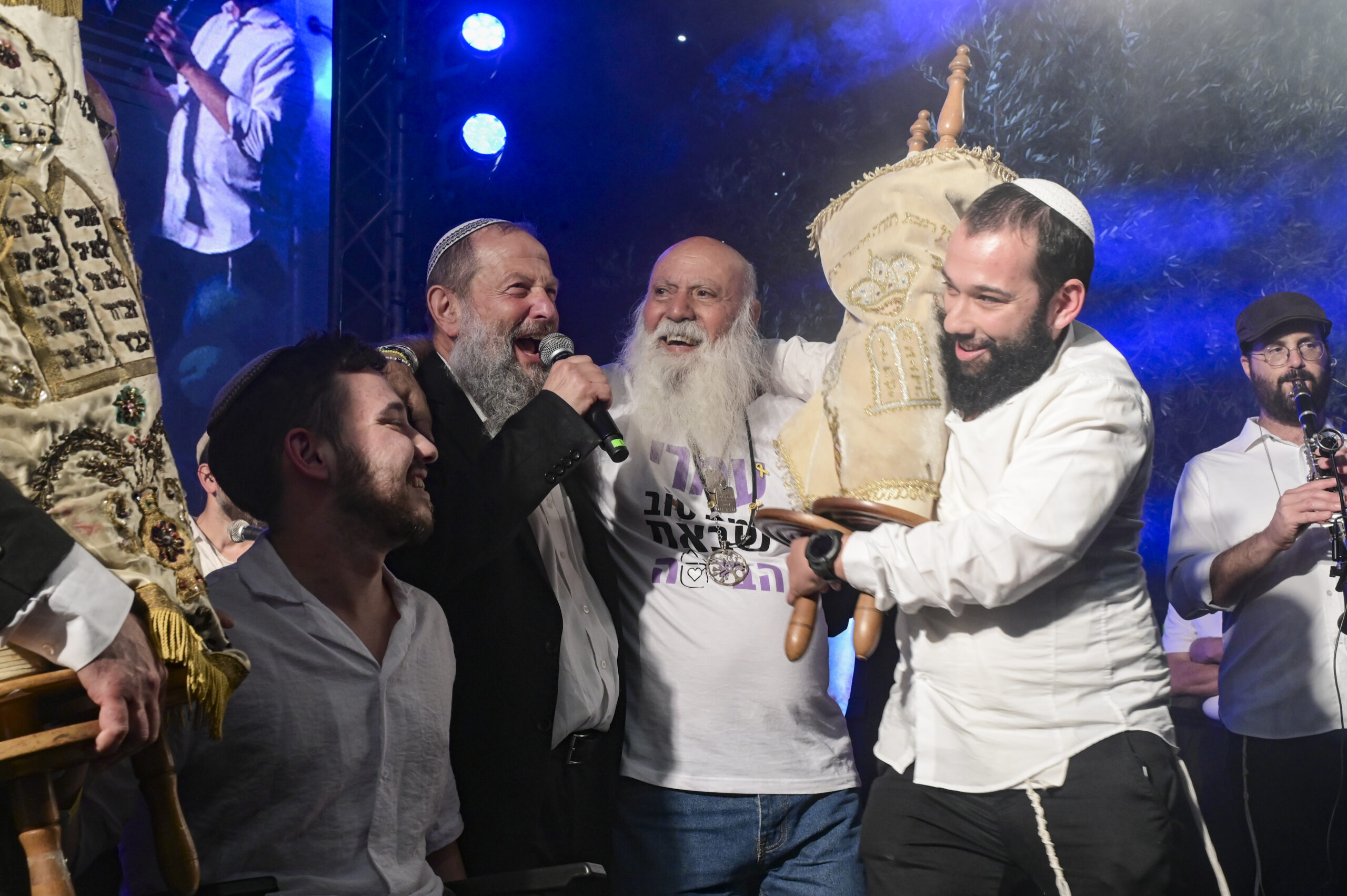
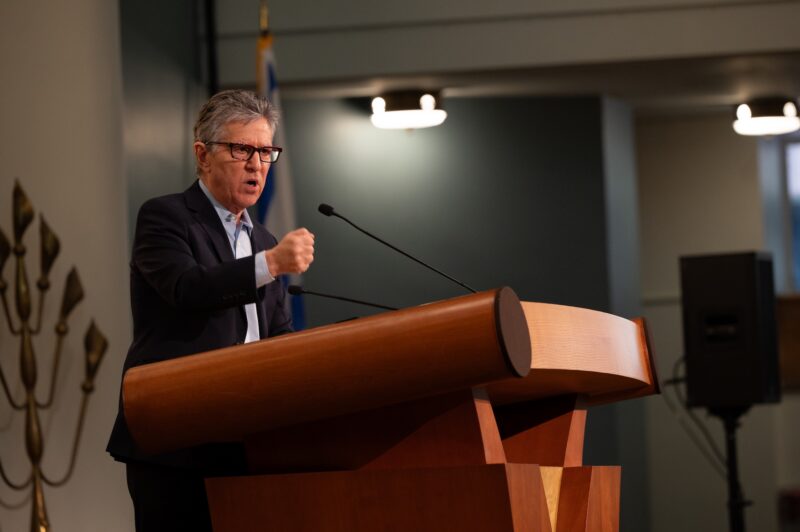
Rabbi Ammiel Hirsch speaks at the Re-Charging Reform Judaism conference at the Stephen Wise Free Synagogue in New York City on May 27, 2026.




 Add EJP on Google
In a fiery keynote address opening the Re-Charging Reform Judaism conference on Wednesday morning, Ammiel Hirsch, Stephen Wise Free Synagogue’s senior rabbi, denounced Reform religious seminaries that ordain anti-Zionist clergy members and doubled down on the importance of Jewish particularism.
“We cannot succumb to those who preach a false philosophy of Jewish universalism that camouflages disdain for Jewish particularism under the guise of a sometimes sweeping, self-righteous, sanctimonious and suffocating misunderstanding of tikkun olam,” said Hirsch, to wide applause.
He warned against the possibility of the movement becoming isolated from the broader Jewish community, mentioning the Hebrew Union College-Jewish Institute of Religion (HUC)’s inclusion of anti-Zionist students within its rabbinical programs, despite the Reform movement’s flagship seminary’s official standing as a Zionist institution.
“Any seminary that either in word or deed, in principle or impression, acquires the reputation of being hostile to Zionism – a seminary that ordains anti-Zionist clergy – has no future in America,” he said, also to wide applause.
In recent years, HUC has faced questions about its commitments to Zionism as several of its students have identified as anti-Zionist and signed onto letters that are highly critical of the State of Israel. Representatives of the seminary have insisted that the school maintains its commitments to Israel but does not demand a “loyalty oath” of its students.
The two-day conference, now in its third year, drew over 300 lay leaders, rabbis and educators to the Upper West Side’s Stephen Wise Free Synagogue. Founded shortly before Hamas terrorists attacked southern Israel on Oct. 7, 2023, the Re-Charging Reform Judaism conference operates independently of the official Reform movement.
In the years since the Hamas attacks, Hirsch has often criticized his co-denominationalists for not establishing a firm enough bulwark against anti-Zionism.
“Over the course of the past three years, I have received queries regarding the authority of the
Re-Charging conference: “On whose authority,” I am asked, “do we even convene, let alone, write papers, and now pass resolutions?” said Hirsch. “I would reverse the question and ask: ‘On whose authority does our seminary change decades of Reform theology, as expressed in numerous platforms and resolutions that do have constitutional authority, accepting, let alone, ordaining, anti-Zionists?’”
Hirsch’s prominence, coupled with his vocal stance on Israel and Zionism, has been met with some pushback from other members of the Reform movement, who view him as deprioritizing a “big tent” approach, a dynamic Hirsch appeared to address in his address, saying, “If you believe everything, you believe nothing.”
On Tuesday night, Rabbis Jonah Dov Pesner and Josh Weinberg penned a blog post on the Union for Reform Judaism’s website, titled “Stop Asking Us to Choose,” arguing that members of the Reform movement should not be asked to choose between their commitments to Zionism, fighting antisemitism, democracy, and social justice.
“Some tell us, now is not the time for social justice or to concern ourselves with the fate of the Other. Now is not the time for public critique, however nuanced. With antisemitism on the rise, now is the time to circle the wagons, to stand with our people, full stop. We respectfully, but firmly, disagree,” wrote Pesner and Weinberg. “We are proud Jews, Zionists, and North Americans who fight for social justice. Not only do we think those identities are inseparable, we believe they are complementary. As Reform movement luminary Rabbi Dick Hirsch always taught us, ‘Zionism is a Social Justice Movement!’”
Though Pesner and Weinberg’s piece did not mention Hirsch or the conference, a URJ spokesperson told eJewishPhilanthropy that the blog post was connected to them, saying that it offered “useful context” for the “themes expected to be discussed at the conference.”
While Hirsch was adamant about the importance of Zionism, he also railed against the current Israeli government and the “closed-minded chauvinistic particularism” demonstrated by “elements” of it, which he described as “an embarrassment to Israel and world Jewry.” The Reform movement, he said, walks a fine line between particularism and “an expanding universalism threatening to eclipse Judaism’s fundamental command of ahavat Yisrael – love for the Jewish People.”
“It is true that we are seeing worrying signs of a narrowing particularism in some quarters of the Jewish world and the Jewish state… the hooligans who violently assault Palestinians on the West Bank are a disgrace. It is Israel’s responsibility to thwart them, on pain of imprisonment, and it is our responsibility to say so,” he said, to wide applause.
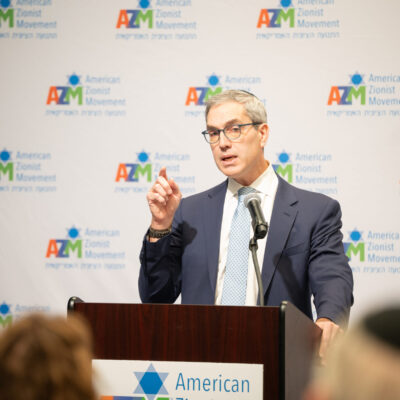
Hirsch’s address is among a growing number delivered by prominent pulpit rabbis in an effort to redraw lines or expand the “big tent” to include, or preclude shifting opinions on Israel and zionism in the years since the Oct. 7 terror attacks, as consensus on Israel and Zionism has morphed and splintered since the war in Gaza began, particularly among young Jews. In an address at the American Zionist Movement’s Biennial National Assembly in December, Park Avenue Synagogue’s Elliot Cosgrove, a leading voice in the Conservative movement, warned that communal “orthodoxies” on Israel and Zionism could isolate young Jews.
Hirsch also warned that the Reform movement risks being severed from the broader community if its relationship with Israel deteriorates.
“If the North American Reform movement, in word or in deed, by action or silence, becomes, in fact, or even in perception, an anti-Zionist, anti-particularistic movement that cares only, or mostly, about universal concerns, unanchored in, and unmoored from, the centrality of Jewish peoplehood, most American Jews will abandon us,” he said.
Related News
CLOSING WORDS
In AZM address, Cosgrove links communal ‘orthodoxy’ on Israel to rising anti-Zionism among young Jews

MAGICAL EXPERIENCE
Shefa launches psychedelics retreat for Jewish professionals suffering burnout
EXCLUSIVE
Detroit-based philanthropists Nancy, James Grosfeld donate $8M to renovate JDC’s Israel campus
ADVANCING A VISION
N.Y. federation donates $1M toward building shared-society center named for peace activist killed on 10/7
HIGHER EDUCATION
As Jewish donors reconsider academia, Jan Koum doubles down, endowing Israel studies at Stanford