SUPER HEROES
Nonprofits fight to honor the Jewish roots of long-overlooked comic book creators
The Jack Kirby Museum is launching a pop-up exhibit in New York's Tribeca neighborhood, near the Lower East Side, where the famed Marvel artist grew up as Jacob Kurtzberg
COURTESY/KIRBY MUSEUM
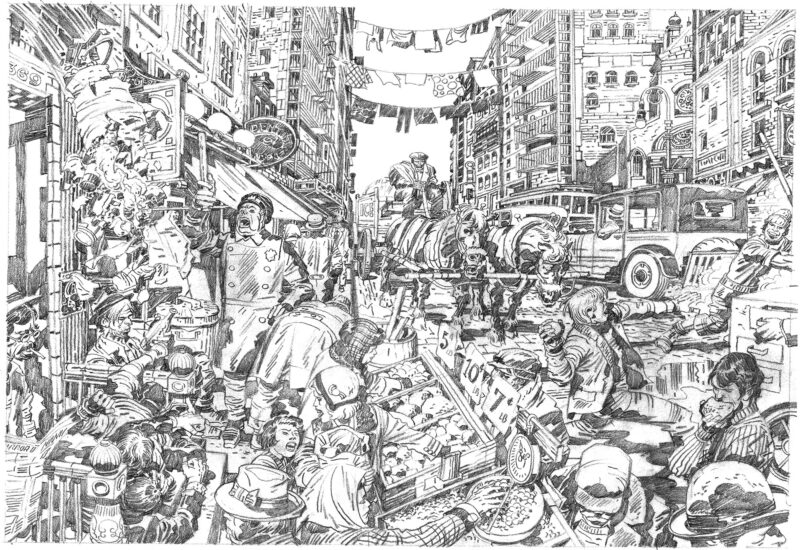
A street scene of the Lower East Side of New York, drawn by Jack Kirby, who grew up there.




 Add EJP on Google
This year, four of the top 10 domestic blockbuster films were based on comic characters created by Jews — Superman, the Fantastic Four, the Avengers and Captain America — which collectively brought in more than $1 billion.
This Black Friday, the franchises will generate further revenue as parents brave their way to Walmarts and Targets to snag cartloads of action figures, apparel and Lego sets based on their kids’ favorite Marvel and DC heroes and heroines. But that same day, legions of fans will trek to One Art Space in Tribeca, New York City, to celebrate the man who co-created many of these characters: Jack Kirby, the artist behind the Fantastic Four, Captain America, X-Men, much of the rest of the Marvel Universe, who also fully created DC Comics’ New Gods.
Organized by the Jack Kirby Museum, the pop-up event titled “Jack Kirby: From the Ghetto to the Cosmos” runs from Nov. 28-Dec. 7, with an opening reception on Saturday. The heart of the event will be a display of reproductions of Kirby’s only explicitly autobiographical story, the 10-page “Street Code!,” which portrays Kirby’s life growing up in the tenements of the heavily Jewish Lower East Side, a 30-minute walk from the exhibit.
Kirby, born Jacob Kurtzberg in 1917, grew up at 147 Essex St., less than a block from Economy Candy and less than three blocks from Katz’s Delicatessen. He died in 1994 at the age of 76. “He would’ve loved to talk for endless hours to anyone that walked through the exhibit about all the transitions of his career and the stories behind his stories,” his granddaughter Tracy Kirby, who remembers never-ending Passover seders with her grandfather, told eJewishPhilanthropy. “He was always proud and humbled when people would tell him how much his work touched and inspired them.”
The Kirby Museum, along with The Siegel and Shuster Society, which honors Superman’s Jewish co-creators, is one of the few nonprofits celebrating the Jewish masterminds of the comics medium. Even though these writers and artists’ creations are plastered on nearly every child’s lunch box — not only in America, but around the world — their foundations and museums often lack the financial support of nonprofits dedicated to those deemed “fine” artists.
In 2000, Randolph Hoppe, the treasurer/acting director of the Kirby Museum, was on a trip to Europe when he noticed several single-artist museums in Paris and in Barcelona. At the time, the main archive of Kirby’s work was the quarterly, black-and-white fanzine, The Kirby Collector, published by TwoMorrows Publishing and marketed towards hardcore fans.
“Jack should really have something a little bit stronger than that and something that’s an actual nonprofit that’s focused on his legacy as an artist and a writer and his imagination,” Hoppe thought to himself.
Five years later, with the support of Kirby’s daughter Lisa, Hoppe founded the Kirby Museum. Not a physical museum, the nonprofit has scanned over 16,500 digital objects — original artwork and comic book pages, including the Kirby family’s collection — with the goal of opening a digital collection that can be appreciated by fans and used by researchers. It’s important that the work is digitized, Hoppe said, because Kirby’s original artwork could deteriorate if not properly cared for in a museum or gallery. The museum owns a small collection of original Kirby art, three pieces that will be displayed at the pop-up.
The museum is also working with Emmy-winning producers Dan Braun and Josh Braun of Submarine Entertainment (“The Andy Warhol Diaries,” “Wild Wild Country”) on a documentary, “Kirbyvision,” inspired by an exhibit the museum mounted last August at Los Angeles’ Corey Helford Gallery.
The Tribeca pop up is the seventh pop-up the museum has organized since 2013, and they received a deal on the location, as the gallery was founded by the son of comic book inker Joe Giella. They couldn’t afford to spend tens of thousands to display the pop-up elsewhere.
While museums like the Norman Rockwell Museum, which honors the iconic Life magazine cover artist, in Stockbridge, Mass., have millions in assets with many foundations supporting it, the Kirby Museum has no major donors and relies on T-shirt and poster sales and small donations.
Comics should be seen in the same category as all great art, Roy Schwartz, author of Is Superman Circumcised?: The Complete Jewish History of the World’s Greatest Hero and a board member of the American Jewish Historical Society, told eJP. He is advocating to have a street near Kirby’s birthplace co-named “Kirby Way.”
“Comic books are Jewish literature,” he said. “They tell the same stories as Philip Roth and Bernard Malamud and Primo Levi just through metaphor and hyperbole with a younger audience in mind, but they’re selling the same bagels on the same street corner, and this canon of Jewish American literature and art deserves to be on the same shelf as those other greats.”
You cannot take the Jewish out of these creators and their creations, Rabbi Simcha Weinstein the author of Up, Up, and Oy Vey: How Jewish History, Culture, and Values Shaped the Comic Book Superhero, told eJP. His book was one of several on the topic of Jews in comics published in the late aughts after Michael Chabon’s 2000 Pulitzer Prize-winning novel, The Amazing Adventures of Kavalier and Clay, told the story of two Golden Age comic creators modeled after Siegel and Shuster, drawing attention to the Jewish history of the medium for the first time in mainstream media. “It’s impossible not to see [the superhero] journey as a reflection of the Jewish immigrant experience, name changing, the desire to mask the double identity, the wrestling of the outsider/insider.”
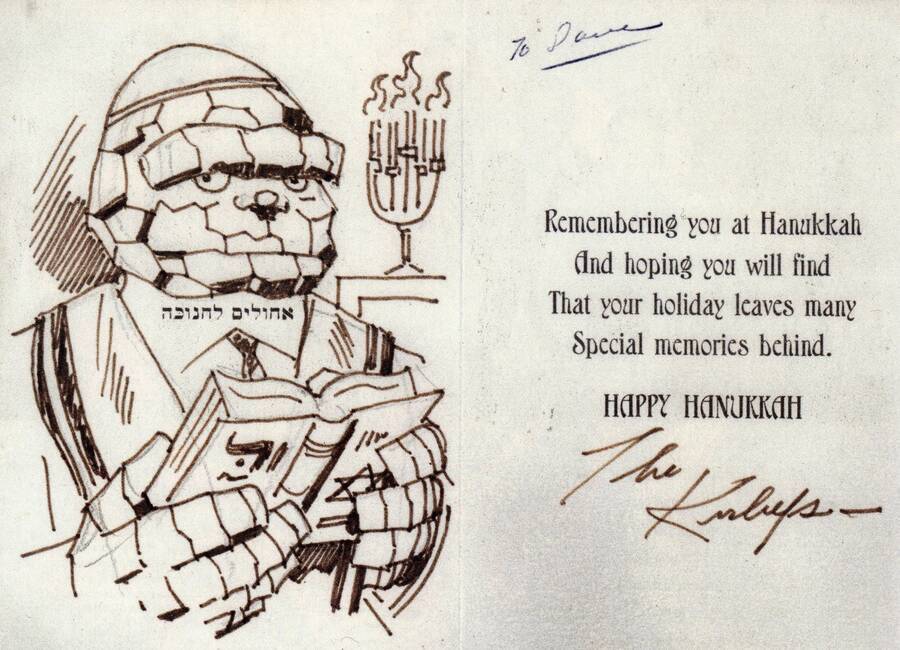
Comic characters often mirror their creator’s experiences, even if not implicitly. Superman is the story of an immigrant to Earth whose planet was destroyed — widely seen as a reflection of the Jews fleeing Eastern Europe for America. Captain America can be read as a Golem or a take on assimilation, a character so American that he envelopes himself in the flag. The Fantastic Four’s Ben Grimm, known as the Thing, grew up on Yancy St., a stand-in for Essex St., and his often gruff, sarcastic character was revealed to be Jewish after Kirby died, with many believing the character was based on him.
Hoppe is not Jewish, but he said that Kirby’s heritage can be seen in everything the museum does. “The whole comic book industry, we wouldn’t have that without the Jews and any of the creative people that were shut out of mainstream publishing,” he said.
Kirby and many of his peers couldn’t get jobs in their chosen fields, advertising and journalism, due to antisemitism, so they fell into comics, which were new and viewed as a second-rate medium, not deserving of respect, a view that is still seen today.
For decades, Superman’s creators Siegel and Shuster were erased from the picture completely. DC Comics refused to credit them for their creation because they signed their work away under a work-for-hire contract in 1938, giving DC full rights for a one-time payment of $130. Last week, a copy of the first issue of Superman sold for over $9 million.
In the mid-1970s, just before the first Superman movie debuted in theaters, after many lawsuits and a campaign led by fellow comic artists, Warner Bros., which had purchased DC Comics, agreed to credit Siegel and Shuster in comic and movie credits and provide a lifetime annual stipend and health benefits to the creators.
“Every time I watch any television show or any movie and at the end, or sometimes at the beginning, where it says ‘Superman created by Jerry Siegel and Joe Shuster,’ I still smile,” Samantha Baskind, a distinguished professor of art history at Cleveland State University, the editor of The Jewish Graphic Novel: Critical Approaches and a board member of the Siegel and Shuster Society, told eJP.
The nonprofit was founded in 2007 after a local journalist wrote a series of articles about his shock that Clevelanders didn’t realize that Superman was born from the minds of two Cleveland Jewish kids.
In the years since, the society restored Jerry Siegel’s boyhood home, installed a Superman-paneled decorative fence around the location of Joe Shuster’s boyhood apartment, created a permanent Superman display at Cleveland Hopkins Airport, as well as a rotating exhibit at Cleveland Public Library’s Main Library.
“None of it was easy,” said Gary Kaplan, board president and Jerry Siegel’s cousin. The society recently installed a Superman statue in downtown Cleveland that cost over $1 million. They still owe the construction company nearly $1 million more. Plus, they pay $10,000 yearly for insurance and maintenance.
The society depends on small donations of $25 to $50, with the only large donations coming from Siegel and Shuster family members, who have collectively donated $400,000 over the last few years. The society also received a $5,000 donation from the Maltz Museum of Jewish Heritage in Beachwood, Ohio, but it has not received support from the local Jewish federation or other communal institutions. (Hoppe said the Kirby Museum has not sought Jewish institutional funding.)
Before the society, Kaplan said, less than 10% of Clevelanders knew Segal and Shuster were from the city. Today, the Cleveland Guardians hold a Superman night, as does Cleveland’s minor-league hockey team. “We really put Jerry Segal and Joe Shuster in Cleveland on the map,” Kaplan said. “Now, everybody in Cleveland knows.”
Because superheroes are ubiquitous, it’s important non-Jews recognize the characters’ Jewish roots as a way to combat antisemitism, Schwartz said. “One would think that if somebody loves a character and finds out that they were not only created by Jews, but were designed to reflect the Jewish experience, that makes it a little bit harder for this person to hate Jews.”
Schwartz added that these nonprofits are important for Jews as well. They offer an opportunity to bask in Jewish pride and to gain newfound appreciation for and identification with their favorite superheroes, whose Jewishness is not “happenstantial,” he said. Superman’s DNA is laced with Moses and Samson and the Golem.
Comics are “the modern American mythology,” Schwartz said. “They are our Greco-Roman myths. They are our shtetl folklore.”
Related News

ADVANCING A VISION
N.Y. federation donates $1M toward building shared-society center named for peace activist killed on 10/7

MAJOR GIFTS
Center for Jewish History celebrates 25 years with a $25M matching grant

EXCLUSIVE
Detroit-based philanthropists Nancy, James Grosfeld donate $8M to renovate JDC’s Israel campus
EXIT INTERVIEW
Elizabeth Sokolsky, longtime EVP of Birthright Israel, to retire next year
CLOSING WORDS
In AZM address, Cosgrove links communal ‘orthodoxy’ on Israel to rising anti-Zionism among young Jews