Q&A
From wartime deficits to workforce integration: Aaron Institute’s Eckstein examines Israel’s economy
Zvi Eckstein warns that the country needs economic reforms to pay for its increased defense spending and prevent Israelis from fleeing abroad
Courtesy
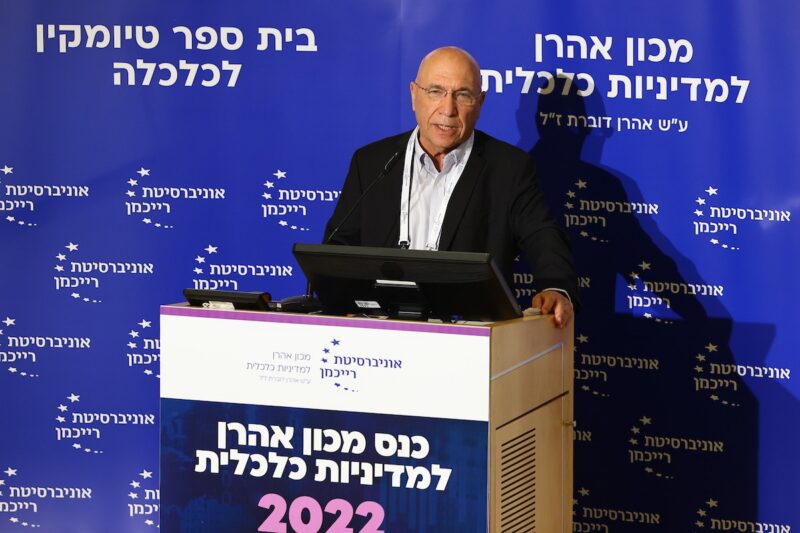
Zvi Eckstein, head of the Aaron Institute for Economic Policy at Reichman University, speaks at the group's conference in 2022.




 Add EJP on Google
As Israel continues to maneuver through an era of profound regional — and internal — instability, the economy is emerging as the “eighth front,” a theater as critical to national survival as the seven military ones, according to Zvi Eckstein, head of the Aaron Institute for Economic Policy at Reichman University and former Bank of Israel deputy governor.
According to Eckstein, the nation’s long-term financial health is being tested in ways not seen since the Second Intifada in the early 2000s, pointing to historic highs in defense spending and the complex pressures of a strong shekel as primary stressors. With these forces defining the current moment, Eckstein warns that the country’s fiscal resilience has reached a pivotal threshold.
Eckstein argues that the shekel’s historic highs present a complex challenge. He explains that an “excess supply of dollars,” driven by a high-tech sector that accounts for 57% of exports, keeps the currency strong despite wartime pressures. However, Eckstein points out a stark contrast on the ground: While Israel ranks among the top 15 globally in nominal GDP, its citizens face a cost of living 30% higher than that of other average advanced nations.
Against this backdrop, the Aaron Institute is convening its annual conference on Tuesday — a two-day deep dive into the 2027 budget, the country’s cost-of-living crisis and the potential economic growth that the greater integration of Arab and Haredi Israelis into the workforce will yield for the economy. The conference will feature a prestigious roster of experts, including Nobel Laureates Daron Acemoglu and Joel Mokyr, as well as Bank of Israel Governor Amir Yaron.
Eckstein spoke with eJewishPhilanthropy ahead of the conference, offering a sober look at Israel’s wartime economy. Beyond the fiscal burden of war and the shifting demographic fears of a “brain drain,” he outlined the country’s historical economic rhythms and current-day forces that define this moment — and Israel’s economic future.
This interview has been edited for length and clarity.
Justin Hayet: This is the Aaron Institute’s 11th annual conference, and while each year has its own “hot topics,” the current economic situation feels uniquely heightened by more than two years of war. Given the massive scale of these events, what are the fiscal challenges posed by the conflict, and how do you see it impacting Israel’s national expenditures and economic stability moving forward?
Zvi Eckstein: We are facing huge expenditures from the war. Through 2023, 2024 and 2025, [Israel’s] spending was running around 8% of GDP, which requires the government to issue debt. The main challenge is the uncertainty of whether the war will continue across military fronts in Lebanon, Iran and Gaza. This generates a demand for military action and costs that simply were not there before Oct. 7, [2023]. The question is how to balance the budget to maintain a high quality of life so people do not leave Israel.
We built a macro model based on the necessity of military expenditure being higher than the pre-Oct. 7 rate of 4.5%. During the war, these expenditures doubled, generating a huge debt. Another challenge is funding the expenditures needed to renew stocks of ammunition and interceptors to prepare for the next round with Iran and to renew army units. We need a larger army expenditure over the next several years. The key is determining what economic reforms we can generate to have a higher growth and income rate to fund these expenditures and achieve stability in the medium and long run.
JH: While we hear about acquisitions in the startup arena, we also hear about some of Israel’s smartest minds leaving in a “brain drain.” What is the current situation regarding demographics and this trend?
ZE: If you look at the stock market, [Israelis] are optimistic; if you compare the value of stocks to profits, Israeli stocks are expensive. However, there is the topic of [the] “brain drain.” Middle-aged professionals — doctors and high-tech workers — see the danger through the war and have high opportunities in many other countries. Usually, there is a movement of Israelis going abroad and then coming back. Before 2023, more people were coming back than leaving. Since 2023, the number of Israelis who left versus those coming back has switched from a positive to a negative. It went from positive 20,000 people to negative 40,000 people. This net effect has changed, and it is worrisome.
JH: The shekel is at historic highs. How do the currency and high-tech sector impact the economy?
ZE: As a child, the big problem was that the currency was always depreciating, but since 2004, the high-tech sector has driven a massive growth period. Today, 95% of the sector is export-based and highly competitive, drawing Israel’s top talent.
High-tech now accounts for 57% of total exports and 20% of the GDP — higher than any other country, including the U.S. Because the industry is so profitable, production continues even as the shekel strengthens. This sector flourished during COVID and throughout the war; even with many workers in the reserves, production has increased due to AI. Since our exports exceed our imports, there is an excess supply of dollars, which strengthens the shekel. We predict the shekel could [stay at 3 or go] lower in the near future, though if the S&P 500 jumps, Israelis may move money there, causing the shekel to weaken.
JH: Your institute prides itself on non-political and data-driven proposals with the potential to unleash economic growth for Israel. What are the proposed reforms for economic stability and the cost of living that you will announce at the conference?
ZE: We must enhance employment for Arab men and women by improving education and Hebrew-language proficiency. We estimate this would increase the growth rate by an additional 0.4%, based on Israel’s GDP of NIS 2 trillion ($670 billion).
Second, we must address the cost of living. While Israel ranks between 10-15 in GDP among OECD nations, our cost of living is 30% higher than the average of advanced countries. This is a result of bureaucracy and bad planning, particularly in agriculture. We are the only country that subsidizes farmers by price rather than production volume. While Israelis admire farmers, we must find ways to support them without maintaining these market failures. Our final conference session will focus on these main sources of the cost of living, specifically food and housing, to improve the national quality of life.
The path forward depends on the integration of the two sub-populations most critical to our economic and social value: the Arab and ultra-Orthodox communities. We are already seeing a shift toward better integration; interestingly, we have also noted a reduction in interest from donors in supporting ultra-Orthodox causes. If the next government shifts even a modest amount of resources toward workforce integration — with a specific focus on high-tech, AI, transportation and housing — we could see Israel’s growth rate reach 3.5-4%. While this will not solve the underlying political issues, it will return Israel to a much higher quality of civilian life.
JH: There is often a lot of noise regarding the statements and work of ministers and political appointees, yet your think tank focuses its work at the professional level. What is the role of civil servants in government fiscal and economic policy?
ZE: Our institute is the most focused, high-quality economic program in the country in terms of actually influencing the professional economists within the government.
We are serious and non-populist. The professionals in the government are not populists either; in fact, the most successful reforms in Israel’s history occurred because professionals convinced politicians to adopt new policies.
The history of Israel shows that even major economic policies attributed to leaders like [Prime Minister Benjamin] Netanyahu were actually created by professionals. Perhaps the only major reform driven by politicians was stopping the 1985 inflation crisis — and even then, it was George Shultz, a professor of economics, alongside Stanley Fischer and Herb Stein, who provided the road map to save the economy.
The “rules of the game” have changed on three major occasions: the 1985 hyperinflation, the loan guarantees for immigrants in the early ’90s, and the post-Second Intifada period, when the U.S. required Israel to lower expenditures in exchange for debt guarantees. Throughout these shifts, the U.S. has remained economically supportive, but the successful execution of policy always comes back to the influence of Israeli [governmental] professionals.
Related News

EXCLUSIVE
Detroit-based philanthropists Nancy, James Grosfeld donate $8M to renovate JDC’s Israel campus

EXIT INTERVIEW
Elizabeth Sokolsky, longtime EVP of Birthright Israel, to retire next year
CLOSING WORDS
In AZM address, Cosgrove links communal ‘orthodoxy’ on Israel to rising anti-Zionism among young Jews

PRESIDENTIAL REBUKE
Israel’s Herzog: Mamdani ‘makes no effort’ to hide disdain for Israel, Jews must fight back

MAGICAL EXPERIENCE
Shefa launches psychedelics retreat for Jewish professionals suffering burnout