Q&A
‘The veneer of security is being stripped away:’ A conversation with longtime U.K. Jewish community leader, Simon Johnson
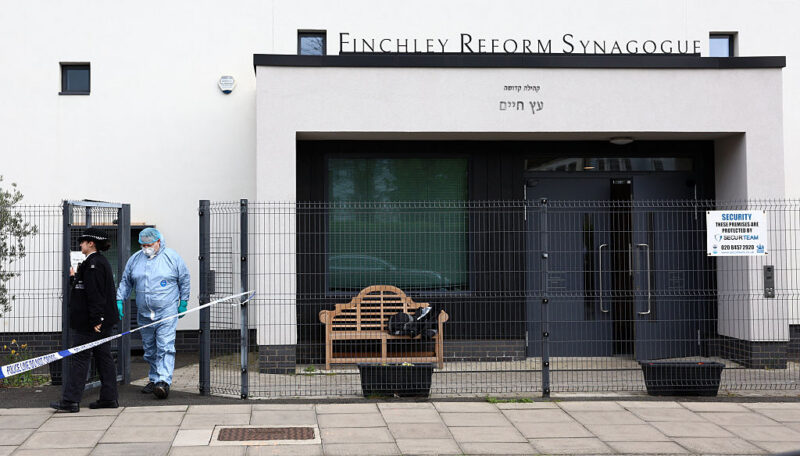
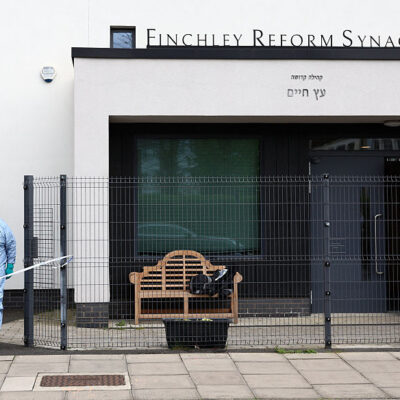
A police forensics officer works during an investigation into an attack in the early hours of the morning, at the Finchley Reform Synagogue, in the North Finchley area of north London, on April 15, 2026. Britain's Metropolitan Police said on April 15 they are seeking two suspects following an attempted arson attack at Finchley Reform Synagogue in north London, where bottles thought to have contained petrol were thrown at the building. (Photo by Toby Shepheard / AFP via Getty Images)




 Add EJP on Google
A series of targeted attacks against Jewish institutions in the United Kingdom is “chipping away” the community’s sense of safety, veteran communal professional and lay leader Simon Johnson told eJewishPhilanthropy’s Justin Hayet in an interview on Thursday.
Previously the ceo of the Jewish Leadership Council from 2013 to 2020 and currently a trustee of The Bloom Foundation and chair of Camp Simcha UK, Johnson made aliyah earlier this year and now splits his time between Israel and the U.K. Johnson sat down with eJP to discuss the shifting landscape of British Jewry, offering praise for the work of the Community Security Trust (CST) in fortifying communal life and providing a nuanced look at how shifting demographics and new government policies are creating a “dangerous storm” of structural and economic “quiet crises.”
This interview has been edited for length and clarity.
Justin Hayet: The recent uptick of attacks in the United Kingdom against Jewish institutions has sent shockwaves through the community. How has the sense of safety changed for British Jews?
Simon Johnson: The veneer of security is being stripped away. For lots of people, even at the height of anti-semetic attacks, even in the areas where the Jews live, there was broadly a tense, but steady, stable level of security. The CST volunteers, buildings well protected, police protected. People thought provided they stayed within the community, there would be a relative level of safety and security. It has chipped away a feeling that we will be OK if we stay in our area. That has shocked people. It caused them to question how secure they really are.
JH: In response to recent events, many are calling for increased security at Jewish institutions across the U.K . Is that the right solution, or are we missing a deeper issue?
SJ: The response of the government is always to say that we will increase the police presence, better security, and build more walls, and that is probably the correct assessment. But as Lord David Wolfson of Tredegar said in the House of Lords: “But so far as the government’s response is concerned, while we are always grateful for support for the Community Security Trust, the debate about Jewish security needs to move away from being about higher walls around our synagogues and more guards outside our schools and on to the root causes of why we need such security?”
The answer to this problem is not merely more guards, higher fencing, steel-reinforced, or bomb-proof glass. This is addressing the symptoms of the problem. What the Jewish community cannot do alone, and the government has to, is they have to address the causes. To stop enabling visible anti-Jewish racism in the public arena. Stop making it possible.
JH: You’ve mentioned that these attacks aren’t just random acts of vandalism. Who do you believe is fueling this violence?
SJ: Our belief [as a community] is that all four recent attacks have been motivated or inspired by Iranian-linked organizations. What we have known for a long time in the U.K. is that the IRGC [Islamic Revolutionary Guard Corps] has been using proxies — small-time criminals, vandals, untraceable connections — in order to do this harm. But the police and government have very good intelligence that the IRGC and the Iranian elements are behind this attack.
Manchester [Johnson’s hometown] was the attack everyone was fearing for 20 years. We were not surprised. That it should happen in the most Zionist community of Manchester, where Muslims, Sikhs, Hindus and Jews live in a good state of harmony — that that should be undermined by someone creating such a violent attack on a synagogue… It’s very disturbing.
JH: We’ve seen central London become a flashpoint for weekly protests. How has this impacted the community’s ability to live openly as Jews?
SJ: Since Oct.7, I’ve been concerned that on certain days, places in central London have become no-go zones. The police have enabled the protests and marches; they have not made sufficient arrests and have not stopped antisemitic chanting and banners. On these days, the city is no longer safe for Jews openly expressing their Judaism or support for Israel. I know people who are now hiding outward signs of Judaism while traveling.
JH: Beyond physical safety, the “donor ecosystem” is facing its own crisis in the U.K. What are the primary threats to the sustainability of U.K. Jewish nonprofits?
SJ: My general concern for philanthropy is demographic changes and government policy affecting the charitable sector. Once you look outside CST, at social services and religious organizations, they are under threat. Wealthy individuals are leaving for Israel or [leaving the United Kingdom] for financial reasons due to taxation. This shift in the donor base is directly affecting our charities.
Charities are also being hit by policies like increased employer taxes and the minimum wage, which cost the biggest employers—those in social services, special education, and elderly care—often an additional £1 million a year [per nonprofit]. The government has also introduced VAT to private schools, which caused Immanuel College to close among other issues. This is significantly impacting the donor ecosystem.
JH: With the cost of operations rising and the donor base shifting, how are foundations responding?
SJ: The philanthropic foundations [in the U.K.] are being approached to help charities address these gaps of increasing costs and reducing funds. While foundations are being open and generous, there is a challenge. Security is seen as a tax on the community; it’s a must. Fortunately, CST is one of the best supported and most financially robust communal organizations, with government funds running through it, but the pressure elsewhere is immense.
JH: As a new immigrant to Israel yourself, how do you view the relationship between aliyah and the future of British Jewry?
SJ: The data shows more people are leaving, but there is not an exodus. [For instance] We came to Israel to be with our three children – it’s a s simple as that. We all wanted to be together. Had they all been in Australia or elsewhere, perhaps we might not have joined them. But because they were all in Israel, a country I had advocated for and defended professionally when in the UK, and which means so much to our family, well it made it a very simple and exciting decision for us to take.
The community is broadly staying, yet it is under a unique combination of pressure: increased antisemitism, reduced philanthropy, and rising costs. This means long-term sustainability is going to be under greater pressure than in a place like the U.S.
I say this now even as a new immigrant: a strong Israel needs a strong Diaspora. These communities need to be self-sustaining. As important as it is that Israel welcomes those who want to come, world Jewry and philanthropy must also support Jews outside of Israel. There will always be a requirement for elderly care, for example, because not everyone can move. If we strip away those who can support these causes, who is going to support them?
Related News
EXCLUSIVE
Detroit-based philanthropists Nancy, James Grosfeld donate $8M to renovate JDC’s Israel campus
CLOSING WORDS
In AZM address, Cosgrove links communal ‘orthodoxy’ on Israel to rising anti-Zionism among young Jews
ADVANCING A VISION
N.Y. federation donates $1M toward building shared-society center named for peace activist killed on 10/7
PRESIDENTIAL REBUKE
Israel’s Herzog: Mamdani ‘makes no effort’ to hide disdain for Israel, Jews must fight back

MAGICAL EXPERIENCE
Shefa launches psychedelics retreat for Jewish professionals suffering burnout