Q&A
Craigslist founder Craig Newmark: ‘Good philanthropy never goes out of style’
The accidental billionaire defends his support for the ADL, highlighting group’s intelligence gathering and counter-extremism work
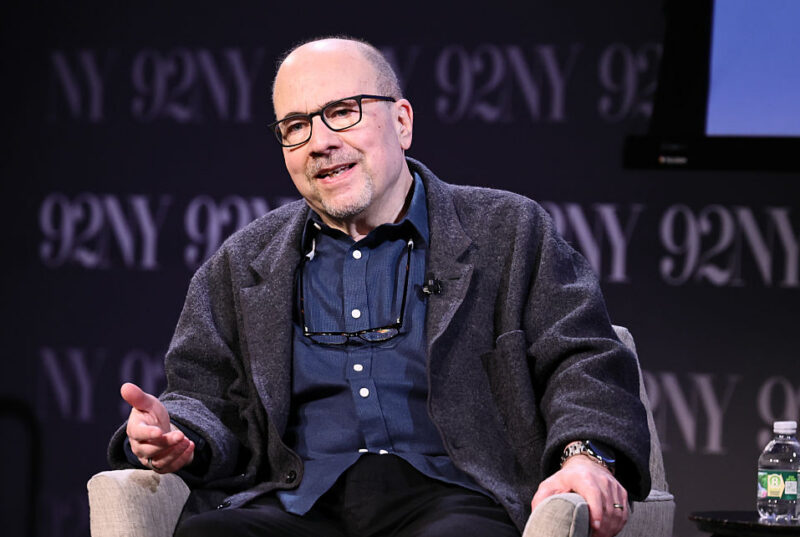
Theo Wargo/Getty Images
Craig Newmark attends "Conversations With Tyler: Tyler Cowen with Special Guest Craig Newmark" at 92NY on April 14, 2026 in New York City.




 Add EJP on Google
Craig Newmark, the founder of Craigslist, has a message for Jewish philanthropists:
“Everyone should help out to the extent they can,” he told eJewishPhilanthropy. “Some people are privileged. We got lucky by birth or business, and after we’re living well and helping our family live well, maybe it’s time to consider giving away the surplus.”
Like fellow New Jersey native Bruce Springsteen, Newmark came from humble beginnings. His father sold meat and insurance, and his mother was a bookkeeper; they met at a synagogue dance. His father died of cancer six months after Newmark’s bar mitzvah.
It was a pair of teachers at the Hebrew school he attended at the Morristown Jewish Center, Raphael and Rachel Levin, both Holocaust survivors, who inspired the values that Newmark says he still lives by today. “On a deep gut level, [thinking of their memory reminds me] that there are times and places where Jews haven’t done very well, where they had to escape from a train on the way to a bad place,” he said.
An approachable philanthropist, who is passionate about supporting military families, fighting cyberattacks and rescuing pigeons, Newmark largely fell into his wealth: Craigslist started out as an email list for friends, became a bare-bones website and took off unexpectedly. He finds people’s interest in him both “surreal” and “funny,” he said, admitting “there’s a lot of stuff I don’t get.”
In 2020, Newmark was estimated to have a net worth of $1.3 billion, but he claims to no longer be a billionaire: he’s given much of his wealth away, recently joining — and advocating for — the Giving Pledge, where billionaires commit to giving half their wealth to charity.
Newmark spoke with eJP about what makes something Jewish philanthropy, admitting when he isn’t an expert on topics, when to give to specifically Jewish organizations and criticism of the Giving Pledge.
The interview has been edited for length and clarity.
Jay Deitcher: Because many of your values were shaped by the Levins at Sunday school, does that make your philanthropy inherently Jewish, and what does that mean to you?
Craig Newmark: They basically set my moral compass, which is how I approach everything. I’m working on stuff I’ve always had difficulty understanding, like brother’s keeper, sister’s keeper. How literally do I take that? I think [these morals are] more broadly Judeo-Christian, because Jesus said something about selling one’s stuff and feeding the poor. What does that mean exactly? I don’t know, but I have a feeling I’m missing something. But I always feel like I’m missing something. I wish that was a joke.
JD: You said in your recent New York Times opinion piece that “Making money isn’t proof to me that I know something any better than someone else.” You were just talking about not fully grasping everything, but you have this power as a philanthropist to make decisions that impact others. How do you weigh that knowledge, knowing that because you have this money, you are making decisions that are impacting people who don’t have the power to make these decisions?
CN: I get a lot of help. Any success I’ve had is [because of] the networks of networks of people. I am on a nearly continuous basis talking to people who are smarter than I am and who are better in a number of areas where I’m lacking. I have to rely on the intuition and emotional intelligence of other people. I make the best decision I can do in good faith, and then question my decisions at a later time.
JD: Who are some of these people who help you?
CN: The best two examples are Blue Star Families for military families, and that’s [CEO] Kathy Roth-Douquet, and for veterans, that’s Anne Marie Dougherty [CEO of the Bob Woodruff Foundation]. When it comes to cybersecurity and fighting scams, I rely on the Aspen Institute in Washington on a near-daily basis.
JD: The Chronicle of Philanthropy said you have a “bare-bones philanthropic infrastructure.” You outsource for accounting, legal and communications, and are one of the philanthropists who is the easiest to access. You replied to my email within minutes. Why take such a hands-on route?
CN: The deal is that I have no employees. I do have people who help me. I don’t have a spin doctor hovering over everything I say; I filter myself. The best part of that is that I now have some idea of where I’m smart and where I’m stupid, and I do my best to avoid the stupid areas.
JD: You’ve given to a number of Jewish initiatives. You’ve given to The Forward, the Anti-Defamation League, your local Chabad and supported a lot of Leonard Cohen-related initiatives. You helped to restore a Torah at the Morristown Jewish Center. Often in the philanthropic world, we talk about balancing focusing on the particular, which is initiatives based around the Jewish people, and the universal, or obligations to the entire world. How do you weigh that in your own philanthropy?
CN: I just do what makes most sense. I have some small bias towards specifically Jewish initiatives. As you noticed with the ADL, they do good work in threat intelligence gathering regarding threats to the Jewish community in the U.S.
I also support other groups that support traditional Jewish values, like I support 92NY. I think it’s Jon Stewart [who] said [it’s] a tie for the second holiest place in Judaism, along with Zabar’s, although I kind of prefer Russ & Daughters. [Editor’s note: Stewart ranked Zabar’s before 92NY in holiness. Russ & Daughters did not make Stewart’s list.]
I support the Jewish Community Relations Council in New York, and the [Secure Community] Network in Chicago. They’re doing good work. I don’t talk about them a lot because anyone doing threat intelligence gathering that protects us is at serious risk, and I don’t want to get them targeted.
JD: The ADL has come under fire a lot the last two years from both sides of the political spectrum, where some on the left are frustrated feeling that the organization conflates criticism of Israel with antisemitism, and some on the right have been upset about the organization’s labeling of Christian nationalism as extremism. Bret Stephens has called for the dismantling of the organization. You’re an interesting person to speak with, because you are on the tech advisory board and probably see what a lot of people don’t see. Why is ADL still an important initiative to support?
CN: Right now, they’re getting a lot of crap from different people. I’m not qualified to address that because being smart about it requires social skills. I try to avoid areas where I’m largely ignorant.
But I can see they do good counter-extremism work. They do it quietly, and I’m very aware whenever you’re dealing with anything involving intelligence gathering or law enforcement… they appreciate it when I keep my mouth shut. Sometimes it is really good when a tech success story guy keeps his mouth shut.
JD: At a time when it’s become increasingly unfashionable to be affiliated with the Giving Pledge, you joined last year. Why was that the time?
CN: I don’t think it’s unfashionable. It’s just that there are people who don’t believe in it, and they’re newsworthy, so what they’re saying got attention. Good philanthropy never goes out of style. We need to be louder about it.
JD: Why was last year the time to join?
CN: Somebody brought up the subject with me, and I started thinking about it more, and I realized that it might do some good for me to speak up, and it might be funny.
JD: Why is it funny?
CN: That kind of thing is something I think is surreal, and I find my doing something surreal kind of entertaining. No one else may, but sometimes it’s enough to just amuse yourself.
JD: What do billionaires and millionaires owe society?
CN: I think they only owe what their value systems and religious background suggest that they do. All I really understand is the whole Judeo-Christian thing, which says, “You do well for yourself and your family, and then maybe you help out where you can.” So I’m not judging anyone, but I will remind people that the Bible is relatively clear on this subject.
Related News

PRESIDENTIAL REBUKE
Israel’s Herzog: Mamdani ‘makes no effort’ to hide disdain for Israel, Jews must fight back

EXCLUSIVE
Detroit-based philanthropists Nancy, James Grosfeld donate $8M to renovate JDC’s Israel campus
CLOSING WORDS
In AZM address, Cosgrove links communal ‘orthodoxy’ on Israel to rising anti-Zionism among young Jews

MAGICAL EXPERIENCE
Shefa launches psychedelics retreat for Jewish professionals suffering burnout

MAJOR GIFTS
Center for Jewish History celebrates 25 years with a $25M matching grant