Opinion
STRATEGIC INFRASTRUCTURE
Presence without power changes nothing




 Add EJP on Google
In Short
There is a crucial difference between access and influence: Access gets you into the room. Influence shapes what happens when you are not there.
American public support for Israel is dwindling to historic lows, yet our community is looking to the same old strategies to respond to this crisis.
The numbers are troubling. According to a Pew survey released this month, 60% of Americans now hold an unfavorable view of Israel. A year ago, that number was 53%. Among adults under 50, the survey found unfavorable views of Israel are at 70%; and among Democrats under 50, they’ve reached 84%. Even within the Jewish community, favorable views of Israel dropped sharply.
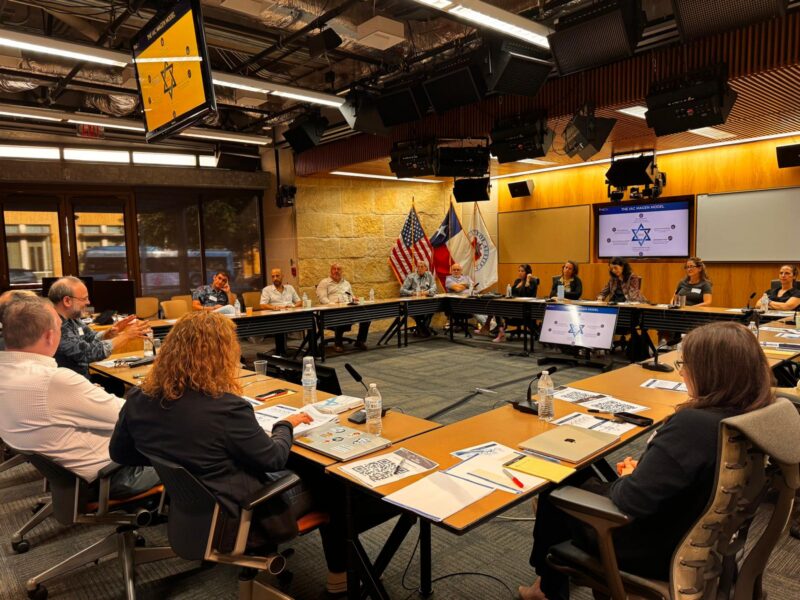
Courtesy/Israeli-American Council
A civic engagement meeting held by the Israeli-American Council in Austin in April 2026.
The instinct in moments like this is to look for a messaging fix. Better hasbara. More outreach. Stronger relationships. More meetings with the right people.
But our problem is not a lack of access. It is that access and influence are not the same thing.
What influence actually requires
For decades, Jewish leaders and institutions have had meaningful access to centers of power: universities, government offices, corporate boardrooms, civic spaces. But access alone does not shape outcomes. It does not determine which frameworks take hold, which values become normalized or which concerns are taken seriously before a crisis erupts.
Influence is something deeper. It is built when a community is not merely visible to institutions but embedded within them, present where agendas are formed early and quietly: school boards, city commissions, advisory councils, local political networks and the civic structures that shape public life long before issues become national headlines.
That kind of influence is rarely dramatic. It does not produce a headline or a viral clip. It is cumulative. It comes from steady civic presence, leadership development and the patient work of showing up before there is an emergency.
After Oct. 7, 2023, the Jewish community mobilized in meaningful ways. People showed up, marched, donated and demanded action. That mattered. But mobilization is not the same as infrastructure. A community that activates only after the moment arrives will almost always be reacting to decisions others have already spent years shaping.
They built systems; we built campaigns
The erosion in public opinion is not a messaging problem. It is the visible result of a structural imbalance built over decades.
For over two decades, while Jewish philanthropists funded university buildings and endowments, others funded something more consequential: professors, department chairs, curricula and student organizations trained to carry a coordinated ideology forward. Research has documented billions in foreign funding flowing into American universities, much of it unreported, with a direct correlation to rising antisemitic incidents on campus. And the system has not stayed on campus: according to JLens research recently cited by Ari Hoffnung of the Anti-Defamation League, there are now more than 75 active BDS campaigns targeting S&P 500 companies. From the lecture hall to the boardroom, the infrastructure is the same. Only the venue has changed.
Our adversaries understood that influence requires coordinated effort across institutions, geographies and years. They built systems; we responded with campaigns. That asymmetry is not incidental. It is the result of a strategic choice: theirs to build, ours to react.
Why the cycle is hard to break
Part of this is structural. Campaigns are easier to fund. A rally, a video, a solidarity event — these produce visible, immediate proof of impact that works in a grant report or a donor appeal. Civic infrastructure takes years to show results and resists clean metrics. Organizations respond to incentives, and right now the incentives favor the visible over the durable. That is not a criticism of any single organization. It is a problem the entire funding ecosystem shares.
The coordination problem runs just as deep. When I spoke recently with lay leaders and Jewish organizations executives from coast to coast, I searched for something simple: a short list of shared civic priorities the Jewish community could present as one voice to every candidate running for office.
Adoption of the IHRA definition of antisemitism. Bubble-zone protections around houses of worship. Anti-BDS contracting rules. Clear enforcement when protests become harassment.
But with the exception of some organizational or city coalition position papers, no such document exists. More than two years after Oct. 7, with a midterm election approaching, the broad Jewish community still cannot agree on a minimum set of civic demands.
What needs to change
Meetings matter. Relationships matter. Access matters — it opens doors. But doors are not the same as leverage, and visibility is not the same as power. What matters now is not gaining entry to more rooms. It is building the local leadership, civic fluency and durable structures that shape what happens inside them.
That requires a different kind of investment: in civic training, local leadership pipelines and coordinated long-term strategy that treats influence as infrastructure rather than an event. It requires funders willing to measure success over years, not grant cycles. And it requires organizations willing to share accountability for outcomes, not just credit for activity.
Because presence without power changes nothing.
Aya Shechter is the chief programming officer of the Israeli-American Council.