Opinion
SURVEY SAYS
The fire outside is real. So is the burnout within.




 Add EJP on Google
In Short
At a time of democratic strain and social fracture, we are exhausting the very leaders and institutions still capable of building trust.
In the last few months, both of us stood beside our sons as they became b’nai mitzvah. Like many parents, we felt joy, pride and gratitude; but we also heard something in their bar mitzvah speeches that felt larger than our personal family celebrations.
Liberation is never a solo act. In the biblical story of the Exodus, for instance, Moses matters enormously — but alone, he is not enough. He needs Aaron. He needs Miriam. He needs a people willing to move together through fear toward responsibility. The Exodus story does not glorify the lone hero. It insists on shared leadership.
Rabbi Benjamin Ross
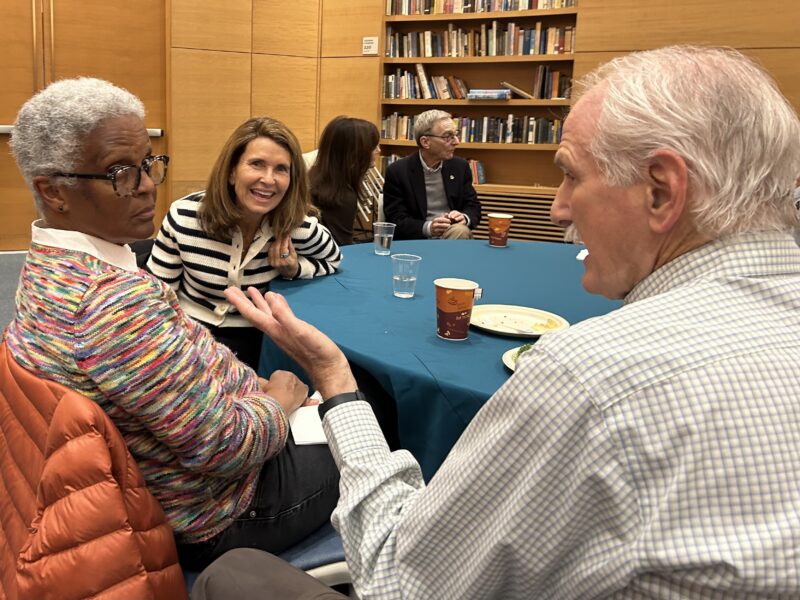
Photo from an Amen Center event in Los Angeles in January 2026.
That ancient lesson speaks directly to this political moment.
America is living through a crisis of trust. Public trust in government remains near historic lows, and trust in one another has also weakened. At the same time, loneliness and social isolation have become so widespread that the U.S. Surgeon General has called them an epidemic. Democratic norms are under visible strain, while fear and polarization increasingly shape how Americans relate to institutions, neighbors and even reality itself.
In a moment like this, congregations matter.
Not because they are perfect. Not because everyone belongs to one.
They matter because they remain among the few places in American life where people still practice the habits a democracy depends on: showing up, arguing without disappearing, grieving together, taking responsibility for others and learning that freedom requires obligation.
But here is the problem: We are asking congregations to be anchors in a storm while allowing the people who lead them to burn out.
That is not only a religious problem. It is a civic one.
In December 2025, the Amen Center for Civic & Spiritual Leadership and the Institute for Jewish Spirituality conducted a pulse survey of rabbis and cantors. Within days, 450 rabbis and 276 cantors responded. The speed and scale of that response said something before we even read the comments: a nerve had been touched.
The message was not that clergy have lost faith in their work. Quite the opposite. Again and again, respondents told us their work remains deeply meaningful. But meaning is not enough to make leadership durable.
Nearly 1 in 4 respondents rated their well-being in the lowest range. Nearly 1 in 5 rabbis said they had no consistent sustaining practices at all. Many reported strong relationships with lay leaders but far weaker systems for leadership development, shared responsibility and durable support. Roughly 70% of cantors reported spending less than 20% of their time on music-specific work, a striking sign of how outdated many assumptions about clergy roles have become.
The point is larger than clergy wellness. It’s about the health and wellness of our congregations, which are microcosms of our communities.
Jewish communities face an added burden. At a time of elevated antisemitism, many congregations are carrying not only spiritual weight but security fears, threatening our safety and undermining the hope of finding a true sanctuary of peace.
When leaders are depleted, institutions become brittle. Creativity narrows. Conflict intensifies. Fewer people step forward. More quietly wonder whether they can stay. Communities lose some of the last local places where trust, belonging and moral courage are still being formed.
We suspect this problem reaches beyond the Jewish world. In conversations with Christian, Muslim and other faith leaders, we are hearing many of the same concerns: burnout, isolation, overdependence on clergy and underbuilt leadership systems. We do not yet have parallel cross-faith data at the same scale, so we should be careful, but all signs suggest that what is happening to rabbis and cantors is part of a wider crisis in American religious leadership and American religious communities.
That should concern even people who never enter a synagogue, church or mosque.
In periods of democratic erosion, the fantasy of the strongman grows more seductive. People start longing for someone else to fix it, carry it or save them. Healthy congregations teach the opposite lesson. They teach that no one gets free alone. They teach that responsibility can be shared, leadership can be cultivated and communal well-being is a team sport.
What should we do?
First, stop treating burnout as a private failure. It is not mainly a matter of clergy needing better self-care. It is a design failure in the systems around them.
Second, build real, repeatable support: peer cohorts, coaching, spiritual direction, Sabbath-protecting norms and rhythms of work that actual human beings can sustain.
Third, invest far more seriously in volunteer leadership. Not token volunteerism. Real shared leadership: clearer roles, better training, stronger lay-clergy partnership and systems that identify, develop and rotate leaders so communities are not built around chronic overdependence on a few exhausted people.
This is not mushy work. It is democratic infrastructure.
If we keep starving the leaders and institutions still teaching Americans how to carry one another, we should not be surprised when loneliness deepens, trust erodes further and public life grows even harsher.
If we want communities capable of resisting fear and rebuilding trust, we must stop treating the sustainability of our leaders as optional. The fire outside is real. So is the burnout within.
Rabbi Josh Feigelson is the president and CEO of the Institute for Jewish Spirituality.
Rabbi Benjamin Ross is the founder and executive director of the Amen Center for Civic and Spiritual Leadership, and serves on the board of the Institute for Jewish Spirituality.