Opinion
COMMUNITY TIES
The opposite of helplessness




 Add EJP on Google
In Short
I realize it sounds naive to claim that it wasn’t bulletproof glass or security planning that saved the day at Temple Israel last month, but rather the bonds between people. Yet all of it matters.
I am a congregant at Temple Israel, the synagogue in West Bloomfield, Mich., targeted in a terror attack last month. I was not at Temple Israel on March 12, and the story of what happened there that day is not mine to tell. Those stories are still being pieced together, understood by the people who lived them only in fragments at a time, even in their own hearts and minds. Telling the story together as one community is a thing we will do one day; that’s the Jewish way. We may not have accounts from every person who crossed the Red Sea or traversed the desert over the course of 40 years; we only know they did it as one, as a people, and here we are today, remembering their journey.
But I do want to tell a story, one story, of the days that have followed. It is about the opposite of helplessness.
Erika Bocknek
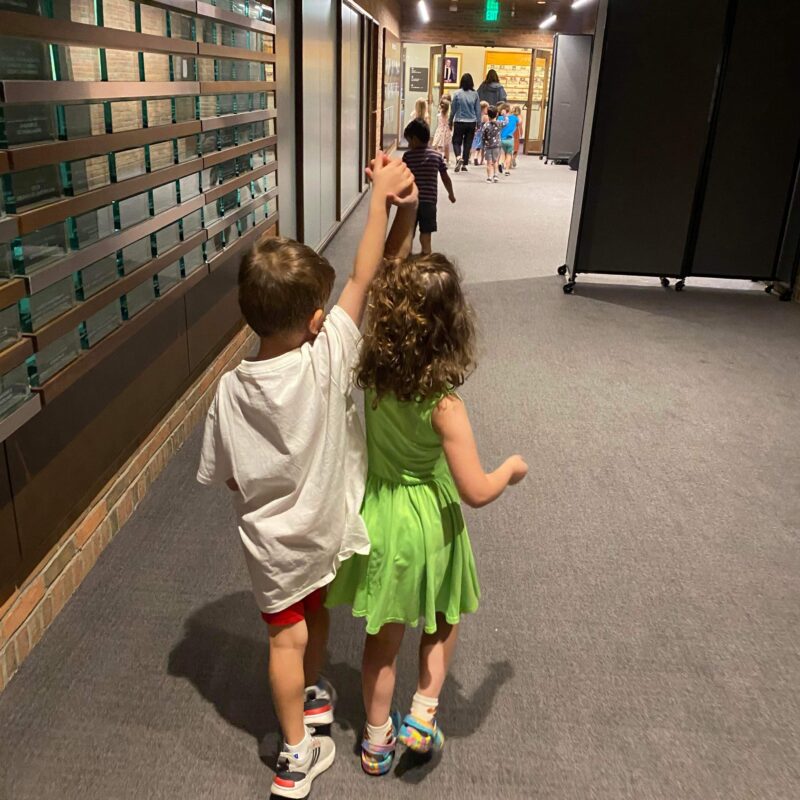
Students in the early childhood center program at Temple Israel in West Bloomfield, Mich., follow their teachers from chapel to classroom in an undated photo.
Terrorism, at its core, is about power. Whether it’s a mass shooting, a targeted attack or violence against a single person, the intention is the same: to dominate, to control, to instill fear. However much we analyze or contextualize, at its most basic level, it is an attempt to exert power over others. The natural consequence of that kind of violence is a profound sense of helplessness.
In the days since March 12, I’ve watched how people everywhere respond to that feeling. For some, there is a pull toward reclaiming power: toward strength, certainty, control. This is understandable. I’ve spent years working with people recovering from trauma, and the desire to refuse disempowerment is deeply human. But what has become especially clear to me is this: power is not the opposite of helplessness. Sometimes, it is just another way of organizing ourselves around vulnerability. We suit up in armor as a reaction, not a resolution.
Over the last few weeks, I’ve listened to many, many stories from the people who were inside or just outside of Temple Israel on March 12. Staff, teachers, first responders, and parents whose children are slowly sharing their own details.
While the news cycle is captivated by the violence, by the narratives of power and powerlessness in these events, I am captivated by co-teachers who move through the world more like family than coworkers, and who see their students as their children. By parents who already trusted their children’s teachers, now reckoning with the reality of just how far that care extends. By the wider staff whose relationships, forged through countless small exchanges of mutual care, reveal how deeply a community can be held long before it is tested. The kind of love that is almost hard to believe, except that it is the only thing that makes sense of what happened. When people here speak about their fears and their grief, they also speak simultaneously about their love for and deep devotion to one another, the work they do and the children, families and congregation they serve. Before the attack, they cared for each other and the synagogue building itself in ways that were sometimes invisible, but their devotion was witnessed during and since the worst crisis they could imagine. When they tell me their stories, every single one is threaded with moments of care, connection, and trust. They often reject the word “hero,” not because it’s not true, but because they, most of all, know themselves first and foremost as simply human.
I’ve watched and listened as these deep bonds have only grown. People are sleepless, and they are bereft. They call each other. They gather, and they talk and they cry. They share a meal. The parents plan play dates, and the teachers bring their books, their musical instruments, their joy. They make dark jokes here and there, and they let the even darker thoughts and words they’ve held onto tumble out, while someone sitting nearby simply nods and says, Me too, or You are ok. They tell stories about the before times, too, and they remember who they have always been.
Birds don’t just build nests of sticks, though that’s what is most visible to the world. Sticks are what you think of when you picture a nest. Birds feather those nests, too. Feathers are made up of strands that are individually fragile but interlock in a way that makes a single feather incredibly strong. A feathered nest is more than comfortable; it is the basis for the kind of safety that is sustainable, adaptable to that which can’t be predicted.
I hesitated to tell any story about March 12 because my sacred work is to listen. I am moved to tell this story, though, because of how struck I am that the people most directly impacted by our community crisis are also mostly the people who have always been holding our community together. We speak of miracles that managed to keep the very worst possible tragedies from occurring, but we do not really illuminate the human bonds that were woven together to make that so before war even arrived at our door. Those people, their bonds, are the miracle of which we speak. This is why connection and community is actually the opposite of helplessness.
A terrorist, I’m sorry to say, can bust through walls, even those we build and rebuild. We may not have weak knees, but we are also human beings who are not meant to be invincible. We can, and we must, build nests with sticks like steel. But what we must also continue to do, with even more of ourselves than ever before, is to build relationships; to shine a light and celebrate the strength of a people bound to one another; and to know that where we find safety, and even power, once more, is necessarily going to be in everyday small acts of care and connection, like tiny, almost invisible feathers, that are collected over time.
I realize it sounds naive to claim that it wasn’t bulletproof glass or security planning that saved the day, but rather the bonds between people. Yet all of it matters. It would be equally naive to believe that resilience can be built from physical barriers alone.
We are still in the desert, still making meaning, still finding our way. And what I am seeing, again and again, is that no one needs to do it alone.
Erika Bocknek is a licensed marriage and family therapist.