FIRE AND ICE
Minnesota Jewish community warns of ‘volatile situation’ as ICE raids, protests rock the state
Businesses shut, nonprofits find themselves short-staffed as people stay at home out of fear, local Jewish leaders say
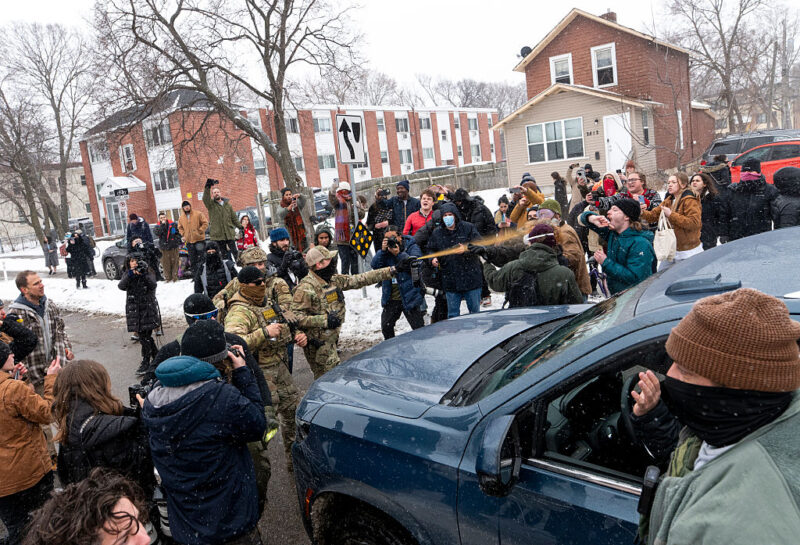
Stephen Maturen/Getty Images
A Border Patrol officer pepper sprays protesters after getting into a car crash in Minneapolis on Jan. 21, 2026.




 Add EJP on Google
While for much of the American Jewish community, the often-violent immigration raids in Minnesota and protests against them have played out on televisions and cellphone screens in recent weeks, the Immigration and Customs Enforcement operations in the state have had a direct, major impact on the lives of many in the local Jewish community, James Cohen, CEO of the Minneapolis Jewish Federation, told eJewishPhilanthropy.
Beginning last month, the Department of Homeland Security has sent thousands of federal agents to the state — particularly to the Twin Cities — as part of a crackdown dubbed “Operation Metro Surge,” in what the department called “the largest immigration enforcement operation ever carried out.” The widespread raids, some of which have targeted American citizens, have featured violent tactics, including the use of tear gas. On Jan. 7, an ICE officer shot and killed Renee Good, 37, in what federal officials have called an act of self-defense, but which critics consider to be an unwarranted use of deadly force. Protesters have increasingly held demonstrations against the operations, including — controversially — at a St. Paul church over the weekend.
Earlier this week, Cohen organized a local joint statement, signed by more than two dozen Jewish organizations and synagogues of all denominations, raising deep concerns about the “current volatile situation” throughout the Twin Cities and Minnesota.
“There are too many stories of lives upended by what the government itself refers to as the ICE surge,” according to the statement. “There are members of the Jewish community who are immigrants themselves, have family members who are immigrants, or could be reasonably perceived to be immigrants. Many of these people are scared to leave their homes out of fear of being arrested and deported.”
The turmoil in Minnesota is expected to escalate on Friday as Minneapolis labor unions, community leaders and faith groups are organizing an “ICE Out of Minnesota” protest in the state, with demonstrations planned and local businesses set to close.
Minneapolis “feels otherworldly” because of the raids, David Locketz, rabbi at Minnesota’s Reform Bet Shalom Congregation and co-chair of the Minnesota Rabbinical Association, told eJP. Many businesses have been shuttered for over a week because employees are frightened. At stores and restaurants that are open, customers sometimes need permission to enter, as owners don’t trust people filtering in and out freely, he said.
Cohen added that Jewish organizations, including synagogue preschools, Jewish family and children’s services and the local Jewish nursing home, are increasingly finding themselves short-staffed as employees are staying home. “There are many seniors who are without their health care provider because [their carer is] afraid to come to work.” As the situation escalates, “the risks to everybody in Minnesota just grow substantially,” he said.
To support those who are unwilling to leave their homes, Locketz has been delivering food to residents. But even that is a tumultuous experience, as people delivering food have been targeted by ICE as well, he said, and people receiving the food are often worried that they will be confronted by ICE agents when opening the door to take food.
Though some Jewish groups have announced plans to participate in Friday’s protests, others are wary of the event in light of the possibility of violence.
“I’m not really encouraging people to go [to the protest Friday], which I’m sure is not the general response you’re hearing from clergy,” Locketz said. “I just don’t know what to expect, and I fear that it’s not going to be as peaceful as everybody hopes it is going to be.”
Instead, he and other faith leaders are organizing alternative events to cultivate community, especially since schools aren’t expected to be in session due to the boycott and protest. They will also collect supplies to support those who won’t leave their homes.
It’s important that the Jewish community sees their leaders making joint statements and standing for Jewish values, Cohen said. “After all that we’ve gone through, particularly here in Minnesota with [the COVID-19 pandemic], George Floyd, and then for us, Gaza, Ukraine, you name it, a sense of unity, or as close as we can get to it, is a good salve for us ourselves.”
Cohen noted that in the wake of the Oct. 7 attacks, many of the Jewish community’s allies did not come to its aid. This, he said, made it more — not less — important for the Jewish community to speak out on the immigration issue today.
“Many of the people who are out in the streets demonstrating were not there for us when we needed it, and there are people in our community whose hearts have hardened as a result of that,” he said. “But I do think it’s important for all of our neighbors in Minnesota to see that, in spite of the fact that many of the Jewish community’s allies were not there in our moment of need, we’re still going to speak up on behalf of what’s decent.”
Some in the Minnesota Jewish community did not agree with the statement organized by the federation, Cohen said. “There have been a couple of comments made criticizing the statement, many from the left that felt it was mealy-mouthed and insufficient,” he said. “A little bit from the right saying that if Minnesota had behaved differently, we wouldn’t need the ICE surge. But the vast majority have been supportive.”
Rabbis and representatives from the Reform, Conservative and other Jewish communities are making the trek to Friday’s protests. Rabbi Marcia Zimmerman, senior rabbi at Minnesota Reform congregation Temple Israel and co-chair of the Minnesota Rabbinical association, said she is moved by those who are traveling far to attend the protests, but eventually, the visitors will leave, and Minnesotans are “going to be here again, driving our car to a hospital or driving our car to school, or driving our car to home, and we’re going to come upon ICE still, because ICE isn’t going away.”
Merrill Zack, HIAS’ vice president of community engagement, who will be at the protest on Friday, told eJP that individual members of the Minnesota Jewish community have been actively involved in the protests and activism throughout, which she said is a sign that American Jewry’s support for immigrants has never waned.
When HIAS calls, people stand up to help, she said, and when HIAS doesn’t call, Jews call the organization offering to help. Currently, Jewish community members are acting as “walking school buses,” ferrying children to school to support parents afraid to leave the house. Jews are forming mutual aid societies and creating rapid response networks. Rabbis are holding detention vigils, demonstrating, raising money and running food kitchens, she said.
Max Davis, rabbi at the Modern Orthodox Darchei Noam Congregation in St. Louis Park, Minn., a Minneapolis suburb, said that he will also be at Friday’s protest. Last Shabbat, congregants at his congregation watched as the apartment complex next door was raided by ICE. The agents are perpetuating crimes “against people of all backgrounds, including United States citizens, people who are legally in this country,” he said. “We have people in our community who are fearful of going out, who are carrying their passports on them, who are driving scared children from impacted communities to school past agents carrying visible weapons.”
He signed a “Letter from Minnesota Jewish Clergy Regarding ICE Presence” that was organized by the Minnesota Rabbinical Association, and his congregation is listed on the Jewish federation-organized letter as well. “We have diversity of opinion about the politics of everything within my community, within my shul, so I appreciate that, and I respect that,” he said. “But it’s also a time of significant alarm and concern for basic human rights, and there has to be something said, and something needs to change.”
Related News

MAJOR GIFTS
Center for Jewish History celebrates 25 years with a $25M matching grant
EXIT INTERVIEW
Elizabeth Sokolsky, longtime EVP of Birthright Israel, to retire next year

EXCLUSIVE
Detroit-based philanthropists Nancy, James Grosfeld donate $8M to renovate JDC’s Israel campus
CLOSING WORDS
In AZM address, Cosgrove links communal ‘orthodoxy’ on Israel to rising anti-Zionism among young Jews
ADVANCING A VISION
N.Y. federation donates $1M toward building shared-society center named for peace activist killed on 10/7