DISPOSABLE INCOME
Former professor brings chemistry ‘renaissance’ to Brandeis with $18M endowment
Professor emeritus Peter Jordan says gift honors his father, Hans, who fled the Nazis and created one of the first reliable garbage disposals
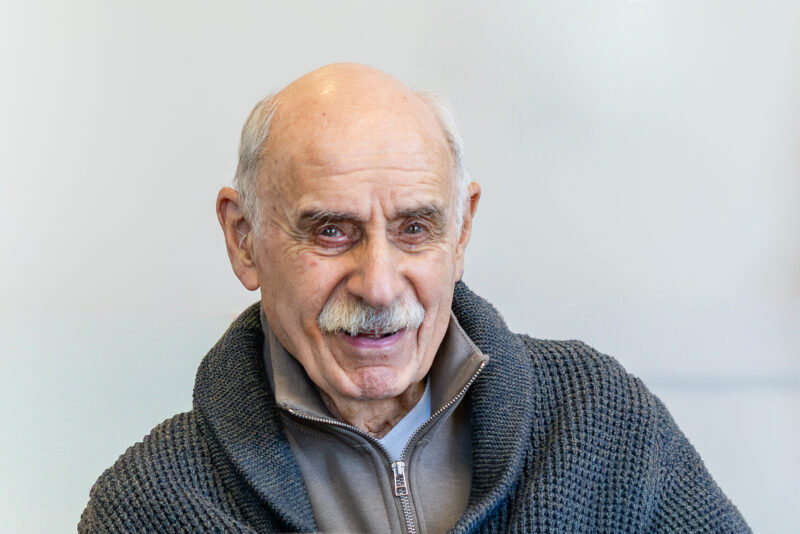
Gaelen Morse/Brandeis University
Brandeis University professor emeritus Peter Jordan attends a luncheon in his honor at the Boston-area university on Jan. 15, 2025.




 Add EJP on Google
When Arthur Levine studied science at Brandeis University during the late 1960s, professor Peter Jordan was a legend.
“He was the chemistry department,” Levine, now the school’s president, told eJewishPhilanthropy.
A half-century later, Jordan continues to pave the way for a dazzling future for the department. On Friday, Jordan, who retired in 2011 as professor emeritus, and his wife, Barbara Palmer, announced an $18 million endowment to support research in theoretical and physical chemistry at the school. The donation honors Jordan’s father, Hans Jordan, who fled the Nazis and designed one of the first reliable garbage disposals.
“I’ve been a college president for 20 years and have never had a faculty member give a gift of this dimension with this power to change the university,” Levine said.
The story of the donation traces back to Germany, where Jordan was born in the early 1930s before fleeing when the Nazis seized power. In 1940, Jordan and his parents, Trudy and Hans, settled in their new home of California. In the old world, Hans worked as a civil engineer who helped design Berlin’s subway system, but once in America, he struggled to find work.
Already in his 40s, Hans “had three strikes against him,” his son told Brandeis’s alumni magazine. He was seen by prospective employers as old, Jewish and foreign, but he eventually secured work as an engineer in the defense industry. But within his first decade in the U.S., Hans designed and patented an improved version of a truly American appliance. And he did it during his downtime.
First invented in 1927, the garbage disposal hit the American market in 1940 and went through an evolution in the mid-century, with Hans playing a part in it, pushing the product forward by creating one of the first reliable garbage disposals. Today, while nearly non-existent in European homes, garbage disposals demolish food scraps in over 50% of American houses, according to a 2020 Consumer Report survey.
“My becoming a professor was somewhat of a full circle moment for my father,” Jordan said. After earning his undergraduate degree at the California Institute of Technology and his doctorate at Yale University, Jordan joined Brandeis in 1964. During his nearly 50 years at the school, his research centered on theoretical biophysical chemistry, he served for a time as department chair for chemistry, and he authored over 100 scientific papers and a textbook.
The $18 million endowment was funded partially by his father’s initial financial success, but also thanks to lucrative investments Jordan made in the stock market.
On Friday, the day the endowment was announced, Brandeis held a luncheon to honor Jordan with guests including Levine, the university’s provost, Carol Fierke, and four current and past chairs of the chemistry department.
“Here’s a man who spent his entire career at Brandeis, he is this distinguished professor, and he asked himself, given the money that he had, how could he make the largest difference?” Levine said.
Jordan’s wife, Barbara, also dedicated much of her life to the school, which was originally founded and funded by Jews in the late 1940s and is named after Louis Brandeis, the first Jewish justice of the U.S. Supreme Court, who served as associate dean, university registrar and head of institutional research. Since 2018, the couple has also endowed the Jordan-Dreyer Endowed Summer Undergraduate Research in Chemistry Fellowship Fund.
“I got to teach and do research in a subject that I was fascinated by,” Jordan said. “It was a privilege to make my career at Brandeis, and Barbara and I are delighted to pay it forward by providing for the future of the Chemistry Department.”
The $18 million endowment will create nearly $1 million in funding annually for the school indefinitely. “That’s enough for several chairs,” Levine said. “That’s enough for endowed professorships, and that’s enough for fellowships and scholarships. You can make a real difference with that amount of money.”
The donation allows the school to hire two new positions — a senior professorship in theoretical chemistry and a junior professorship in physical chemistry — and to create three new graduate research fellowships in the Chemistry Department, as well as provide additional funding for research.
“What this gift did is create a renaissance,” Levine said. “It’ll bring more faculty to the department. Brandeis can use these new chairs to recruit the world’s ablest and most promising chemists. We can also use it to attract the best chemistry students in the world.”
Related News
ADVANCING A VISION
N.Y. federation donates $1M toward building shared-society center named for peace activist killed on 10/7
HIGHER EDUCATION
As Jewish donors reconsider academia, Jan Koum doubles down, endowing Israel studies at Stanford

MAJOR GIFTS
Center for Jewish History celebrates 25 years with a $25M matching grant

EXIT INTERVIEW
Elizabeth Sokolsky, longtime EVP of Birthright Israel, to retire next year

EXCLUSIVE
Detroit-based philanthropists Nancy, James Grosfeld donate $8M to renovate JDC’s Israel campus