Opinion
HER LEGACY
On Marion Wiesel’s first yahrzeit, follow her example with a mitzvah




 Add EJP on Google
A yahrzeit, the annual Jewish commemoration of someone’s death by remembering their life, is a way to honor those who have passed. Observing the yahrzeit of late Holocaust survivors particularly ensures that their memory lives on and that their legacy continues to improve the world through the actions of the living; it also drives us to remember the lives of victims whose names and dates of death we don’t know or who have no families left to mourn them.
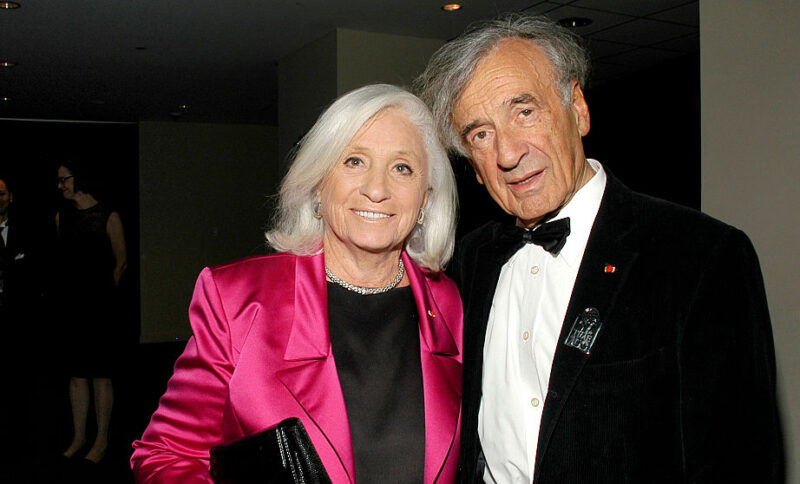
Today marks the first yahrzeit of Marion Wiesel, one of the world’s most prominent Holocaust survivors and a tireless advocate for Holocaust memory. Her story is not as well-known as that of her husband, Elie Wiesel. However, as he noted, one cannot tell his story without hers.
Patrick McMullan via Getty Images
Marion Wiesel and Elie Wiesel in 2007 in New York City.
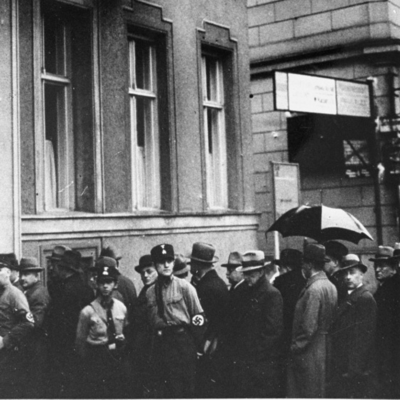
Marion Rose Wiesel was born Mary Renate Erster in Vienna in 1931. She and her family were forced to flee when the Nazis annexed Austria in 1938, seeking refuge first in Belgium, then in France, where they were interned in the Gurs concentration camp. After escaping the camp, they smuggled themselves into Switzerland and lived there until 1949.
She then emigrated to the United States and pursued a career of leadership and advocacy, the impact of which endures to this day.
If you’ve read Elie Wiesel’s most famous books — Night, The Trial of God, All Rivers Run to the Sea — you’ve benefitted from Marion’s work. She translated 18 of her husband’s books, plays and other writings, which he preferred to pen in French or Yiddish, into English, making them accessible for a global audience.
Elie thanked her often, writing in the foreword to Night that she “knows my voice and how to transmit it better than anyone else.” His praise for her was a regular feature of his public appearances, and he never let his audience remain ignorant of how important Marion was to his career and the prominent position he achieved: “[A]ny book that is written in French translated into English,” he told one audience, “the English, you should know, I owe to Marion.”
When he was preparing to address the nation and the world at President Bill Clinton’s 1993 inauguration, he did not prepare alone. “We worked all night on that speech, Marion and I,” he recounted in another address.
His famous exhortation to President Ronald Reagan against appearing at Bitburg Cemetery in 1985 was also driven by his wife; the Wiesels’ editor, Ileene Smith, wrote that “there would not have been a Bitburg speech without Marion’s conviction.”
But Marion’s work was by no means limited to supporting her husband’s writing. After he won the Nobel Peace Prize in 1986, the couple used the prize money to co-found the Elie Wiesel Foundation for Humanity, where Marion served as vice president and the organization’s driving force. She and Elie both became founding chairs of the United States Holocaust Memorial Museum, which opened in 1993.
Marion also co-founded and oversaw the Beit Tzipora Centers in Israel, named for her husband’s sister who was murdered in the Holocaust. Beit Tzipora Centers were established to help educate and support Ethiopian Jews as they integrate into Israeli society, and they continue to serve more than one thousand children every year.
Thankfully, Elie wasn’t the only one who publicly recognized Marion’s incredible life. When she turned 90 in 2021, celebrities, politicians and philanthropists including George Clooney, Oprah Winfrey, Bill and Hillary Clinton, Ted Koppel, Benjamin Netanyahu and Ronald Lauder all honored her at a virtual celebration organized by the Elie Wiesel Foundation for Humanity and the Women’s International Zionist Organization.
“The Marion Wiesel we celebrate today inspires us with her seemingly bottomless heart and her endless energy in giving voice to the voiceless,” said Clooney.
One of her greatest achievements came at a deeply personal level. When they met, Elie was opposed to having children. He had seen so much death and lived through so much antisemitism; he did not want to bring more Jews into a world he saw as deeply hostile. He said as much to the Lubavitcher Rebbe, Menachem Mendel Schneerson, who had encouraged him to marry and have children in defiance of the Nazis’ genocidal goals.
Marion ultimately changed his mind. The couple went on to have a son Elisha, who currently leads the Elie Wiesel Foundation, and Elie became close with Marion’s daughter Jennifer Rose, whom she had with her first husband.
Restoring faith in humanity for someone like Elie Wiesel was no small feat, but Marion accomplished it through love. “I changed his mind,” she told a biographer. “I told him he would be happy.”
And they were.
As we remember Marion Wiesel and her legacy, we remember that while there is an Elie Wiesel story and a Marion Wiesel story, it was their partnership that ultimately touched millions around the world.
It is traditional to honor someone’s yahrzeit by performing mitzvot, good deeds, in their name. I can think of no more appropriate way to honor Marion Wiesel, whose life was defined by them. May her memory be for a blessing.
Mike Igel is the chair of the Florida Holocaust Museum’s Wiesel Archive and Legacy Council, which stewards the world’s largest collection of artifacts of Elie and Marion Wiesel.