Opinion
THE MORE WE TEACH
Teaching about Iranian Jews today




 Add EJP on Google
Whenever I talk to teachers in public schools or non-Jewish independent schools about Iran and Jews, most assume the conversation will invariably go in the direction of Iranian-Israeli relations. They expect my shpiel will be about geopolitics; they tend to be taken aback when I instead direct the conversation towards the 2,700 years of Jewish life in Iran.
The historical and ongoing presence of Jews in Iran is a shock to many public school history teachers. Talented, learned and well-intentioned educators often do not know what they do not know. So many are themselves the product of an education that ignores much of humanity and the vastness of human experience; it’s understandable that they would lack knowledge of Iran’s demographic diversity and the longevity of Jewish history in Iran.
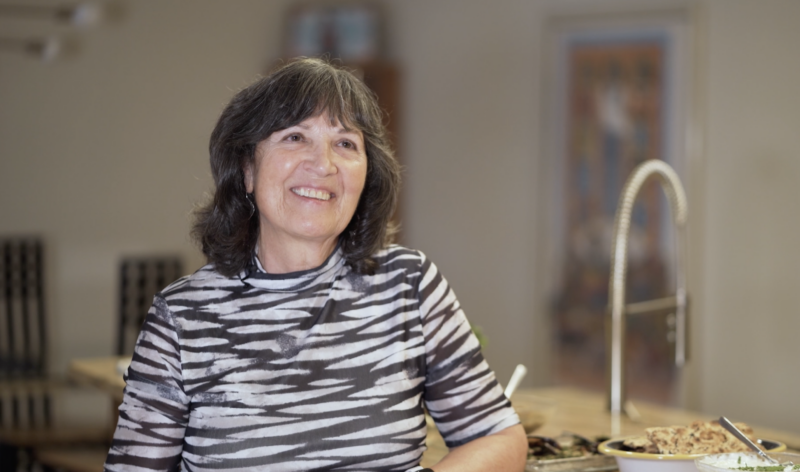
Emily Graham-Handley/Lightning Bulb Productions
Farideh Goldin reflects on her journey from Shiraz, Iran, to the United States during an interview with Dan Osborn of Project Mosaics.
Going forward, education does not need to perpetuate the same erasures as in the past. Today, as Iranians are on the streets risking their lives to demonstrate against the Islamic Republic, many educators are playing catch up as they nobly endeavor to provide their students with information about the country, its government and the people who live there.
Students are living in an interconnected world, yet so much of the world still remains opaque in classrooms. Too many places on the map and people populating the planet are only understood superficially. Who exactly is an Iranian? Where exactly do Jews live around the world? Is there such a thing as an “Iranian Jew”? To academics of Jewish or Iranian or Middle Eastern studies, these questions may seem elementary. Yet, in high schools around the country, these questions may never be posed, let alone answered — but they are germane and they deserve attention.
In 2022, I began interviewing Iranian Jewish memoirists and scholars of Iranian Jewish history. I began this project as a committed history educator and nonprofit professional who recognizes that silences need not persist forever in classrooms. I did this out of an unwavering belief that the Middle East is too often underrepresented in schools. I also did this out of an equally strident knowledge that Jewish people and Jewish history are too narrowly taught.
I’ve been inspired by the work of countless multicultural educators from so many communities who have made schools more inclusive and turned the histories of African American, Asian American, Indigenous, LGBTQIA+ and more communities into fixtures in classrooms. I’ve watched and applauded the efforts of so many theorists, researchers and teachers who created and implemented frameworks to ensure their communities are represented consistently, accurately, and with depth and nuance.
So I was surprised when I was met with skepticism early on in this project. Studying Iranian Jews seemed so niche, I was told. This history was rather obscure, I was assured.
Yet, as I follow the events unfolding in Iran, I remain determined to bring the voices of Iranian Jews into classrooms. The stories of all Iranians deserve to be heard in American schools. Students deserve an education that builds bridges to the wider world and invites them to encounter the worldviews of people who are too often and so easily dismissed as “the other.” I am not telling every story that could be woven into history curricula, but I’m playing a role I’m best suited for.
Across the United States, students often only learn about the Jews when studying the Holocaust. Learning about the Holocaust is vitally important, but it is also an incomplete exposure to Jewish history. Today, when there is so much contention about who Jews are, studying Jews from Iran — and elsewhere around the world, for that matter — is fundamental to helping students of all backgrounds appreciate the geographic, linguistic, ethnic and cultural diversity of Jewish people.
In the past few years, I’ve had the honor of sitting in the homes of soulful and honest memoirists like Roya Hakakian and Farideh Goldin, whose passion and wisdom has taught me about the variety of experiences Jewish women had in 20th century Iran. By listening to Esther Amini, I’ve learned about the Mashhadi community’s crypto-Jewish history, the challenges to integrating into New York Jewish society upon immigration to the U.S. and the ways Iranian culture was safeguarded and cherished by Mashhadi Jews. Jasmine Lawi taught me about “Tehrangeles” and the cultural hybridity of being Iranian, Jewish and American in southern California.
Scholars have also opened my eyes to the seismic transformations Jews have witnessed over the past 2,700 years in Iran. Houman Sarshar challenged me to see Iranian Jewish history as more complex than simply another account of “Jews in Muslim lands.” Lior Sternfeld revealed to me the ways Jews invested in their Iranian identity in the 20th century. Mikhal Dekel even linked Iran to my understanding of the Holocaust, by telling the story of the Polish Jewish refugees known as the Tehran Children.
The more I’ve listened and the more I’ve learned about the Jews of Iran, the more convinced I am that all students need to encounter the voices of these memoirists and scholars, as well as countless other voices who also merit recognition in classrooms. Their personal and impassioned accounts of Jews in Iran have the potential to move us all beyond simplistic framings and reductive accounts of Iran and of Jews.
As Iran undergoes this current wave of popular unrest, American classrooms are the very spaces best designed for making sense of this dynamic situation. Students who know very little about Iran need to listen to Iranians. Encountering the perspectives of Iranian Jews can be but one very powerful catalyst in raising questions, provoking inquiry and cultivating meaningful and timely learning.
And as American Jews wrestle with questions of Jewish representations in history curriculum, the case study of Jews in Iran is one example of all the ways Jews can be represented beyond the familiar formulas.
Students deserve to appreciate how diverse Jews are and how global Jewish history truly is. This approach to teaching Jewish history has never felt less niche or obscure.
Dan Osborn is the executive director of Project Mosaics, a 501(c)(3) education nonprofit whose mission is to expand the representation of Jewish people, history and culture in public and independent schools so all students may encounter the diversity and vibrancy of Jewish identities and experiences around the world.