Jewish Federations, M² launch Aleh Summit to help early-career Jewish professionals evade burnout




 Add EJP on Google
For many young Jews, an entry-level position at a local Jewish federation is the first step towards a career in the Jewish world. But in the wake of the Oct. 7 terror attacks and the ensuing rise of global antisemitism, the trek to becoming a Jewish professional — never an easy career path — has become increasingly fraught, and for many it may be too emotionally draining.
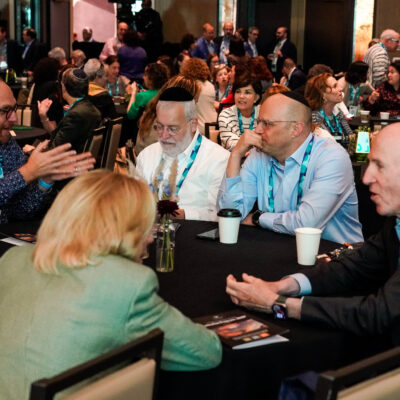
That’s why Jewish Federations of North America teamed with M²: The Institute for Experiential Jewish Education for the Aleh Summit — Aleh meaning uplift in Hebrew — which was held from July 21-23 at the Eaglewood Resort in Chicago, supporting 80 employees with two to five years of professional experience from 34 Jewish federations. Topics included navigating tense conversations around antisemitism and Israel, and remembering what motivated you to get into the field.
The two-to-five-year mark “is the sweet spot” for when to target employees for career advancement, Jessica Balboni, associate vice president of the Mandel Center for Leadership Excellence at JFNA, told eJewishPhilanthropy. “This generational cohort is yearning for personal growth, professional growth, for mentorship, for peer connection.”
That cohort is also the demographic most overlooked, “particularly for the federation system,” Mollie Andron, vice president of programs at M², told eJP. “A lot of these people are dealing with, what does it mean to be a Jewish professional? Questions around fundraising, around authenticity, around connection and communication, testing out the waters to see if they could really turn this into a career path, not just a job that they got after school.”
Since the pandemic began in 2020, there has been crisis after crisis in the Jewish world. “The people holding up the Jewish world are running on fumes,” a recent eJP opinion piece by Barry Finestone, president and CEO of the Jim Joseph Foundation, argued.
While it’s empowering to be needed, the demand on employees has skyrocketed, Judah Gavant, program coordinator at the Norton & Elaine Sarnoff Center for Jewish Genetics, who attended the summit, told eJP. “When we’re so busy just doing the work that needs to get done, we don’t often take the time to actually connect with the resources that could really elevate our work.”
Conferences like this allow employees to brainstorm ideas with peers so work doesn’t feel “stale,” he said.
The work for early-career federation employees is hard, and the pay is low, Andron said. “A lot of [these employees] have ambitions to stay within the federation system, so the question is, ‘How do you best equip them to be able to do that?’”
The answer to the question, according to organizers: by building attendees’ connection, humility, authenticity and resilience, four words repeated throughout the conference. “Connection is directly linked to isolation and the feeling of loneliness,” Andron said. “Humility is in direct relation to Israel and the idea of knowing everything… Authenticity is directly linked to social media and what it means to have authentic relationships and be real. And resilience is [caring for your] well-being and is directly linked to how do we stay in it when we’re having a really hard time.”
Gen Z has broken down the stigma around many taboo topics, including mental health, and often young employees believe that being authentic means “show[ing] you my cards at all times,” Andron said, “and sometimes it’s like, ‘Well, I don’t know that you should.’”
Therefore, sessions were focused on learning how to make intentional choices about how much of yourself and your views to reveal. A major area that the summit addressed was how to hold conversations with people with whom you disagree. “How do you take a sturdier value of conviction with a more supple, softening value of humility and live both,” Balboni said.
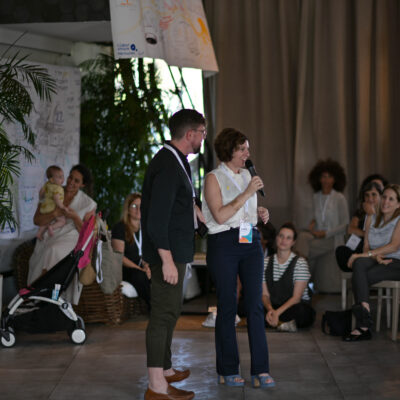
In breakout groups, participants practiced active listening skills, focusing on body language and asking questions to create connections with others who may trigger them, recognizing that if everyone is right, then no one can learn and grow, Andron said.
The event also featured a Tuesday night Borscht Belt soiree, including knishes, hula hooping, a photobooth equipped with goofy props and a performance by “Larry David as a magician,” Andron said.
Feedback from the conference showed that participants appreciated sessions where participants were organized together by their roles — fundraisers with fundraisers, programmers with programmers, etc., Andron said. “People are really craving affinity spaces to the point of, ‘Oh, you get me. You exactly get me.’”
Politics also seeped its way into participants’ feedback of the conference, with some wishing there was more talk about Israel and others feeling that the conference leaned too progressive, possibly due to language around gender, Andron said.
Because M² is used to running five-day programs for educators, organizers may have squeezed too much into the three-day program, Andron said. “People wanted more water cooler time.” In future partnerships with the federation, which both organizations agree will happen, they are planning for how to incorporate more networking, but do it in a structured way.
The conference was supported by Maimonides Fund, the Jim Joseph Foundation, Jack, Joseph and Morton Mandel Supporting Foundation, Charles and Lynn Schusterman Family Philanthropies and the Paul E. Singer Foundation.
For Gavant, the conference was his “first opportunity to network with early professionals in the federation space,” he said. He’s excited by everything he learned from his peers, including how some throw “headshot happy hours” that gather people together for an event, where federation employees can then disperse information, such as about screening for genetic disorders.
Related News
Israel’s Herzog: Mamdani ‘makes no effort’ to hide disdain for Israel, Jews must fight back
ADVANCING A VISION
N.Y. federation donates $1M toward building shared-society center named for peace activist killed on 10/7

MAGICAL EXPERIENCE
Shefa launches psychedelics retreat for Jewish professionals suffering burnout

EXIT INTERVIEW
Elizabeth Sokolsky, longtime EVP of Birthright Israel, to retire next year

MAJOR GIFTS
Center for Jewish History celebrates 25 years with a $25M matching grant