REHABILITATION NATION
Israel’s first school of prosthetics opens amid rising number of war-related disabilities
ADI Negev-Nahalat Eran program is part of a broader effort of developing critically needed rehabilitative care expertise, which can also be exported to boost Israel's standing internationally
COURTESY/ADI
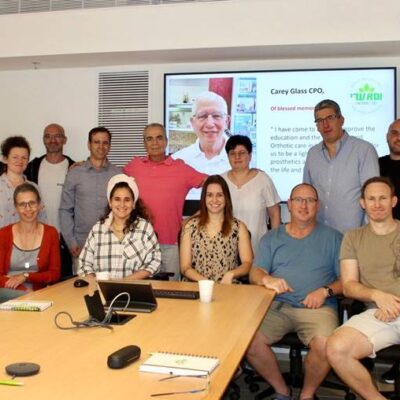
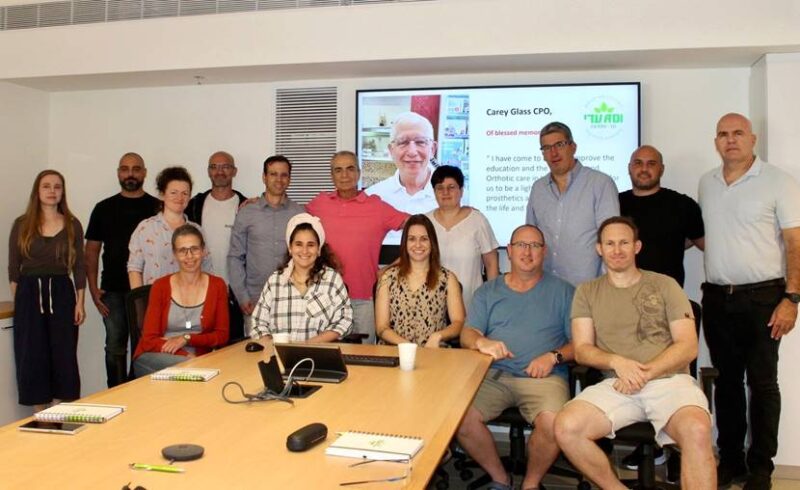
The first cohort of students of the ADI Negev-Nahalat Eran School for Prosthetics and Orthotics meet on the southern Israeli campus, in an undated photograph.




 Add EJP on Google
Since its founding, Israel has spread its technologies and know-how in the fields of computer science, cybersecurity, desalination and agriculture all over the world. All of those advancements emerged from critical domestic needs, but eventually allowed the country to export that hard-won expertise.
Today, the so-called “startup nation” is grappling with rising numbers of soldiers and civilians wounded in the Oct. 7 terror attacks and ensuing wars against Hamas, Hezbollah and Iran. And as Israel’s medical tech sector looks to provide those newly disabled people with the treatments and tools that they need, some also see the potential for the country to become an international hub for rehabilitation technology.
Over the past two years, the number of people in Israel requiring prostheses has jumped more than 10%, from 18,000 before the attacks to more than 20,000 today. In light of both the growing need and the scientific advancements, this month, the ADI Negev-Nahalat Eran Rehabilitation Village opened Israel’s first School of Prosthetics and Orthotics — part of a deliberate push to transform Israel into what leaders are calling “Rehabilitation Nation” in response to the increased needs for rehabilitation of soldiers and civilians impacted by the Oct. 7 attacks and the past two years of war.
“The growing number of people who require prostheses across the country, coupled with the advancement in science over the last few decades, including the use of top-tier materials and computerized technology, has led to an incredibly high demand for truly knowledgeable professionals,” said Dr. Itzhak Siev-Ner, director of the Kaylie Rehabilitation Medical Center at ADI Negev-Nahalat Eran, the first and only fully dedicated rehabilitation hospital in southern Israel. “We are thrilled to be leading this charge and ensuring that Israel finally has the experts and resources required to meet this need.”
The ADI Negev prosthetics school is part of a larger, deliberate push to transform Israel into what leaders are calling “Rehabilitation Nation” — a systematic effort to build infrastructure, expertise and innovation capacity to meet an overwhelming crisis, explained Gidi Grinstein, the founder and president of Tikkun Olam Makers (TOM), which creates open-source plans for objects that assist people with disabilities, including prostheses and a 3D-printable child-sized wheelchair.
“Despite the great need, Israel has never had any formal educational programming for certified prosthetists and orthotists,” Siev-Ner told eJewishPhilanthropy. “But this school changes all of that.”
The ADI Negev program, developed in partnership with Ben-Gurion University and funded by Israel’s Health Ministry, Jewish Federations of North America and Jewish National Fund-USA, offers advanced academic training recognized by the International Society for Prosthetics and Orthotics. The first cohort consists of 12 students with bachelor’s degrees in physical and occupational therapy. They split their time between theoretical studies at Ben-Gurion University and practical instruction at ADI’s prosthetics center.
Within a year, ADI plans to open the first prosthetics and orthotics production center in southern Israel, creating homegrown resources and employment opportunities for the Negev population. “We are changing the face of Israel’s rehabilitative landscape,” said Yael Dotan-Marom, the program’s academic director.
The school’s opening was shadowed by loss. Carey Glass, the program’s clinical advisor, died just one week before the launch. Glass, a New Jersey native and member of the Highland Park Jewish community, was a legendary CPO with 47 years of experience. He served as director of clinical services for AlliedOP Inc., a network of 15 prosthetics and orthotics centers in New Jersey and Pennsylvania, and held patents for prosthetic and orthotic innovations.
Two years ago, during a tour of ADI, Glass and Siev-Ner discussed bringing international state-of-the-art practices to Israel. Glass committed on the spot to becoming a clinical advisor, instructor and practitioner for a training program that didn’t yet exist. He came to Israel in the summer of 2025, planning to stay a year to guide the first cohort of students. He fell ill soon after arriving and died in November. “The only gift better than his professional guidance as a CPO was his friendship. This program is part of his esteemed legacy, and we will carry his memory with us always,” said Siev-Ner.
Since the Oct. 7 attacks, some 22,000 Israeli soldiers have been treated by the Defense Ministry Rehabilitation Department, as of this month. Approximately 1,000 new wounded veterans are entering the rehabilitation system each month. The Defense Ministry projects that it will receive another 10,000 wounded veterans by the end of 2026, and by 2028-2030, the total is expected to reach 100,000 disabled veterans, with at least half of them suffering from post-traumatic stress disorder or other mental health conditions in addition to physical problems.
The scale of need has forced Israel to confront a painful reality: The country was woefully unprepared for a rehabilitation crisis of this magnitude. When the war began, Israel had 0.3 rehabilitation beds per 1,000 people, just 60% of the OECD average and far behind countries like Germany (2.0) and Switzerland (0.8). The Defense Ministry rehabilitation department now faces a ratio of one worker per 750 patients.
As a nation with relatively few natural resources, Israel has long considered its population — its so-called human capital — to be its most valuable resource, turning the country into the so-called “startup nation.”
For Grinstein and others building the “Rehabilitation Nation” ecosystem, the goal is not only treating Israel’s wounded but creating exportable systems, as Israel has done in the fields of computer science, cybersecurity and agriculture, he said. The formula in this case combines Israeli innovation, global Jewish distribution networks and Jewish values around caring for the vulnerable, positioning rehabilitation as both a moral imperative and a diplomatic tool, according to Grinstein.
This ecosystem includes players across the commercial and nonprofit spectrum. At the high end, Sheba Medical Center operates what Grinstein calls the “800-pound gorilla of the for-profit venture ecosystem” — a hospital-based VC operation that leverages patient access to identify and fund commercial medical innovations. On the grassroots level is Grinstein’s TOM, and in the middle sits a new venture, Lakoom. “Between us we’re covering the whole ecosystem,” Grinstein said.
Just two weeks before ADI’s school opened, Lakoom was launched as a so-called “venture builder” for rehabilitation initiatives, headed by four venture capital and innovation veterans. Calanit Valfer, managing partner of the Elah Fund VC firm, serves as chair. Ariel Beery, a social entrepreneur and medical investor, and Michal Kabatznik, vice president of business development at SFI Group, are founding board members. Yifat Shorr, who has spent 20 years turning Israeli academic research into marketable products at universities and hospitals, serves as managing director.
For Valfer, whose day job involves investing in “Industry 4.0” and deep tech, the rehabilitation push follows a familiar Israeli pattern. “Great amounts of innovation are going to come out of our experience in the war, just like when we had no water and we became the world’s authority on drip irrigation systems,” Valfer told eJP. “Now, unfortunately, we have a very horrible and tough challenge related to rehabilitation. And there’s every reason to think that great innovation will come out of it.”
Valfer added that the urgency to address these issues is both morality-driven and economically necessary. “’Rehabilitation Nation’ is what we are, whether we like it or not,” she said. “It’s really something that Israel is going to have to deal with for the next hundred years at least, because these are all young people. And so it’s important for us as the moral and ethical duty we have to our soldiers and our veterans. But it also just makes sense financially because if we lose the people who were injured and their families and they’re not in the workforce because they have to be constantly dealing with badly run poor rehabilitation, then we’re going to lose too much of our workforce to make our economy viable.”
Lakoom creates what it calls “living labs” at rehabilitation centers where new products and services — like prosthetics and other technological solutions — can be tested with actual patients. It provides not only funding but the staff and frameworks for bringing a product to market, filling a crucial ecosystem gap between nonprofit innovation and traditional for-profit ventures.
“A lot of what’s going on, because it’s small and local, is not really being communicated and not being developed efficiently,” Valfer said. Lakoom is now organizing roundtables focusing on priority issues, inviting Knesset members, hospital administrators, volunteer organizations and patients’ parents to coordinate efforts. “There’s something in our neutrality that makes us able to invite representatives from five different hospitals that I would argue probably don’t talk to each other that much, but they all were willing to be on the same panel.”
“We don’t really think that these innovations are going to be unicorns like cyber or AI,” Valfer said. “But where their exit is going to be is that they’re going to be able to help a lot of people. And that is something that would be a great headline to come out of Israel, which is that we’ve unfortunately had the need to develop a lot of rehabilitation innovation. But we can also send it to Ukraine and we can send it to U.S. Army vets and we can send it to any place in the world that needs these kinds of technologies.”
To Grinstein, Israel’s situation is unique. “The war created a huge, dramatic need that pushed the entire Israeli health-care and rehabilitation system to the frontier of knowledge around the world. There’s one other country that is semi-modern in dealing with a similar situation, and that is Ukraine. But it doesn’t seem that Ukraine has the capability to extract wisdom out of their condition and then be able to share it, nor does it seem that they have the passion to share it with the world. Because technically there are many more people, it’s been going on for much longer — they should have been much further ahead in this.”
What distinguishes Israel, in Grinstein’s view, is the convergence of innovation capacity, global Jewish infrastructure, and what he calls a distinctly Jewish imperative. “The story of ‘startup nation’ is almost irrelevant to the Jewish community of San Diego,” he said. “There is a need for Israel and the Jewish people to make a contribution to humanity that is distinctly Jewish. Our insight: The core brand of the Jewish people is the way we take care of the poor, the vulnerable, the weak, the widow, the orphan.”
Related News
ADVANCING A VISION
N.Y. federation donates $1M toward building shared-society center named for peace activist killed on 10/7
EXCLUSIVE
Detroit-based philanthropists Nancy, James Grosfeld donate $8M to renovate JDC’s Israel campus
CLOSING WORDS
In AZM address, Cosgrove links communal ‘orthodoxy’ on Israel to rising anti-Zionism among young Jews

PRESIDENTIAL REBUKE
Israel’s Herzog: Mamdani ‘makes no effort’ to hide disdain for Israel, Jews must fight back

MAJOR GIFTS
Center for Jewish History celebrates 25 years with a $25M matching grant