Opinion
RENEW OUR VIEW
Rabbinical training doesn’t have a pipeline problem — we have a preparation problem




 Add EJP on Google
The rabbinate is one of Judaism’s most indelible contributions to human civilization — not only as a religious office, but as a way of thinking. Maimonides shaped Aquinas. Rabbi Hasdai Crescas anticipated key ideas in modern physics. Dona Gracia Mendes Nasi — though never granted the title as a woman — exercised rabbinic-like leadership that altered the political landscape of early modern Europe. Even modern literature carries a distinctly rabbinic logic of paradox and interpretive daring, refracted through writers like Franz Kafka and Jorge Luis Borges.
For two millennia, the rabbinic imagination has shaped the world far beyond the beit midrash. That is why the questions now confronting seminaries, funders and Jewish institutions surfaced by Atra’s recent empirical research on the U.S. rabbinate carry stakes far beyond institutional maintenance. They ask whether our preparatory systems can cultivate the depth and imaginative power the rabbinate has always carried.

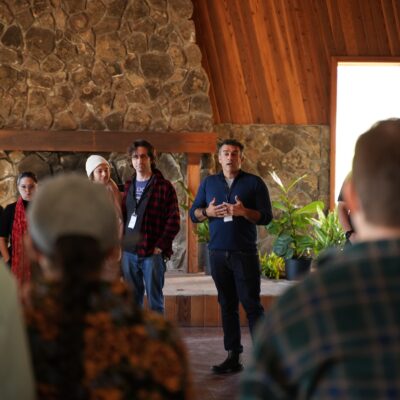
Courtesy/Shalom Hartman Institute
The first cohort of the Shalom Hartman Institute’s Rabbanut North America Students.
A moment that demands more of us
Atra’s “From Calling to Career” shows a far more complex — and more hopeful — picture than the headlines about shrinking pipelines or rabbinic decline. It does confirm what practitioners and stakeholders in rabbinic education have long sensed: that our current training structures and cultural expectations no longer align with the realities of the leaders these institutions seek to cultivate. More than 450 “would-be” rabbis walked away because the deterrents — tuition, relocation, opportunity cost, family disruption — were insurmountable.
But it also challenges some of the loudest anxieties in the field. The most striking data seems to be the least discussed: according to the study, 97% of rabbis — across age, movement and career path — report that their work is deeply rewarding. That statistic alone is astonishing.
In a labor market characterized by unprecedented exhaustion, here is a profession that still manages to offer purpose and relevance at a level almost unheard of in civic life. The crisis is not about the meaning of the work; it is about the structures we have inherited to prepare people for it.
Meanwhile, the profile of those drawn to the rabbinate has shifted: many enter through adult learning or second-career pathways, motivated not only by love of text, but by the desire to navigate moral complexity with intellectual rigor and respect for a plurality of religious sensibilities.
None of this aligns with the training systems designed to meet the needs of an earlier era, a-long acknowledged critique the field has never fully resolved. The Atra study makes that misalignment impossible to ignore. It is not a eulogy but a blueprint, pressing the field to make the structural and philosophical changes the data demands.
What the study actually describes is not a pipeline problem. It is a preparation problem.
If we take the data seriously, the question is no longer: How do we get more people into the old model? The question is: Who do we imagine rabbis to be in this era, and what kinds of preparation does that require?
For rabbinic training to respond deftly, it must be rebuilt around five core commitments: (1) practice-based integration that connects learning to the realities of adult lives and actual leadership work; (2) modular structures that allow students to remain rooted in place and in career; (3) intellectual rigor that preserves the depth of traditional study; (4) the cultivation of moral courage — the willingness to stand in the tension between tradition and the demands of the present with honesty and integrity, and to hold complexity under real pressure; and (5) pluralistic environments where students learn to lead across difference.
Naming these commitments forces us to acknowledge their costs: Practice-based learning means reshaping faculty roles and relinquishing the idea that formation happens primarily in classrooms. Modular structures require institutions to loosen long-standing assumptions about full-time residency and geographic centralization. Genuine pluralism demands more porous boundaries than many legacy institutions prefer. And cultivating moral courage means preparing rabbis to speak from conviction: to bring Torah into public life with clarity and integrity, even when doing so carries risk.
This is part of taking the data seriously. This reckoning clarifies the stakes of what real formation now requires in order to reflect contemporary Jewish life.
Here is the good news: models already exist that respond directly to this reality. I’ve seen this shift up close through my role in redesigning rabbinic formation for working adults. The ordination program I help lead at the Shalom Hartman Institute, Rabbanut North America, has spent the last two years prototyping a different kind of rabbinic formation.
Together with our partners at the Jim Joseph Foundation, we built a model grounded in the commitments this moment demands. The students drawn to it reflect the “untapped well” the Atra study identifies: medical doctors and psychologists; law professors and Ivy League academics; technologists and humanitarian workers. Their presence widens our understanding of rabbinic leadership itself. We’ve learned firsthand how the field’s insistence that “real rabbis” follow a particular institutional trajectory has been more limiting than generative. Our learning makes clear that potential leaders do not reject the rabbinate; they reject a constricted image of it.
The deeper shift is not operational — it’s philosophical
The inherited model of rabbinic formation presumed a stability of life, community and role that no longer consistently exists: full-time relocation for half a decade, early-career entry, denominational continuity, and an almost uniform vision of what a rabbi is. That model hasn’t failed; its operating assumptions simply reached their limits. The new realities — plural, mobile, professionally complex — demand a formation system capable of meeting them with integrity.
What has struck me is not Rabbanut North America’s curriculum or scheduling innovations, but the effect of bringing together genuinely pluralistic cohorts and treating their ideological and developmental differences as part of their formation. Students describe learning to inhabit tension, not resolve it, as one of the most transformative aspects of their development.
In one beit midrash class on halachic decision-making, a student who once described themselves as “completely uninterested” in Jewish law found that working through a concrete case about Shabbat “completely blew my mind.” They weren’t only learning a technical ruling; a single case forced them to ask who gets centered in communal life, what counts as a legitimate precedent, and how far rabbis can stretch inherited norms in the name of dignity. That kind of learning trains rabbis not to erase the tension between values, but to sit inside it and make bold decisions.
And when students reflect on what has mattered most — whether in the beit midrash, leadership labs or ethical formation seminars — they talk about learning to articulate big ideas that meet the moment and about shaping a rabbinic voice that can hold competing truths without tipping into relativism or rigidity.
These are not “soft” skills. They are the core competencies of the next generation: moral courage, thought leadership, rigorous commitment to the rabbinic interpretive project, epistemic humility, ideological pluralism and an understanding of rabbinic authority as a public responsibility rather than a personal credential.
At the level of vocation, the calling is intact; structurally, the reckoning is real
The study’s implications require us to articulate a contemporary theory of rabbinic formation, not merely adjust the mechanics of training. This change will not be accomplished by tinkering with recruitment, fieldwork or scholarships alone. It requires vision and a philosophical culture that treats the student as a moral and spiritual agent, not a bundle of competencies. Rabbinic preparation isn’t a checklist; it’s the slow, iterative work of learning to think in Torah, learning to speak with authority that isn’t arrogance, and learning to hold ethical complexity.
We can keep focusing on the pipeline — counting heads, tracking shortages, predicting decline — or we can focus on formation with a renewed picture of the rabbinic role itself: capacious enough to reflect contemporary Jewish life, and rigorous enough to sustain the weight that Jewish communities still place on their leaders.
What might the rabbinate have become if our models of formation had been expansive enough to include the leadership of a Dona Gracia Mendes Nasi or the searching intellect of a Spinoza — figures our tradition shaped but did not permit to lead? How much moral imagination and intellectual daring have we forfeited by training rabbis in narrower molds than the people who might have carried the title?
The task before us is to ensure we do not repeat that mistake. If the rabbinate is to serve the next century with integrity, we will need models of formation that are as expansive, imaginative and courageous as the rabbinic imagination has always been.
Rabbi Jesse Paikin is the director of Rabbanut North America at the Shalom Hartman Institute of North America.