BARUCH DAYAN EMET
Martin Rosen, lawyer, philanthropist and founding trustee of Simon Wiesenthal Center, dies at 100
His daughter remembers him as deeply patriotic and devoted to his fellow Jews; colleagues recall him springing to action after the outbreak of the Yom Kippur War to raise money for Israel
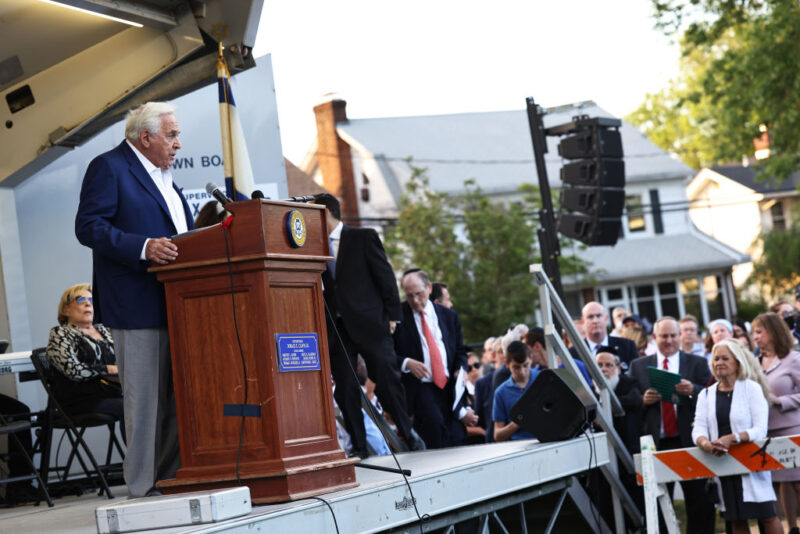
Michael M. Santiago/Getty Images
Martin Rosen speaks during a rally denouncing antisemitic violence in Cedarhurst, N.Y., on May 27, 2021.




 Add EJP on Google
Like many Jewish meet-cutes during the 1950s, the relationship between Martin Rosen, his future wife, Joan, and the UJA-Federation of New York began in the Borscht Belt.
Rosen was on the baseball field, playing with friends at a “young leaders” weekend in the Catskill Mountains organized by one of the groups that would later merge into New York City’s United Jewish Appeal. Joan was watching from the sidelines, wearing what her daughter described as a pair of short shorts.
“She was not watching the game,” the Rosens’ daughter, Ilene Cohen, told eJewishPhilanthropy on Monday. “She just went to look for the good-looking Jewish guys.”
Later that night, he offered to buy her a drink. “Only if you buy one for my friends too,” she replied. It was a classy move that made him fall even harder.
This shidduch between the three — Martin, Joan and the UJA — lasted for over seven decades, until Rosen died on Saturday at 100. In the years following that young leaders’ trip, he held numerous leadership roles in UJA, raising over a billion dollars for the organization, according to Stu Tauber, the Jewish federation’s vice president. In addition to his role as a layleader, Rosen is remembered as an attorney, a World War II veteran, a former mayor of the Village of Lawrence, N.Y., founding trustee of the Simon Wiesenthal Center and one of the renowned Nazi hunter’s most trusted confidants, who helped push West Germany to abolish the statute of limitations for Nazi war crimes.
Born on September 3, 1925, in the Bronx, N.Y., Rosen served in the U.S. Army as a combat engineer during World War II. “Only in America could I have the freedom to be such a good Jew,” Cohen remembered him saying. Before joining the army, he injured his shoulder, and his mother wrote a letter to the draft board, using the injury to keep him out of active combat, but on the way to the board, Rosen shredded the paper. “It was the only time in his entire life he lied to his mom,” Cohen said.
Rosen graduated from The City College of New York and New York University School of Law, founding the firm Rosen & Reade and later becoming a trusts and estates partner at Dentons, where he remained a partner until he was 95, celebrating his 100th birthday with former colleagues in September.
In 1965, Rosen would start another relationship that would last until death. That year, a client introduced him to the Austrian Holocaust survivor and Nazi hunter Simon Wiesenthal. At the time, Wiesenthal was struggling financially.
“Simon Wiesenthal was one of the few people who never left the Shoah,” Rabbi Abraham Cooper, the SWC associate dean and global social action director, told eJP. “Many of the people who went on to support and underwrite the major Holocaust institutions globally, including here in the United States in the 60s and 70s, some of those same people, including Jewish leaders, told Mr. Wiesenthal, ‘It’s time to forgive and forget and move on.’”
But Rosen wouldn’t have it, quickly becoming “Wiesenthal’s personal confidant, supporter, protector,” Cooper said. Rosen offered pro-bono legal services to Wiesenthal, helping prosecute Nazi war criminals. He was one of the few people who could tell Wiesenthal when he felt he was making a mistake and recommend how to handle a situation differently. “He loved Simon, and Simon loved him,” Cooper said.
In 1977, when Rabbi Marvin Hier wanted to use Wiesenthal’s name on a center in Los Angeles, Wiesenthal sought Rosen’s counsel, and it was Rosen’s approval that led to the center’s creation. Rosen returned to Germany in 1977, for the first time since he served in the army, alongside a delegation of SWC representatives. There, he successfully advocated to abolish the statute of limitations in West Germany for Nazi war crimes, making it so Nazis could forever be held accountable for their actions.
Today, the center is known for Holocaust remembrance, Israel advocacy, education and the Museum of Tolerance. Rosen served on the board from 1978 until 2023, deep into his 90s, and was awarded a “medal of valor” two months ago at the center’s 2025 New York Humanitarian Award Dinner. Rosen wasn’t able to attend the ceremony, so instead his granddaughter, Samantha Stern, accepted his award in his honor. She, too, is deeply involved with the organization.
As recently as 2020, when others were sheltered during the pandemic, Rosen spoke out at rallies against antisemitism. He also continued mentoring young advocates at the center. “Literally, up until last week, he was actively working,” Randy Newman, director of UJA’s South Shore campaign, told eJP. “He was attending events with us.” At 97, Rosen self-published a memoir, God Bless America: I Had a Great Run.
For much of his time with the UJA, he led their campaign in the Five Towns. “Marty was the first call we would make whenever it required a few thoughtful, sincere and conscientious people who were able to see beyond their personal needs and who were able to say, ‘I have to think through what’s best for a larger Jewish community,” Tauber said.
Rosen always picked up the phone when needed, and others listened when he asked for help, too. “When the Yom Kippur War broke out, literally within hours, Marty was pulling together the largest donors in our community to say, ‘If we’re not going to step up today, when are we going to step up?’” Tauber said. “The same thing when we went through the 1982 war in Lebanon… He understood when it required real leaders to step up and wrap their arms around our community, wrap their arms around the state of Israel, and create a bear-like hug for us. And if you knew Marty as an individual, you realize that when he gave you a bear-like hug, it was a real hug of loving kindness.”
Rosen is survived by his wife, Joan. Together, they had three daughters, one of whom died in 2023. He also leaves behind eight grandchildren and nine great-grandchildren, many of whom continue to support the causes he cared for. Every year, Cohen and her husband chair the UJA South Shore Inaugural, raising funds for the nonprofit her father loved. “L’dor v’dor, from generation to generation,” she said.
Related News
ADVANCING A VISION
N.Y. federation donates $1M toward building shared-society center named for peace activist killed on 10/7
CLOSING WORDS
In AZM address, Cosgrove links communal ‘orthodoxy’ on Israel to rising anti-Zionism among young Jews

MAGICAL EXPERIENCE
Shefa launches psychedelics retreat for Jewish professionals suffering burnout

MAJOR GIFTS
Center for Jewish History celebrates 25 years with a $25M matching grant

EXCLUSIVE
Detroit-based philanthropists Nancy, James Grosfeld donate $8M to renovate JDC’s Israel campus