Opinion
READERS RESPOND
From the treetops to the ground: What educators are carrying now




 Add EJP on Google
In Short
Leaders help us see patterns across sectors and institutions. Educators show us how those patterns are lived, translated and carried in practice.
Every “state of the field” report depends on where the observer is standing.
The recent eJewishPhilanthropy collection, “The state of Jewish education: Insights from leaders across the field” (June 4), stands in a valuable place. Its contributors — leaders in various sectors of Jewish education — offer a wide-angle view of a field that is energetic, adaptive and also under strain. They name the forces shaping Jewish education now: rising antisemitism, urgent questions post-Oct. 7 about Israel and Israel education, the emergence of AI, financial pressures, staff shortages, mental health concerns and the continuing search for belonging and meaning.

Teacher pinning posters and drawings on notice board at school.
Theirs is an important view. Leaders are often best positioned to see the whole forest: the investments, vulnerabilities and opportunities that define the field’s future.
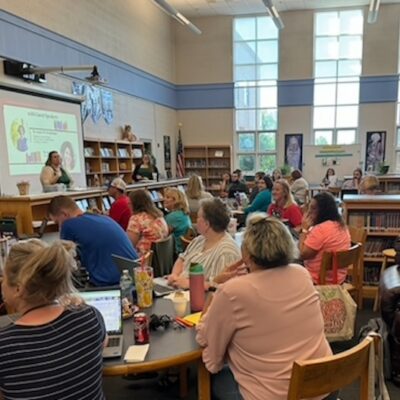
But there is another view we need as well. What does the same landscape look like from the ground? What do these field-level challenges manifest when they are carried by educators in classrooms, camps, campuses, early childhood centers, congregations, JCCs, Federations and other communal settings?
That question is at the heart of GELS: The Growing Educators and Leaders Study, a longitudinal study of more than 600 Jewish educators across North America, conducted by Rosov Consulting with support from the Jim Joseph Foundation. GELS follows educators over time, learning about their work experiences, professional growth, career trajectories, challenges and supports.
A word about timing is important. The most recent GELS findings are still being analyzed and prepared for public release. We recognize the limitations of commenting on evidence readers cannot yet examine in full. We do so cautiously, not to claim finality, but because the field conversation is happening now. Our purpose is to offer a provisional lens that can enrich that conversation while a fuller account is still in development.
What the ground-level view reveals
What we learned from educators surveyed between March and May 2026 does not rebut the leaders’ report. In many respects, it confirms it. Educators across sectors are reporting that October 7 and its aftermath continue to affect their work in substantial ways. Many describe increased emotional load, greater vigilance, concern for their own and others’ wellbeing, and new responsibilities for responding to learners’ questions and fears.
AI is another new frontier. Many educators are turning to AI to help them prepare for lessons and streamlining administrative tasks. Yet its growing presence is also creating new challenges: they are grappling with questions about ethics, accuracy, and data privacy, addressing new issues related to academic integrity and appropriate use, and adapting to changes in how students approach assignments and learning.
In other words, the issues named by leaders are not abstract. They are showing up in the everyday practice of education.
The difference is one of camera angle. From a leadership vantage point, the current moment often appears as a set of strategic challenges and opportunities: strengthen Israel education, deepen belonging, respond to antisemitism, build educator capacity, use technology wisely. From the ground, those same challenges appear first as added professional weight.
Educators are being asked to hold more: more emotion, more complexity, more uncertainty, more conflict and more responsibility for helping others make meaning. In some settings, this means supporting students who are anxious, angry or confused. In others, it means navigating staff dynamics, family concerns, polarization, misinformation, security anxieties or communal grief. Across sectors, educators are not only teaching content. They are facilitating, interpreting, containing, reassuring, and improvising.
Yet substantial numbers report limited professional development in precisely the areas now reshaping their work. 75% of educators reported that in 2025 they received little to no professional development on antisemitism, 55% said the same about Israel, and 81% reported a similar lack of training on AI.
This is not a story of educator deficit. Quite the opposite. The educators in GELS are not passive recipients of field change. They are interpreting events, adjusting practice, seeking resources, supporting learners and helping Jewish life continue under demanding conditions.
But resourcefulness should not be confused with sufficiency. A field that depends on educators’ judgment, care and adaptability must invest in the conditions that make those qualities sustainable.
Three implications follow.
First, professional development needs to catch up to the actual work educators are doing. That means not only more content, but support for facilitation, emotional containment, disagreement, technology and the blurred boundaries between education and care.
Second, educator wellbeing should be treated not just as scaffolding but as field infrastructure. If educators are expected to help learners and communities navigate fear, pride, grief, belonging and complexity, then their own capacity and sustainability are not peripheral concerns.
Third, the field needs both treetop and ground-level knowledge. Leaders help us see patterns across sectors and institutions. Educators show us how those patterns are lived, translated and carried in practice.
The eJP leaders’ collection rightly describes a field facing extraordinary demands and possibilities. GELS invites us to ask a companion question: What are educators being asked to carry now, and what support would match the weight of that work?
The leaders’ view is not wrong. It is elevated. Bringing the camera to ground level can help us see not only what Jewish education needs, but what educators need in order to keep making Jewish education possible.
Alex Pomson is the principal and managing director at Rosov Consulting.
Allison Magagnosc is a senior project lead at Rosov Consulting.