Opinion
NEXT-GEN LEADERSHIP
Jewish students are choosing pride. It’s time to invest in them.




 Add EJP on Google
In Short
If we care about the future of Jewish life, that means more than offering words of support to Jewish students across the globe.
There is one moment I cannot stop thinking about.
It was Friday night in Las Vegas. Shabbat dinner had ended, and Jewish students from across the world — Australia, Brazil, the United States, European countries and Israel — were sitting together in a circle. Different accents, politics, communities and stories.
Courtesy/World Union of Jewish Students
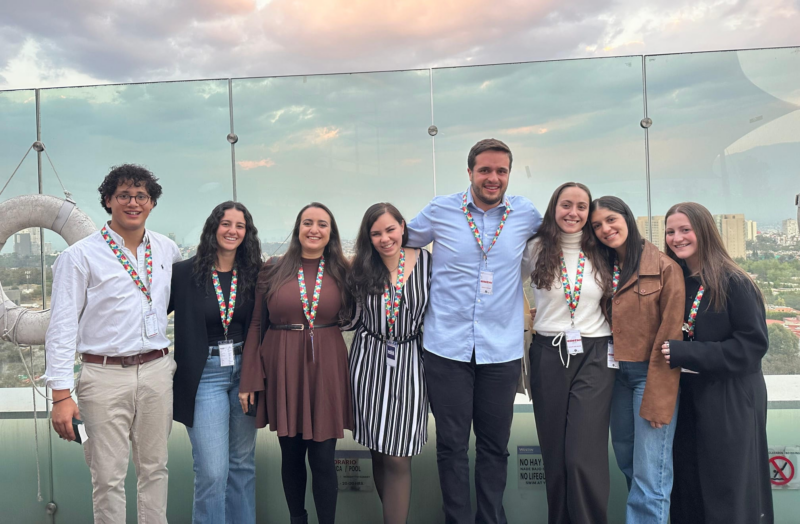
Members of the World Union of Jewish Students Board and members of the Federación Mexicana de Jóvenes Judio Board at a Shabbaton in Mexico City in 2026.
Then somebody started singing.
Within seconds, everyone joined in. Different voices, the same words. Sitting there, thousands of kilometres from home, I was reminded of something I have felt again and again this year: Jewish students are living through very different realities, but they are asking many of the same questions.
What does it mean to be openly Jewish right now? How do we remain proud when pride increasingly comes with a cost? And who is helping young Jews build the confidence, community and leadership they need before moments of crisis arrive?
As vice president of the World Union of Jewish Students, I have spent the year meeting my peers and hearing their stories. While the countries and languages differed, many of the conversations have felt remarkably similar.
I have spoken to students in London who hesitate before wearing a Magen David necklace in public. I have met students in Paris who still feel anxious walking onto campus. I have sat with Australian students who enter tutorials already preparing themselves to defend not simply their views, but their identity.
What struck me most was not the fear, but the refusal to disappear.
In Mexico, I saw the confidence with which students embraced their Jewish identity. Their Jewishness was not something hidden or apologised for. It was joyful, visible and deeply communal. You could feel what serious investment in belonging makes possible.
In Spain, complete strangers invited me into their homes simply because I was Jewish, allowing me to share Shabbat meals with families I had never met before. After the events of Oct. 7, 2023, those experiences carried an even deeper meaning. They reminded me that Jewish peoplehood is not an abstract concept discussed in speeches or in strategy documents, but it is truly real and it is personal. It is the feeling of arriving in a foreign city and knowing somebody will leave a seat open at their table for you, even though they have never met you.
Those moments stayed with me because they existed alongside a very different reality.
Across campuses around the world, Jewish students are confronting many of the same challenges. The same slogans appear in different countries, the same narratives spread online across continents within hours and conversations that once felt local increasingly feel global.
Students describe constantly calculating risk. Should they wear a Jewish symbol today? Is it worth speaking up in this discussion? Questions which should never have been considered normal have become part of daily life for many Jewish students.
A 2025 survey conducted by the World Union of Jewish Students and the Anti-Defamation League found that 78% of Jewish students reported hiding or concealing some aspect of their Jewish identity. Nearly four out of every five Jewish students surveyed felt pressure to make themselves smaller.
Regardless of politics, religion or background, that should concern anyone who believes universities should be places of inclusion and intellectual freedom. Yet if there is one lesson I have taken from travelling across the Jewish world, it is that Jewish students are proving far more resilient than many people realise.
I have seen student leaders respond to hostility not by withdrawing, but by building.
In Australia, Jewish students have continued creating vibrant communities and advocating strongly for their peers despite a difficult environment, by actively being involved in the current Royal Commission into Antisemitism and Social Cohesion. In Mexico, students published a cookbook to raise funds to help rebuild a kindergarten in Kibbutz Nir Am that was devastated on in the Oct. 7 attacks. In Sweden, Jewish students created a book celebrating Jewish life and identity that has sold tens of thousands of copies while also engaging non-Jewish schools in conversations about prejudice, history and understanding. In the United Kingdom and Ireland, Jewish students have published best practice guidance for institutions to support Jewish students and tackle antisemitism. In Argentina, an extensive series of sessions for students at universities to engage with survivors of the Holocaust have been set up. These stories matter because they reveal something too often overlooked.
Jewish students are not defined by the hatred directed towards them. They are defined by the communities they build, the responsibility they take for one another and the future they are determined to shape.
That is what leaves me profoundly hopeful. What I have witnessed is not a generation retreating from Jewish life, but a generation fighting for it. In almost every country, I see students searching for the same thing: community, belonging and the ability to live openly as themselves.
But there is another important lesson.
Strong communities do not emerge by accident. They exist because previous generations invested in them, and because leaders understood that identity must be nurtured before it is tested.
If we care about the future of Jewish life, we must care seriously about Jewish students across the globe.
That means more than offering words of support. It means investing in young leaders, creating spaces where Jewish identity is celebrated rather than hidden and giving students the tools and networks to build meaningful, joyful and connected Jewish lives. The American Jewish Committee’s recent partnership with the World Union of Jewish Students on the inaugural Jewish Student Leaders Advocacy Summit is one example of what this commitment can look like. Others should follow.
Because after meeting Jewish students from around the world, one thing has become clear to me: The future of Jewish life will be secured by young Jews who choose to remain proudly, visibly and unapologetically Jewish, and by communities willing to stand beside them when they do.
Jonah Feiglin is the vice president of the World Union of Jewish Students.