Opinion
MY 'WHY'
Why I chose a food bank




 Add EJP on Google
In Short
Love that stays an abstraction is mere sentiment.
When people hear that I recently chose to leave JTS — one of the great academic institutions of Jewish life and my dear alma mater — to lead the American arm of an Israeli food bank, the polite ones ask about the opportunity; the honest ones ask me, “Why?”
Here is the truth. A hiring process runs in two directions: an organization chooses its executive, and the executive chooses the organization. For those of us who have given our careers to Jewish philanthropy, that second choice is not a career calculation; it is an ethical one. We are not selling a product. We are stewarding a covenant — with our donors, with our mission and on behalf of the most vulnerable among us. Where we choose to serve is a declaration of what we believe Jewish responsibility demands of us right now.
Courtesy/Leket
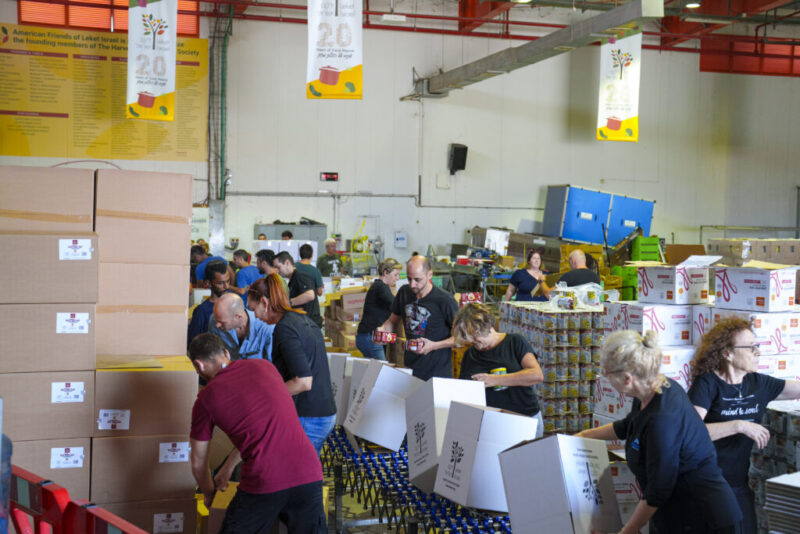
Illustrative. Volunteers work at the Leket logistics center outside of the central Israeli town of Kfar Saba.
I chose to become the CEO of American Friends for Leket Israel because it answers that question with a clarity I find extremely refreshing in a time of overwhelming complexity. One-in-four Israelis, including Holocaust survivors, working and reservist families and their children, struggles to access nutritious food. At the same time, tons of perfectly good produce rot on the vine, and hotel kitchens and army bases discard meals that were never served. Leket stands proudly in that gap and serves as a conduit between what is and what could be. It does not manufacture need, and it does not manufacture supply; it simply refuses to accept that the two should pass each other by, and through the genius of Israeli logistics, it fulfills an ancient Biblical commandment. There is a reason the organization takes its name from the biblical command in Parashat Kedoshim (Leviticus 19:9-10) to leave the gleanings of the field for the poor. Leket is the oldest social safety net in human history, inspiringly reengineered for a modern state.
I have spent more than 15 years in Jewish communal leadership: as a pulpit rabbi, as the director of a Jewish summer camp and as the chief advancement officer of a seminary. Each of those roles taught me that philanthropy, as its Greek root indicates, means love of humanity. But love that stays an abstraction is mere sentiment. Love that becomes a truckload of rescued cucumbers delivered to a soup kitchen in southern Tel Aviv is Torah manifested.
There is also a quieter reason for this choice, one that every Jewish communal professional will recognize. We talk constantly about impact, but much of our work pays out over decades. A camper becomes a committed Jew twenty summers later. A rabbinical student becomes a community’s anchor for generations. That work matters immensely, and I am honored to have served these institutions and am personally invested in their continued success in training the leaders of tomorrow.
In these complicated times, there is also something clarifying about an organization whose impact is measured in meals delivered this week, to people who are hungry today. Both timescales are holy. At this moment in Jewish history, with Israeli society carrying burdens few of us could have imagined, I felt called to feed the hungry — now.
So yes, American Friends of Leket Israel hired me. But I chose them, deliberately and gratefully, because executives in Jewish philanthropy carry a shared responsibility to put ourselves where doing right and delivering results are one and the same.
To change lives. To restore dignity. To feed people.
That is not a job description. It is a privilege. And it begins now.
Rabbi Joel Seltzer is the CEO of American Friends of Leket Israel.