WAR STORIES
Four years after Russia invaded Ukraine, philanthropy is dwindling, even as needs grow
'The Jewish community stepped up philanthropically in very significant ways, but four years in, it's hard to continue to maintain that interest and attention'
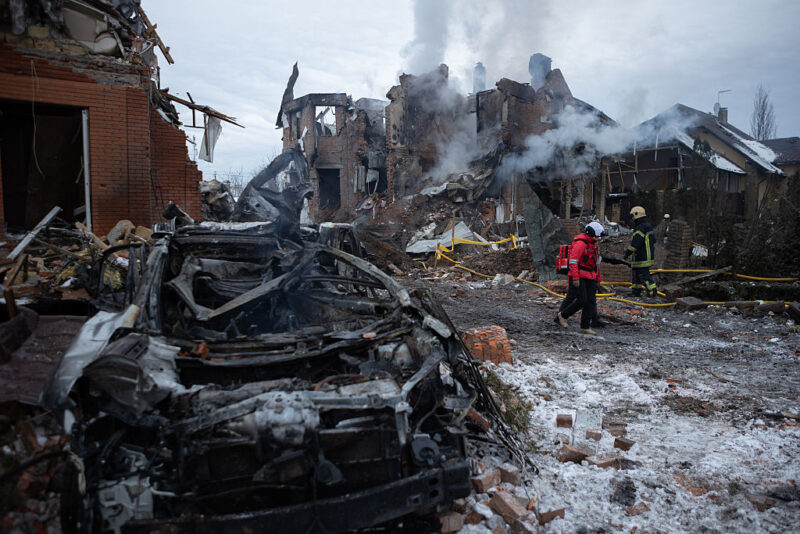
Oleksandr Magula/Suspilne Ukraine/JSC "UA:PBC"/Global Images Ukraine
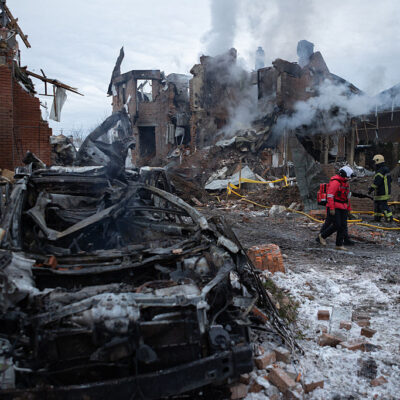
Rescue workers arrive at the site of a Russian missile and drone attack that struck Kyiv, Ukraine, on Feb. 22, 2026.




 Add EJP on Google
Four years into the Russian invasion of Ukraine, Jewish human service organizations are struggling to maintain funding.
“The Jewish community stepped up philanthropically in very significant ways, but four years in, it’s hard to continue to maintain that interest and attention,” Dyonna Ginsburg, CEO of OLAM, a network of Jewish organizations and individuals working in international aid, told eJewishPhilanthropy.
As early as four months into the war, which began on Feb. 24, 2022, Jewish organizations feared the rush of funding wouldn’t last, and they wouldn’t be able to provide the services Ukrainians needed, according to a July 2022 OLAM study. At the time, 16 OLAM partners worked in the region. Today, the number has decreased to six. Many OLAM partners now refer to the war as “a forgotten crisis,” a designation normally used to refer to far-off conflicts like those in Sudan or the Democratic Republic of the Congo.
In the immediate aftermath of the Russian invasion of Ukraine, the Jewish Federations of North America raised and distributed more than $100 million for Ukrainian aid projects. In 2025, JFNA allocated roughly $5.2 million in emergency funds for Ukraine, according to the organization.
Cuts in philanthropic donations are occurring alongside a decline in international aid overall, after the Trump administration slashed 83% of U.S. Agency for International Development programs last year. Even if an organization never depended on USAID, when one organization struggles to maintain services, others need to step up, international aid organizations told eJP.
Even as much of the philanthropic and American federal funding has dried up, the needs of Ukrainians have only increased, Alena Druzhynina, country director of IsraAid Ukraine, told eJP. Even though life is a struggle, Druzhynina, who lives in Ukraine and rushes almost nightly into a bomb shelter with her family, said that she is grateful. “We are still alive,” Druzhynina said. “This is already a positive thing to start with.”
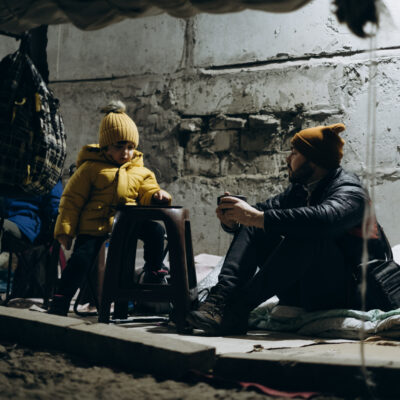
Ukraine, like the U.S., is dealing with the coldest winter in years. But unlike most of the U.S., many Ukrainians are doing it without electricity, compounding the community’s needs, especially around mental health.
Temperatures in Ukraine have plummeted as low as minus-8 degrees Fahrenheit. At the same time, there have been increased Russian attacks on power plants, power stations and the country’s energy infrastructure, and many Ukrainians are unable to heat their apartments and houses. They sleep in hats and jackets. When a home is not welcoming, it feels like there is no safe place in the world, Druzhynina said.
IsraAid has provided in the countries’ most vulnerable areas with heaters and power stations along with watering stations providing clean water which have become hubs for socialization.
“It’s like circles on the water,” Druzhynina said of the effects. Since the war began, IsraAid has provided communities with 122 water stations, including mobile and stationary reverse osmosis water filtration systems, pumping stations and solar panels to filter water. The stations allow schools to run, providing children with mental health support and learning. Heating and water sites cultivate locations for friends and family to meet up, improving mental health. Through such initiatives, IsraAid has reached more than half a million people.
Because of the winter’s brutality and the power outages, Chabad’s Jewish Relief Network Ukraine has established shelters in Odesa and Zhytomyr, where more than 100 people are living indefinitely. Overall, JRN Ukraine provides food, medical care and social services to over 50,000 Jewish Ukrainians.
“More people need food” than ever, Judi Garrett, the chief operating officer of JRN Ukraine, told eJP. Families have drained their savings, and women are carrying the brunt of the struggle at home and work, while men ages 18-62 are serving in the military, unless they are disabled or wounded. “More people need help paying for medicine. More people need help with their utilities.”
Chabad rabbis serving the community are struggling, too. “It’s exhausting and it’s difficult and it’s scary,” Garrett said. Last weekend, to offer rabbis respite, JRN Ukraine held a retreat in Dnipro, one of the centers of Jewish life in the country, with over 50 rabbis attending, some driving 18-plus hours to attend. The rabbis decompressed as their families played together.
“There are more people coming to religious events than ever before because [Jewish Ukrainians] are desperate for support, for fellowship, for help,” Garrett said.
Jews come to Chabad events for the heat and a hot meal and stay for religious services. They volunteer and send their children to Chabad after-school programs.
To meet the country’s needs, Jewish organizations are working together, Garrett said. JRN Ukraine works closely with other Jewish organizations in the region, including the Joint Distribution Committee, which is also partnered with OLAM.
“This is an anniversary we hoped we would never see,” Amos Lev-Ran, external relations director of JDC’s Former Soviet Union Division, told eJP. “I have been in Ukraine every year since this crisis began and the compounding effect is devastating — prices are skyrocketing, goods are hard to find, work is hard to get and education and social life have been totally upended.”
Over 34,600 people — more than a quarter of the estimated 120,000 Jews in Ukraine — depend on JDC services, including mental health support, housing assistance, home care for the elderly, trauma support, educational opportunities and financial and employment assistance. “This transition from short-term crisis to a protracted, underfunded struggle is the defining characteristic of the current situation,” Lev-Ran said.
But Jewish organizations are in for the long haul in Ukraine, Ginsburg said, even as the Jewish world has been bouncing from crisis to crisis — pandemic to war in Ukraine to Oct. 7.
Although it’s frigid and Ukrainians are rushing from bomb shelter to shelter from the cold, Druzhynina is emboldened by the work the Jewish community is doing. Even on the toughest days, she tells herself, “Your life matters,” she said. “Things you do in life matters for someone.”
Druzhynina believes that the international Jewish community still cares and has compassion for Ukrainians, but “it is very important that compassion will not be the background noise,” she said. “That it will turn into action, to tell people what is going on, to donate, to support, to volunteer. We understand that the world is tired from the Ukraine crisis. Unfortunately, we’re also tired.”
Related News
CLOSING WORDS
In AZM address, Cosgrove links communal ‘orthodoxy’ on Israel to rising anti-Zionism among young Jews
PRESIDENTIAL REBUKE
Israel’s Herzog: Mamdani ‘makes no effort’ to hide disdain for Israel, Jews must fight back

EXCLUSIVE
Detroit-based philanthropists Nancy, James Grosfeld donate $8M to renovate JDC’s Israel campus

EXIT INTERVIEW
Elizabeth Sokolsky, longtime EVP of Birthright Israel, to retire next year
ADVANCING A VISION
N.Y. federation donates $1M toward building shared-society center named for peace activist killed on 10/7