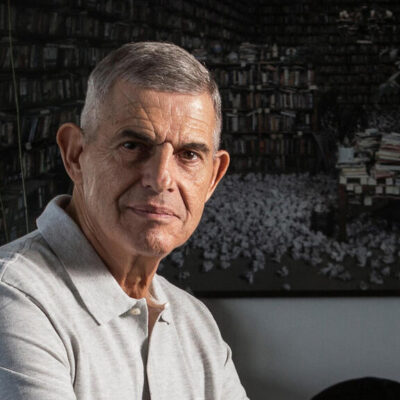
'MENDING THE STRETCHER'
Celebrating $180M gift, Harlaps hope Rabin Medical tower will inspire Israelis, combat ‘brain drain’
Hospital says new heart and brain centers, state-of-the-art technology will help combat the country's ‘brain drain’

courtesy/rabin medical center
Anat and Shmuel Harlap (center) stand with Israeli President Isaac Herzog (fourth from left) and First Lady Michal Herzog (third from left), and top Israeli medical officials, at a gala celebrating the Harlap's recent $180 million donation to Rabin Medical Center in Petah Tikva, Israel, on Sept. 14, 2025.




 Add EJP on Google
PETAH TIKVAH, Israel — Israel’s top medical figures gathered on Sunday night under purple lights illuminating the nearly completed 15-story Tower of Hope at Rabin Medical Center outside Tel Aviv to celebrate the $180 million donation from Anat and Shmuel Harlap that is making the building possible— the largest gift ever made to Israel’s health-care system.
Standing on the stage, the Harlaps presented an image of humble and soft-spoken people, sprinkling self-effacing comments through their remarks. “It’s not an accident that an octogenarian should donate money to a medical center,” the 80-year-old Harlap joked before outlining the serious health-care challenges facing Israel. According to Ministry of Health reports, hospital bed capacity has declined by 9% per capita over the past decade, leaving Israel significantly behind other OECD nations.
In his speech at the event, Harlap highlighted the deeper, societal need for a stronger medical system. “Many people are losing hope today in Israel. Close to 100,000 people, including high-tech workers, academics and physicians, have left Israel in the past year,” he said. “The Israeli stretcher is broken.”
The “stretcher” metaphor refers to the Israeli military’s grueling “beret marches” — the final initiation ritual for combat units before they receive their unit’s colored berets, in which recruits must work together to carry heavy loads on stretchers. The symbol has evolved to represent collective responsibility and national unity, with segments of the public regularly being praised for “getting under the stretcher” and pulling their weight, or being criticized for failing to do so.
“The Israeli stretcher has broken under the weight of incitement, divisiveness and hatred, which weakened Israel over the past few years and dragged us to Oct. 7,” Harlap declared to thunderous applause. “Our gift is meant to join the efforts to fix the stretcher and mend its broken pieces.”
The balmy September evening brought together President Isaac Herzog and First Lady Michal Herzog, alongside prominent Israeli figures, including former Prime Minister Ehud Barak, journalist and former MK Ofer Shelach, New York Times correspondent Ronen Bergman and businessman Rani Rahav. Hospital staff clad in scrubs mingled with distinguished guests in formal attire in the outdoor atrium, sipping wine and munching hors d’oeuvres of stuffed zucchini and roast salmon.
The ceremony, hosted by Arab Israeli television personality Lucy Aharish and featuring a performance by singer Yehuda Poliker, began with the signing of the tower’s foundational charter and official photographs before moving to the hospital’s back lawn for formal speeches. In attendance were Moshe Bar Siman Tov, director general of the Israeli Ministry of Health; Yochanan Locker, chairman of Clalit Health Services, which owns the hospital; and senior medical staff, including Dr. Ran Kornowski, director of the Heart Center, and Dr. Sagi Harnof, director of the Brain Center.
“This donation is not to be taken for granted, especially when one considers that it comes from such deeply rooted Israelis who are soulfully connected to the nation and its people and who bring forth their commitment in myriad ways,” Isaac Herzog said. “This is a most important precedent for civil society and for the field of philanthropy in the state of Israel.”
The Harlaps have been longtime donors to the Rabin Medical Center, also known as Beilinson Hospital, having donated to other hospital units over the past several decades.
The new center will add over 300 beds to existing capacity along with new surgical theaters, helping to bridge the gap between Israel and other Western countries in healthcare infrastructure.
The Tower of Hope will house advanced Heart and Brain Centers, integrating clinical care, teaching, research, and innovative technologies. The Harlaps emphasized the facility’s inclusive mission: “The Tower of Hope will serve all parts of Israeli society — secular, religious, Haredi, Muslim, Christian, Druze, and Circassian. The tower will be for all of us, a lighthouse of hope.”
Scheduled to open in early 2027, the state-of-the-art 15-floor, 750,000-square-foot facility will integrate advanced cardiology and neurology care, including national transplant units, cutting-edge surgical suites and AI-assisted diagnostic systems, the hospital said. In addition to its 12 stories aboveground, the Tower of Hope will feature three fully fortified subterranean floors that will house operating rooms, imaging units, catheterization labs and intensive care wards for cardiology, cardiac surgery and neurosurgery. The need for these reinforced facilities was demonstrated this summer in Iran’s missile strike on the Soroka Medical Center in Beersheva, which caused massive damage to an entire building on the hospital’s campus — one that had already been cleared of patients.
At the ceremony, Dr. Eytan Wirtheim, CEO of Rabin Medical Center, presented the Harlap family with the tower’s foundational charter in an emotional moment.
The tower is an ambitious attempt to address Israel’s “brain drain” by creating a center that is so groundbreaking on an international level and that contributes greatly to Israel’s medical system, according to Dr. Leor Perl, head of the Interventional Cardiology Institute.
The new center will focus on complex cardiology patients sent from all over Israel, leveraging Clalit HMO’s position as the country’s largest health maintenance organization with over 5 million patients.
Asked whether the new center will succeed in helping Israel retain the top medical professionals, Perl, who trained at Stanford and recently returned from a research collaboration at Oxford University, was optimistic. “The infrastructure matters. The visibility, the comfort of a modern, redesigned space. It [attracts medical professionals with advanced] abilities,” he told eJP. “Medicine in 2025-2026 is expensive, so you have to have the correct medical equipment, so this is huge for us.”
In his speech, Kornowski, director of the Cardiology Division and Cardiac Catheterization Institute at Rabin Medical Center, discussed the tower’s foundational pillars: providing empathetic and compassionate care. “During the many years of my professional life pursuing excellence in the field of heart medicine, I have learned that research and innovation in cardiology are not merely a process of discovery and improvement, but a journey in understanding the needs of our patients,” he said.
“Our vision for this center is not just for the physical structure, but rather the most important mission for humanity. Our goal is to break the glass ceiling and provide first-class treatment that combines innovation and advanced technologies together with sensitivity and compassionate care.”
Related News
CLOSING WORDS
In AZM address, Cosgrove links communal ‘orthodoxy’ on Israel to rising anti-Zionism among young Jews

PRESIDENTIAL REBUKE
Israel’s Herzog: Mamdani ‘makes no effort’ to hide disdain for Israel, Jews must fight back

EXIT INTERVIEW
Elizabeth Sokolsky, longtime EVP of Birthright Israel, to retire next year
EXCLUSIVE
Detroit-based philanthropists Nancy, James Grosfeld donate $8M to renovate JDC’s Israel campus
HIGHER EDUCATION
As Jewish donors reconsider academia, Jan Koum doubles down, endowing Israel studies at Stanford