Q&A
Beit Shemesh fund offers aid to victims of deadly Iranian strike, aims to boost rescue teams
Without an American 'sister city,' Keren Shemesh relies on support from a variety of donors; 'Our needs are greater than what we have right now,' foundation's director tells eJP
Yonatan Sindel/Flash90
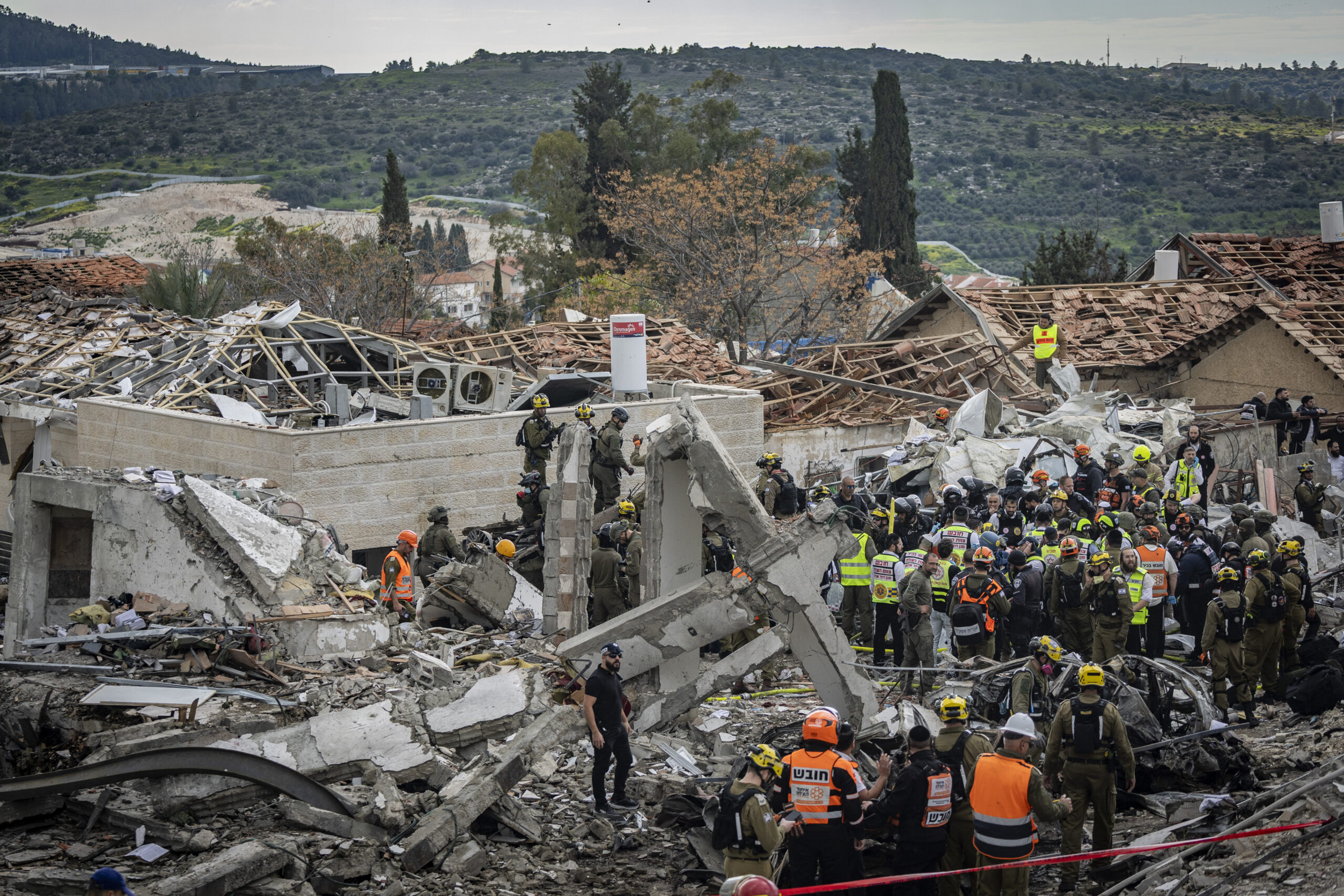
Israeli security and rescue forces operate at the scene where a ballistic missile fired from Iran struck Beit Shemesh, in central Israel, killing nine people and wounding dozens more on March 1, 2026.




 Add EJP on Google
Evading Israeli air defenses, the half-ton Iranian missile made a direct hit on a synagogue in Beit Shemesh, under which stood a bomb shelter where dozens of local residents had sought cover. The force of the blast destroyed the synagogue and collapsed the shelter’s concrete roof, killing several of the people inside, as well as some who were still outside, rushing to safety. The blast also severely damaged surrounding buildings in the neighborhood, one of the older and poorer areas of the city.
Nine people were killed in the strike: Sara Elimelech; her daughter, Ronit Elimelech; Oren Katz; 16-year-old Gavriel Baruch Ravach; Bruria Cohen; her son, Yosef Cohen; and teenage siblings Yaakov Biton, 16, Avigail Biton, 15, and Sarah Biton, 13. Dozens of people were injured in the blast, and hundreds were displaced as their homes were damaged and made uninhabitable.
Nearly every city in Israel has a dedicated philanthropic foundation, through which donors can provide support for municipal programs and local initiatives. In peacetime, these foundations can bolster welfare services, educational activities and employment assistance. In war and other emergencies, they have an even more critical role to play, filling in the gaps left by the government.
In Beit Shemesh, that foundation is Keren Shemesh, a Hebrew play-on-words that means both “Shemesh Foundation” and “Sunbeam.”
On Monday, some 24 hours after the missile strike, eJewishPhilanthropy spoke with Raanan Eliaz, the executive director of the foundation, about the organization’s work and the community’s newfound needs in the wake of the deadly attack.
The interview has been lightly edited for clarity.
Judah Ari Gross: Tell me what role does Keren Shemesh have to play in a situation like this? What are the current needs of the community?
Raanan Eliaz: The situation is that nine people were killed. Three of them were siblings on the way to the shelter. Ten buildings were destroyed. Roughly 50 people were injured and remain in the hospital, and around 300 were evacuated to hotels.
The Shemesh Foundation, which has been operating since 2005, is like many other municipal foundations. We’re an independent foundation, and we work closely with the municipality. We’ve always been working in the field of welfare, education and employment. Beit Shemesh is the fastest growing city in Israel, and it has a rare combination of different populations: There are many Haredim; many religious, especially English speakers; but also many non-religious Israelis. Our board members come from all these streams, and the foundation now is primarily working to connect the Haredi community to the mainstream Israel community through employment, education and different opportunities in the community.
JAG: Who are your main partners and supporters?
RE: Keren Shemesh has donors from the federation system, primarily from the United States, but also from other Jewish communities around the world and inside Israel. We also have Christian donors.
But our needs are greater than what we have right now.
Our first and primary need is to provide immediate support to the families and children who are affected by this.
Our secondary needs would be more long-term. There is a rescue unit in the city that needs equipment and training. We actually already have a price tag for this of $65,000. There is also a longer need to maintain and upgrade the fortified facilities in the city. They are not all in the best shape, and we need to upgrade them, and that’s bigger money and a longer-term project.
JAG: Have donors already begun reaching out to you and the city in light of the scale of the tragedy, or is it still too early for that?
RE: We are still at the stage of sending messages and getting the word out.
JAG: There are, of course, some government support programs and other nonprofits that are assisting people who are affected by the war. Have you been able to see what help is already available so that you can fill in for the things that are falling between the cracks?
RE: I don’t want to pretend that we have a map of everything that’s going on, but I know that some organizations are [assisting victims] on the ground. There are also a number of hesed [charity] organizations, including local ones like Ezrat Achim [Brotherly Support], and they are doing their job. They are doing that without our support, and it is important work.
With the municipality, we want to do more work on welfare and on the rescue unit, which is something that we are trying to make sure will happen.
JAG: Does Beit Shemesh have a sister city or other partner community?
RE: It’s a sad story. Beit Shemesh used to have Washington as a sister city. This was before my time in the foundation and before this mayor and even the previous mayor.
[Ed. note: The Jewish Federation of Greater Washington split with Beit Shemesh in 2014 after the then-mayor made homophobic slurs, among other issues.]
So we don’t have a sister city now, but I’d be very happy to have a new one.
Related News
CLOSING WORDS
In AZM address, Cosgrove links communal ‘orthodoxy’ on Israel to rising anti-Zionism among young Jews
HIGHER EDUCATION
As Jewish donors reconsider academia, Jan Koum doubles down, endowing Israel studies at Stanford
EXIT INTERVIEW
Elizabeth Sokolsky, longtime EVP of Birthright Israel, to retire next year
PRESIDENTIAL REBUKE
Israel’s Herzog: Mamdani ‘makes no effort’ to hide disdain for Israel, Jews must fight back
EXCLUSIVE
Detroit-based philanthropists Nancy, James Grosfeld donate $8M to renovate JDC’s Israel campus