MAME-LOSHN MADNESS
Bar-Ilan and Babes-Bolyai University gathers over 70 ‘Yiddish hunters’ in Transylvania
The program was modeled after similar programs run by Manhattan’s YIVO Institute for Jewish Research, but with a focus on Soviet Yiddish topics.
Courtesy
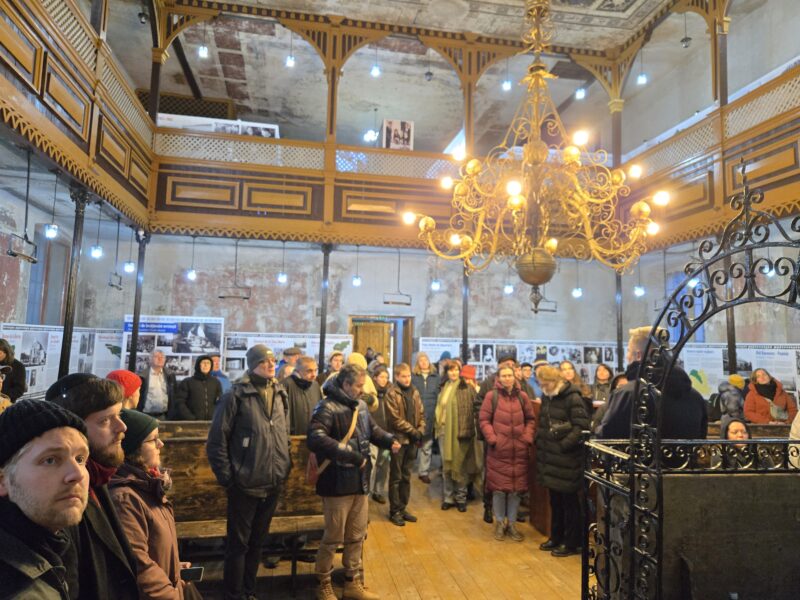
Participants in a free advanced Yiddish Winter School gather at the Simleu (Shamloy) Synagogue in Northern Transylvania.




 Add EJP on Google
A hundred years ago, there was a saying that you could travel anywhere on the globe and find someone who speaks Yiddish. Today, there’s been a reversal — Yiddish enthusiasts pick a spot on the map and schlep across the world to find one another.
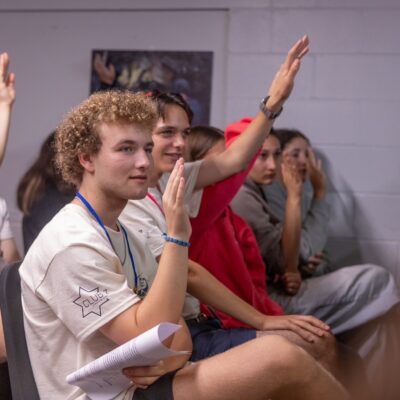
Ber Kotlerman, Yiddish professor at Israel’s Bar-Ilan University, calls these aficionados “Yiddish hunters,” and last week, from Feb. 9-16, over 70 of them gathered for a free advanced Yiddish Winter School in Cluj-Napoca, Romania, in the Transylvania region, to immerse themselves in the language and culture they love, with every activity, from tours to lectures, taking place in Yiddish.
The program was a partnership between Bar-Ilan University and Romania’s Babes-Bolyai University, with instructors representing Germany’s Heinrich Heine University Düsseldorf, University of Regensburg and Ludwig-Maximilians-Universität Munich and France’s Sorbonne University.
Kotlerman, head of the Rena Costa Center for Yiddish Studies and incumbent of the Sznajderman Chair in Yiddish Culture and Hasidism at Bar-Ilan University’s Department of Literature of the Jewish People, connected with Augusta Costiuc-Radosav, assistant professor of Yiddish language and literature at the Babes-Bolyai University, and brainstormed the program in September. Neither anticipated more than 30 attendees, but over 100 people applied to attend, with 30 turned away due to language proficiency — attendees, often students and activists, had to breathe Yiddish.
While the programming and housing at Babes-Bolyai University were free, travel wasn’t. Hunters came from the United States, Germany and Poland. They flew in from the United Kingdom, the Netherlands, Sweden, Russia and Ukraine. They gathered from Denmark, Macedonia, Mexico and Spain. It doesn’t matter where a Yiddish event is held, “If they see something which is organized somewhere in Greenland, they will come,” Kotlerman said.
The program was modeled after similar programs run by Manhattan’s YIVO Institute for Jewish Research, but with a focus on Soviet Yiddish topics. Yiddish programs often focus on Yiddish culture from between Lithuania and Poland, not the Soviet Bloc. Courses included the “Soviet Yiddish Theater’s ‘New Jew,’” “Yiddish Modernist Manifesto,” and Yiddish dialects, film, music and folklore.
On Sunday, attendees toured historically Jewish towns, including Simleu, once known as Shamloy, and Satu Mare, previously named Satmar, and on Monday, the program held a “Yiddish-in-Yiddish International Symposium” titled “Yiddish in the Soviet Union, Romania, and Poland: Between Heritage, Modernism, and Ideology.”
While there is a stereotype of Israelis thumbing their nose at Yiddish, seeing it as the language of the poor, weak shtetl Jew compared to the strong, powerful, Hebrew-speaking Israeli, that stereotype isn’t true, Michael Lukin, Yiddish educator at Bar-Ilan University, The Hebrew University and Jerusalem Music Academy, told eJP. Many in Israel yearn for Yiddish, as evidenced by the winter program.
Last month, Lukin attended a Yiddish play in Jerusalem starring 96-year-old actress Lea Koenig, nicknamed The First Lady of Israeli Theatre, and the auditorium was packed. Both The Hebrew University and Bar-Ilan University have Yiddish departments, and at Bar-Ilan, students can write their PhD dissertation in Yiddish, which is what Kotlerman did when he graduated 25 years ago. Last semester, there were 240 students enrolled in Bar-Ilan’s Yiddish courses.
The winter program attempted not to touch on politics around Zionism, but having an Israeli school involved added inherent politics. Still, “it was significant to teach people and to explain what happens when Jews are trying to organize their Jewish culture without their state and without their country,” Lukin said.
The Winter School was inexpensive to run, with Bar-Ilan University and other schools paying for their instructors to travel to Romania, Kotlerman said. Babes-Bolyai University was on school break, so the dorms and campus were available, and the school was very generous in offering their premises. “Romania is the friendliest country to Israel,” he said. (This would likely come as a surprise to the Yiddish-speaking Jews of Romania who faced deadly antisemitism even before the Holocaust.)
Kotlerman has organized similar Yiddish programs in the past, starting in 2007 in Russia, but they have always been on a smaller scale. The winter program was held in February because most other Yiddish immersive programs take place in the summer.
In 2012, when Costiuc-Radosav received her Ph.D. from Babes-Bolyai University, there were 20 students studying Yiddish at the school. That dwindled to 12 by 2020 when the pandemic hit. Today, they average three to four students per year.
Because she yearns to be in community with other Yiddish lovers, Costiuc-Radosav has traveled many times to attend similar programs to the winter school, including in Tel Aviv. Through the programs, she has cultivated a community of friends. They have Yiddish nicknames for one another, for both her buddies and the peers who annoyed her. She hopes the attendees in Yiddish Winter School have the same experience, sharing the same jokes.
Before the Holocaust, the Jewish community surrounding Babes-Bolyai Universitynumbered over 13,000, but there are fewer than 100 Jews remaining. The students who study Yiddish at the school are often not Jewish, and many faculty and student volunteers at the Winter School weren’t either. As part of the program, organizers held a Yiddish song concert at a nearby synagogue — half the audience weren’t Jews. Costiuc-Radosav hopes that they enjoyed themselves. She hopes they inhaled the joy in the room. Maybe, she said, they will enroll in her program. Maybe, they, too, will join the hunt.
Related News

MAGICAL EXPERIENCE
Shefa launches psychedelics retreat for Jewish professionals suffering burnout

MAJOR GIFTS
Center for Jewish History celebrates 25 years with a $25M matching grant
PRESIDENTIAL REBUKE
Israel’s Herzog: Mamdani ‘makes no effort’ to hide disdain for Israel, Jews must fight back
ADVANCING A VISION
N.Y. federation donates $1M toward building shared-society center named for peace activist killed on 10/7
EXCLUSIVE
Detroit-based philanthropists Nancy, James Grosfeld donate $8M to renovate JDC’s Israel campus