EXCLUSIVE
Aviv Foundation grants $1 million to expand operations of Orthodox LGBTQ inclusion group Eshel
Donation, which will allow group to work in new areas and hold more events, comes amid both a surge in interest and pushback
Courtesy/eshel
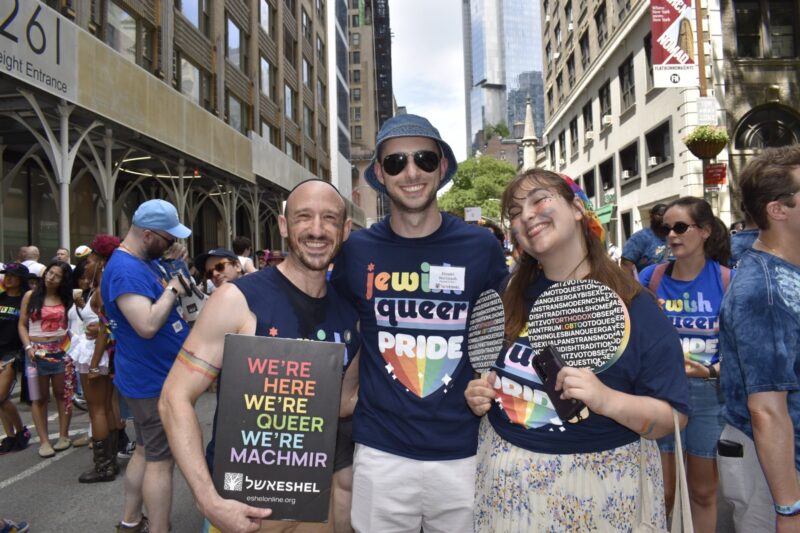
Ely Winkler, director of advancement at Eshel, Mendel Weintraub, a program director, and Sophia Nachmanoff, an intern, attend the 2026 New York City Pride parade on June 28, 2026.




 Add EJP on Google
Once a strictly taboo topic, the inclusion of LGBTQ Jews in the Orthodox world has become a far more commonplace concept in the 16 years since Miryam Kabakov co-founded Eshel. But there is still more work to be done, Kabakov, the group’s executive director, told eJewishPhilanthropy.
A new $1 million grant from the Aviv Foundation, shared exclusively with eJP on Monday, will allow Eshel to expand its work supporting traditionally observant Jewish communities in cultivating welcoming spaces for LGBTQ Jews and their families.
“I feel it,” she told eJewishPhilanthropy. “There’s been a real turning point within Orthodox spaces that now this conversation is happening more and more. It’s no longer a taboo conversation, per se. We’ve seeded a lot of opportunities for people to actually talk about this without any stigma.”
Yet alongside this growing acceptance, there remain some in the Orthodox community who are pushing back on this trend, Kabakov said. She added that these tensions come at a time when many queer Jews feel rejected by non-Jewish LGBTQ spaces — many of which have adopted staunch anti-Israel positions in response to Israel’s war against Hamas in Gaza.
Eshel serves LGBTQ individuals, family members and allies in the United States and Canada and is the only English-speaking support system in Israel for parents of LGBTQ people within Orthodoxy. From the organization’s inception, Kabakov knew “we couldn’t just confront the issue head-on,” she said. “We would knock on doors of Orthodox synagogues, and they wouldn’t open. Now, this past Pride month, we’ve sponsored at least 10 Pride Shabbats in Orthodox spaces. That’s an amazing thing that we’ve been able to catalyze and help Orthodox communities celebrate their LGBTQ members.”
As more institutions and individuals turn to Eshel for help, communities grow more welcoming, therefore creating increased interest in the organization. “The growth has just been leading to more and more growth,” Kabakov said.
The grant from the Aviv Foundation will help the organization implement its three-year strategic plan, launched last year. The plan is titled “Branching Out,” a play on the organization’s logo, a tree image that recalls the tamarisk tree that the biblical Abraham planted in Beersheva as a sign to travelers that food, water and shelter were available there.
According to the plan, now in year two, Eshel is expanding its geographic reach and programming and will soon hire three new positions, including an operations manager and national program director.
The grant will also support the organization in updating its website with a larger resource library and launching in-person programming in more Orthodox hubs. The organization will increase ally training in Orthodox institutions and on college campuses, expand mental health programming and add a third annual retreat. It will also grow the organization’s Welcoming Communities initiative, in which Eshel interviews rabbis across North America so it can better connect LGBTQ families and members to caring communities and synagogues.
Eshel is a “flagship investment” for the Aviv Foundation, Adam Simon, the foundation’s CEO, told eJP. “It’s an anchor investment for us that aligns with our goals around ensuring queer Jews are full participants in Orthodox institutions in Orthodox life.”
The Aviv Foundation was founded in 2015 by American Israeli philanthopists Steven and Chani Laufer. The foundation has funded liberal Orthodox initiatives, in the U.S. and Israel, since its inception. Supporting the Orthodox LGBTQ community became a priority investment in 2018, and the foundation first invested in Eshel in 2019.
“There is a strength in the infrastructure nationwide that Eshel has created — the program history, the tools it has to support synagogues and other institutions — to be more inclusive,” Simon said. But at the same time, he added, “It’s an interesting moment in which you have both an increase of acceptance and curiosity amongst Orthodox institutions and Orthodox leaders about how to be more inclusive and more humane to LGBTQ members and family members, and also a stronger rise of the right wing of Orthodox institutions that are rejecting that same inclusion. So you have both forces on the ends of Orthodoxy pushing against each other.”
While organizations are working to be more accepting of LGBTQ Orthodox youth, mental illness in the community is “through the roof,” he said. “That conflict is really confusing and all the more reason why we need to be funding great institutions that are trying to support individuals and support organizations and be public about their work to create safe spaces.”
The grant comes at a time when LGBTQ Jews feel increasingly alienated from queer spaces post-Oct. 7. A 2025 study by Eshel and the now-defunct A Wider Bridge showed that 82% LGBTQ Jews reported being “kicked out,” “blocked,” having “experienced verbal harassment” or being “made to feel uncomfortable” in online queer spaces, and 42% reported those situations occurring in-person. At the same time, a 2024 Eshel study of parents showed that 44% of Orthodox parents said their LGBTQ child had experienced “some,” “significant” or “very significant” discrimination from their synagogues.
Simon hears from Orthodox organizations that “they want to do better,” and Aviv hopes to help those institutions “do it better,” he said. “We also hear from individuals who are struggling oftentimes, and we want to be supportive of those individuals.”
The Aviv grant follows a trend of investments in Eshel, including from Micah Philanthropies, the Charles and Lynn Schusterman Family Philanthropies and SRE Network. Last year, UJA-Federation of New York granted the organization $100,000, which gave Eshel a “vote of confidence,” Kabakov said, and allowed the organization to hire a program manager in New York to expand programming throughout the tristate area.
The Aviv grant “gives us confidence going forward that we can grow with our strategic plan,” Kabakov said. “Without it, I’m not sure that we would be able to fulfill the road map that we’ve set out for ourselves.”
Related News
EXIT INTERVIEW
Elizabeth Sokolsky, longtime EVP of Birthright Israel, to retire next year
HIGHER EDUCATION
As Jewish donors reconsider academia, Jan Koum doubles down, endowing Israel studies at Stanford
ADVANCING A VISION
N.Y. federation donates $1M toward building shared-society center named for peace activist killed on 10/7

MAJOR GIFTS
Center for Jewish History celebrates 25 years with a $25M matching grant

MAGICAL EXPERIENCE
Shefa launches psychedelics retreat for Jewish professionals suffering burnout