COSMIC ENERGY
Astrophysicist Paz Beniamini snags science prize — a burst of light for reenergizing Open University
In a first for the 52-year-old institution, Beniamini wins the Blavatnik Awards for Young Scientists in Israel for physics based on his work on 'extreme' events
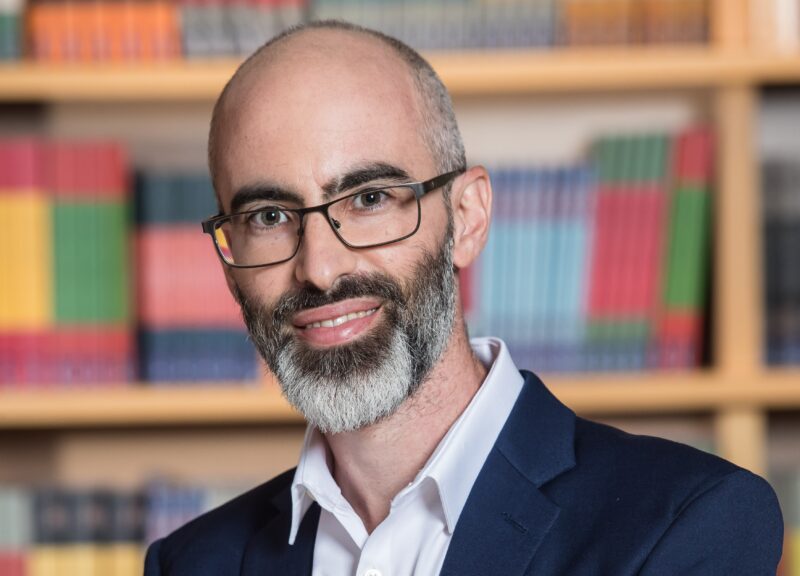
Courtesy/Oded Gaya
Paz Beniamini, an astrophysics professor at the Open University of Israel




 Add EJP on Google
When the Blavatnik Family Foundation announced its recipients of this year’s Blavatnik Awards for Young Scientists in Israel last month, a researcher from the Open University, Paz Beniamini, was selected in the physics category, marking the first time that the more than 50-year-old institution made the cut.
Beniamini, 41, an astrophysicist and head of the Astrophysics Research Center at the Open University (ARCO), was chosen based on his research into “extreme” cosmic events, such as stars exploding, radiation bursts and rapid collisions.
The Open University, which launched in 1974 as the “Everyman University,” was aimed at providing a higher education to nearly everyone, with its courses primarily offered through remote learning and on a course-by-course basis, instead of on a semester model, allowing people with limited free time and means to also access a university-level education.
Beniamini, who describes himself as a theoretical physicist who stays as close as possible to real-world observations, is also a key part of the Open University’s efforts to improve its standing by focusing its physics department almost solely on astrophysics, giving it an edge over larger, “jack of all trades” institutions. (He hopes that winning this prize will help in that effort.)
eJewishPhilanthropy’s Judah Ari Gross spoke with Beniamini last week about his research, the state of the hard sciences as Israel faces growing academic boycotts and what his selection means for the often less-well-known university.
The interview has been lightly edited for clarity.
Judah Ari Gross: Earlier this month, you were named one of three laureates of the Blavatnik Awards for Young Scientists in Israel. Tell me a bit about the award process. Did you apply? Were you nominated? When did you find out that you had been selected?
Paz Beniamini: The process was that my university, the Open University, suggested that I could be a candidate for this award. Technically, they do the application, but I have to agree in advance to be the candidate of the university. So I had to prepare some materials and find recommenders who would write letters on my behalf. That all happened sometime in the fall of 2025, and in late January, I got the phone call from the Israel Academy of Sciences and Humanities, and I was told that I got the award, so I was very happy to hear that.
JAG: Ah, so you’ve known for a while already.
PB: Yes, there was an embargo on this, so I was only allowed to tell close family and a few people at the university.
JAG: In preparing for this, I read through some of your publications and your areas of study. I’ll admit it’s a bit over my head, so can you tell me about your work and about some of the publications that led you to receiving this prize.
PB: I’d be happy to talk about that. My field is high-energy astrophysics. And it deals with environments that are very extreme in one way or another. So for example, it could mean that we have particles that are moving very, very close to the speed of light say 99.99% of the speed of light, and they emit some radiation in processes that we don’t typically detect here on Earth but can become extremely powerful and can enable us, in some cases, to see emissions that are coming from billions of light years away.
High-energy astrophysics also includes dealing with the very strong magnetic fields or very compact stars, where you have a huge amount of mass compressed to a tiny, tiny size, and you have very strong gravity effects. You can have interaction between light particles, photons and other fundamental particles, creating all sorts of processes that have to do with particle physics interactions, some of which are not easily approachable on Earth and actually can compete with our biggest and best accelerators, like the Large Hadron Collider in Switzerland. Some of the particles that come from space are much more energetic than anything we can create at the LHC, so there is really an opportunity when studying high-energy astrophysics to get a glimpse into nature that is unique because nature does the experiments for us that are way beyond the scale of what we can do with our technology. And it allows us to push physics to the extreme in some sense.
JAG: How much of the work that you do is based on collecting and analyzing data of these phenomena and how much of it is theoretical?
PB: What I personally like to do is to really combine the two. Really, I’m a theorist, and the field is roughly divided into theorists and observers, but I like to sit quite close to observations. I collaborate a lot with observers as well. And I like the back-and-forth interaction that you can have between observation and theory, so you’re not just creating a theory in isolation. But you come up with a model or with some idea of what might be going on, you make a prediction, then maybe the next year someone opens a telescope at the right wavelength, at the right location, and maybe they see it, right? That’s very exciting when that kind of thing can happen.
JAG: And the award ceremony is [this] week.
PB: There are two. It is co-organized by the New York Academy of Sciences and the Israeli Academy of Sciences. On Monday morning, there’s a symposium at the Israeli Academy of Sciences, where there are three laureates, me and two others, one in life sciences and one in chemical sciences. We will give a 15-minute talk, and then there will also be a longer talk by one of the Bravatnik award winners from a few years ago. And then there’s the event in Jerusalem the following evening. That’s the big ceremony at the Peres Center in Tel Aviv. It’s a very formal event, a black-tie event, with a very elaborate setup, so that, I think, will be quite an experience. I’m looking forward to it.
JAG: Can you tell me about the speech that you are planning to give?
PB: I decided to just give one story, one example of something that we did a few years ago and the consequences of that.
So this was a work where we were trying to understand, in a type of event called “fast radio bursts,” where is the radiation that is produced coming from? So fast radio bursts are a relatively new phenomenon. These are events that are seen in the radio band. They’re also very fast. That’s why they’re called fast radio bursts. They last about a millisecond typically, and they’re very bright, and they can come from huge distances — hundreds of millions of light-years away or more. And there is still an open question in this field of how and where is this radiation produced?
Very roughly speaking, there are two classes of models: one that says the radiation is produced very close to the central object, which we think is a neutron star; and the other that says that the radiation is produced very far away. The difference between the locations in those two models could be a factor of 100,000. So it’s a big difference, and the question is, is there any way that we can use data in some kind of new technique to differentiate between these two possibilities?
So what we suggested is an idea that is similar in some sense to the reason that the stars twinkle [in the night sky] and planets don’t. Why does that happen? Because when you look at the night sky, a star is bigger than a planet, but it’s so much further away in terms of the angular resolution — think of it like pixels on a screen.
A star will be much fewer pixels. So if there’s some turbulence in the atmosphere, which could deflect the light one way or another… the star seems to have moved a little bit. But for the [larger number of pixels for a] planet, one pixel could be hidden for a moment, but the other will still be towards you. So overall, the whole thing is fluctuating less.
What this demonstrates is that if you have something that is large, then you see small fluctuations. If you have something small, you see big fluctuations. So you use a similar technique, but instead of looking at it as a function of time, looking at it as a function of wavelength, where we observe the radio waves. If the region where the radiation is produced is large compared to typical sizes of fluctuations… then we will see a small amount of fluctuations. And if this source is small compared to these regions, then we will see a large amount of fluctuations. So we wrote a paper about this, explaining the theoretical background and how, in practice, it could be used to try and differentiate between the two cases of fast radio bursts.
And then a year later, we got a contact from one of the biggest telescopes in the fast radio burst field, which is called CHIME (Canadian Hydrogen Intensity Mapping Experiment). This is a Canadian telescope. And they found a burst for which they can do this analysis. They had good enough data where they could do this analysis, and indeed, when they did the analysis, they found an imprint that shows this strong scintillation, which is definitely coming from the host galaxy, and therefore tells us that the source has to be sufficiently small and small enough that we can effectively rule out this model that it happens at a large distance.
So this was very nice, but a different way to look at it is that it is a way to get a very, very precise angular resolution, well beyond anything that we would ever achieve with human-made telescopes. Being able to resolve something of that size that we saw there, which is, let’s say, a few thousand kilometers (across) at a distance of a hundred million light-years away. It’s the equivalent of being able to resolve something the size of a shekel coin (less than an inch wide) from a distance that is 10 times greater than the size of the galaxy. So it’s absolutely impossible to imagine these kinds of resolutions, and it’s just because we relied on this special trick, where we’re not actually seeing this object, but we are seeing sort of the imprint of something of that size.
It’s like these famous pictures where you have the camels on the dune, and you’re not directly seeing the camels, but you’re seeing the long shadows of the camels on the dune because the light hits them at the right angle. So that’s sort of the analogy to what we are doing in this case.
It’s a way to demonstrate this kind of interplay between observations and theory, and what kind of ideas can help us to try and push our understanding a bit further.
JAG: Wow, and what does solving a problem like that and providing a definitive answer to that kind of a question do for you as a scientist?
PB: It tells us which physics we can now focus on in terms of our understanding of these objects, so it brings us a step closer towards solving this puzzle. Generally, in astrophysics, we don’t get to run experiments. We rely on what nature gives us. And so this is a way to get to the next level of the mystery, which is always our goal. And down the line there might be other implications of this kind of technique in other fields. This can be applicable even beyond astrophysics in a more technological application.
JAG: You mentioned collaborations. I understand that you are also a lecturer at George Washington University. Can you tell me about the state of your international collaborations, how you find it working in universities abroad, and how things have changed — or not — over the past 2 1/2 years, where academic boycotts against Israel are growing. I believe that is more common in the liberal arts and social sciences, but has it affected you personally in the hard sciences?
PB: So certainly I have collaborators from all over the world, really many countries and many different institutes. And I have this adjunct position at George Washington University. I was there for my first postdoc at George Washington University, so I spent 2 1/2 years there, and I’m very close with the people there. We collaborate very often and try to visit there pretty often as well. It’s been a bit more difficult recently, of course, because of the war and so on. In terms of access to data, the data that is relevant to my work is publicly available.
Regarding boycotts, I agree with both these points. Just today, we had a visitor from Ariel University who came to give a talk at our institute. I was talking to him, and he also mentioned how difficult it is, particularly at Ariel [which is located in a West Bank settlement of the same name so does not have] access to some of the European grants and so on.
For us, particularly in physics, we have not felt it as much. But that should be caveated with the fact that we don’t know the things we’re not invited to. Right? So overall, my work with my collaborators remains very active, very international. No one that I collaborated with before said, “I don’t want to collaborate with you anymore because you’re Israeli, and now that’s a problem.” That has not happened at all. And I get invitations to conferences and so on. I don’t know what number of invitations I didn’t get because of some potential bias. I do believe that is going on certainly in other fields, but luckily for us, things are really mostly focused on the science and, um, it’s not too political in that sense.
Two years ago, we organized a conference as part of the Astrophysics Research Center of the Open University, which I’m currently the head of, on a field that I work on, which is called gamma-ray bursts. I organized it with another person at the Open University, and we decided — no one told us that we had to — that we were going to do it not in Israel but in Greece, in Athens, just because at the time it would have been very difficult and maybe even impossible for people to come internationally into Israel (because of flight cancellations). So in that case, it was a solution that worked for everyone to do it in Athens, and we had good participation from many people from all over the world. We only had one case of someone who refused to participate because of their political stance.
JAG: From what I understand, you are the first winner of the Blavatnik Prize from the Open University, which is generally not as well known internationally, compared to other Israeli universities. What does winning this sort of prize do for the university?
PB: The Open University is really doing a lot of big changes in terms of the approach to research in general and specifically in astrophysics. So we opened this astrophysics center the same year that I joined in late 2021, early ‘22, and we have significantly increased the number of senior researchers in astrophysics. The main challenge of the Open University is that the number of faculty members is smaller compared to other universities, so we’re dealing with a factor of 5-10 fewer faculty members than other universities. And because of that, we have to work very hard to get the same level of recognition.
Before I joined, the Open University took the position that instead of having people working in different fields of physics, which have little to do with each other, to focus all of the physics faculty specifically into astrophysics. The idea is that any physicist can teach undergraduate-level physics — it doesn’t matter if your expertise is in solid state physics or in plasma physics or in astrophysics. It therefore gives the opportunity to have a focused group. So now, depending exactly how you count, we have between five and seven full-time faculty in astrophysics. In addition, we have external members who have joint appointments with us. We have about 10 post-docs. We now have master’s students. We have teaching staff, some of whom also do research in astrophysics or adjacent fields. So we really now have a critical mass.
If the university had decided to hire just people across the board in physics, there would be no critical mass in any particular field, and now we have this master’s degree in astrophysics, which is the first one in Israel. There are master’s degrees in physics with a specialty in astrophysics, but this is the first one that is really a dedicated M.Sc. in astrophysics.
So I think, yes, we’re not as well known as some of the other places, but hopefully this is something that can change over time, and our individual records as researchers stand in their own right, and hopefully we can build momentum based on that.
JAG: To be a bit indelicate, this award also comes with a $100,000 cash prize. Do you have any specific plans for that?
PB: It was a very, very nice surprise and a very heartwarming thing to learn that I got [the prize]. I didn’t expect to get it, and I don’t have any particular plans of what to do with that. But I was very, very happy about it.
Related News

EXCLUSIVE
Detroit-based philanthropists Nancy, James Grosfeld donate $8M to renovate JDC’s Israel campus
CLOSING WORDS
In AZM address, Cosgrove links communal ‘orthodoxy’ on Israel to rising anti-Zionism among young Jews
PRESIDENTIAL REBUKE
Israel’s Herzog: Mamdani ‘makes no effort’ to hide disdain for Israel, Jews must fight back

MAGICAL EXPERIENCE
Shefa launches psychedelics retreat for Jewish professionals suffering burnout

EXIT INTERVIEW
Elizabeth Sokolsky, longtime EVP of Birthright Israel, to retire next year