Opinion
DAYEINU?
After the Israel Day on Fifth parade: The precarious future of Jewish-Mamdani relations




 Add EJP on Google
In Short
Perhaps NYC Mayor Zohran Mamdani’s navigation of the controversy around his decision not to participate in the Israel Day on Fifth parade is a sign that there may be further improvements in his relationship with the Jewish community.
Tens of thousands of people safely marched up Fifth Avenue yesterday carrying and wrapped in Israeli flags to demonstrate their support of and identification with the State of Israel. At the direction and under the watchful eyes of New York City Mayor Zohran Mamdani and NYPD Commissioner Jessica Tisch, the police department had the situation well in hand, efficiently maintaining order and keeping demonstrators intent on mischief at a distance, thus ensuring that the parade went on exactly as planned.
This alone is grounds for appreciation and commendation.
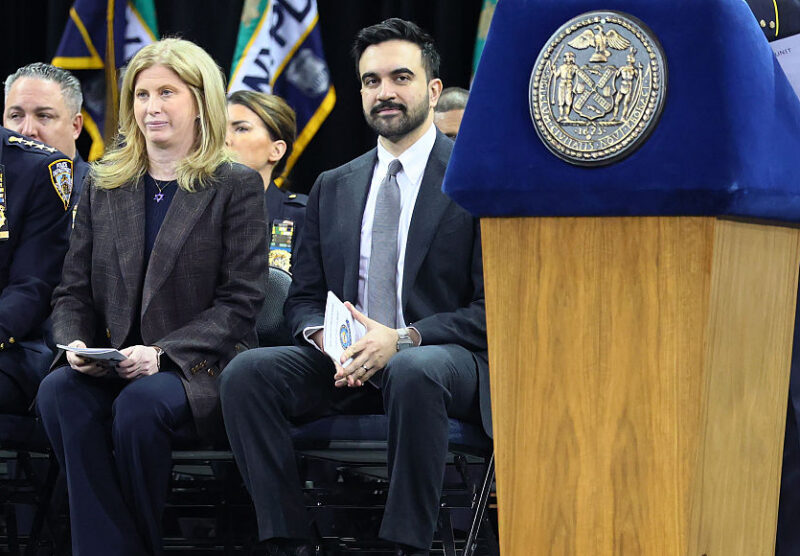
Michael M. Santiago/Getty Images
New York Police Department Commissioner Jessica Tisch and Mayor Zohran Mamdani attend the NYPD Recruit Graduation Ceremony at Madison Square Garden on March 09, 2026 in New York City.
But what of the elephant in the room: the fact that, as has been pointed out ad nauseam, Mamdani is the first sitting mayor not to march in this annual celebration of Israel since the parade’s inception in 1964?
I, for one, have no problem whatsoever with his decision not to do so. In fact, I never expected him to.
First, to paraphrase the insightful observation attributed, perhaps apocryphally, to Sigmund Freud, sometimes a parade is just a parade; and Israel Day on Fifth is precisely that — no more, no less. It’s as important and as significant to New York Jews as the St. Patrick’s Day parade is to Irish Americans, or the Puerto Rican Day parade is to New Yorkers of Puerto Rican descent, or the NYC Pride March, scheduled for June 28, is to the city’s LGBTQ+ community. At its core, this type of parade is an opportunity for people to get together to celebrate their heritage or their identity. Mamdani, had he marched, would most certainly have been booed by his detractors, which would have significantly dampened the atmosphere.
Moreover, Mamdani’s absence, while certainly high profile, was not unprecedented. Mayor Bill de Blasio boycotted the St. Patrick’s Day in 2014 and 2015 in protest against the exclusion of LGBTQ+ groups. In 2002, Mayor Michael Bloomberg refused to march in the Columbus Day parade because its organizers wouldn’t allow him to bring two stars from the TV series “The Sopranos” as his guests. Few people noticed. Even fewer cared.
Mamdani may be many things, but I don’t think even his enemies consider him to be a hypocrite, and his participation in the parade would have been denounced as hypocritical by his critics as well as his base. He is unabashedly pro-Palestinian and openly supports the Boycott, Divestment and Sanctions movement. Asked in a June 2025 interview whether he supports Israel’s right to exist as a “Jewish state,” he replied that “I support Israel’s right to exist as a state with equal rights,” adding that “I’m not comfortable supporting any state that has a hierarchy of citizenship on the basis of religion or anything else.” This position puts him in direct conflict with Israel’s very raison d’être as proclaimed in its Declaration of Independence as a simultaneously Jewish and democratic state. (To the best of my knowledge, Mamdani has not come out publicly in opposition to some 24 countries in the Middle East, North Africa, Asia and Sub-Saharan Africa that have Islam as their official state religion.)
None of this — even the double-standard to which Mamdani holds Israel — is new. I was one of many New York Jews who vehemently opposed Mamdani’s candidacy for mayor last year, deeply concerned that his election would exacerbate the manifestations of antisemitism in the city even though he promised to be protective of New York City’s Jewish community. As it turns out, he has been substantially true to his word and has made a valiant and, I think, sincere attempt to separate his anti-Israelism (a term I prefer to the more charged but in many ways meaningless anti-Zionism) from tangible initiatives on behalf of New York Jews, such as the Mayor’s Office to Combat Antisemitism.
To be fair, Mamdani has been consistent. “I said on the campaign trail that I wouldn’t be attending the parade, and I’ve made my views on the Israeli government abundantly clear,” he declared rather unequivocally at a briefing this past Thursday. At the same time, he emphasized, “I also said on that same campaign that I would have a responsibility as the mayor of this city to ensure the safety and security of each and every New Yorker. And I don’t believe that my presence as the mayor should determine whether or not any New Yorker is safe or secure.”
It is worth noting that the mayor referred to “the Israeli government” rather than Israel qua Israel — a not insignificant distinction, especially since in response to a question on whether he would be “open to meeting with members of the opposition or Israeli or Palestinian activists, grassroots leaders from Israel or living in New York,” he replied that he’d “been happy to meet with Israelis and Palestinians in the past. I would absolutely consider doing so in the future as well.”
When Mamdani and Tisch were asked if they had “any concerns about the mayor not being there,” Tisch, wearing a prominent Star of David necklace, jumped in to say, “It’s the mayor’s decision not to march and it is my decision to march proudly.” Optics are important, and the optics at the briefing in question, namely the smile on Mamdani’s face while Tisch spoke, served to indicate that Tisch would be “marching proudly” in the parade as an honorary marshal in her official capacity and with Mamdani’s approval. This was, to be sure, a compromise, but in this case, it was a positive one.
When it comes to Mamdani, the jury is decidedly still out. On the positive side, I am somewhat more optimistic after the parade that an equilibrium of sorts can exist between him and New York’s Jewish community. I am especially encouraged by his professed willingness to meet with Israelis, a willingness that I hope will extend to Zionists who disagree with him about Israel.
Still, none of us should fool ourselves into thinking that we have reached a “Kumbaya” moment. The mayor’s recent pre-Shavuot reception meant to celebrate Jewish American Heritage Month — to which, incidentally, I was invited — was a case in point. A few days before that event, in what was either a provocation or an instance of reckless insensitivity, Mamdani posted a video marking the Nakba, or catastrophe, the Arab term for the displacement of between 750,000 and 1 million Palestinians in 1947-1948, before and immediately after the establishment of the State of Israel.
I ultimately decided not to attend Mamdani’s May 18 outreach to the Jewish community, but not because he posted the Nakba video. I fully understand and respect his recognition of the very real pain and anguish endured by Arabs — in 1948, it was still some 15 years before they referred to themselves and were referred to as Palestinians — forced or otherwise compelled to leave their homes in what had been British Mandatory Palestine. I stayed away because he did not deem fit to balance his acknowledgment of the Palestinians’ trauma with even an awareness of the simultaneous discrimination, oppression and often lethal violence perpetrated by Arabs against Jews in Palestine and elsewhere in the Middle East.
I did not attend the Gracie Mansion Shavuot reception because Mamdani views the Israeli-Palestinian conflict through a false one-sided narrative in which Jews are the oppressors, the supposedly colonizing victimizers, and the Palestinians are the innocent victims.
For example, he could have also posted a video about the Farhud, the June 1941 pogrom in Baghdad, Iraq, during which between 150 and 180 Jews were killed and hundreds more were injured. He didn’t.
Mamdani could have balanced his endorsement of and identification with the Nakba narrative with a social media recognition, say, of the Arab massacre on April 13, 1948 — one month before the establishment of the State of Israel — of 78 doctors, nurses and patients, 23 of them women, and a British soldier on their way to the Hadassah Hospital on Jerusalem’s Mount Scopus. He didn’t.
Mamdani could have paired his Nakba video with a piece about the more than 820,000 Jews from Arab and North African countries who were forcibly, often violently, expelled between 1947 and 1972. Again, he didn’t.
I want to be absolutely clear: I am a lifelong Zionist, but my Zionism is rooted in the knowledge and firm belief that the land between the Mediterranean and the Jordan River is home to two peoples, each of which is entitled to full civil and human rights, including the right to self-determination. Hamas and its supporters want to deny that right to Jews; the Netanyahu government seems intent on denying it to Palestinians. By placing the authority of the New York City mayoralty exclusively and myopically on the Palestinian side, Mamdani seems to studiously ignore a reality best expressed by Abba Eban, Israel’s legendary foreign minister, that the Israeli-Palestinian conflict is not a conflict between right and wrong but a conflict between two rights. If he wants a chance of gaining our trust, we need to hear Mamdani say so as well.
Perhaps Mamdani’s adept navigation of the parade controversy is a sign that there may be further improvements in his relationship with the Jewish community. At the same time, we must avoid being lulled into complacency, and hope that the faint light we see at the end of this particular tunnel is not a locomotive bearing down on us.
Menachem Z. Rosensaft is adjunct professor of law at Cornell Law School, lecturer-in-law at Columbia Law School and general counsel emeritus of the World Jewish Congress. He is the author, most recently, of Burning Psalms: Confronting Adonai after Auschwitz (Ben Yehuda Press, 2025).