WHAT YOU SHOULD KNOW
As gala season hits, some nonprofits go for glam, others opt for more intimate affairs
Haim Zach/GPO
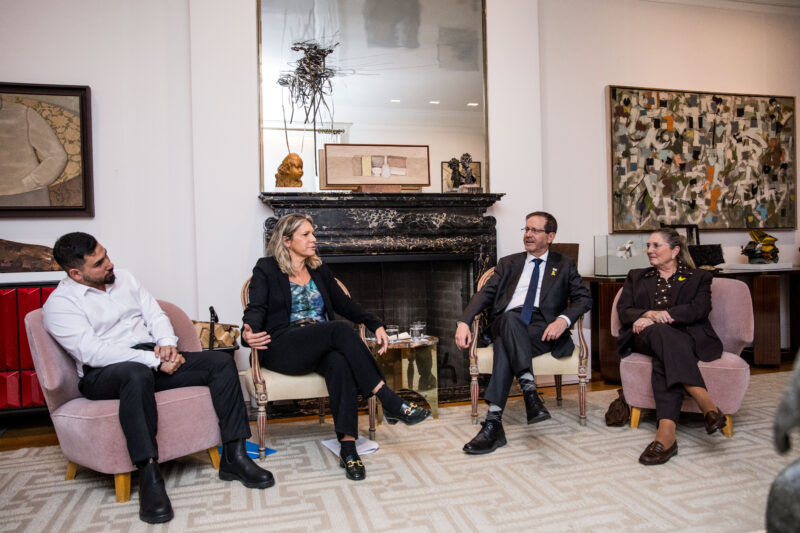
From left, Sergeant Major Reuven Ben Parash, Dr. Osnat Levtzion-Korach, the director of Israel's Shamir Medical Center, Israeli President Isaac Herzog and First Lady Michal Herzog speak at an event in New York City on behalf of the hospital on Dec. 7, 2025.




 Add EJP on Google
As the days get shorter and winter’s snow and rime grip the north, it is a sign that gala season is upon us, that final push to raise funds before the year ends, and the urgency to donate dissipates.
Just since last week, UJA-Federation of New York held its annual Wall Street Dinner; the Israel Policy Forum had its annual gala; Yeshiva University hosted its 101st Hanukkah Dinner; the Jerusalem-based Shalva National Center marked its 35th anniversary; American Friends of Shamir Medical Center held an intimate fundraising gathering; and Friends of the IDF convened its Young Leadership Gala, among many others. And the coming week is scheduled to see events for the Center for Jewish History, American Friends of Magen David Adom and United Hatzalah (both in Miami, two days apart), American Friends of Anu Museum of the Jewish People, Fuente Latina and the Institute for Jewish Spirituality, also among many, many others.
As with every year, this wintry flurry of fundraising fetes forces us to confront their efficacy. But the debate over the efficacy of galas has become increasingly acute in the wake of the Oct. 7 terror attacks and the rise of antisemitism globally. In light of the severity and scope of the Jewish community’s needs — and frustrations with Jewish communal institutions’ efforts to address them — a growing chorus of anarchic figures is questioning the status quo, and swanky galas full of champagne, canapes and celebrities make for easy targets.
Fundraisers themselves are split on the matter. Some consider these high-profile gatherings to be a critical tool in their tool belt, a way to highlight generous donors and volunteers, court new ones and spread their organization’s work.
“This is because galas aren’t just about raising funds; they’re about raising friends. They are about elevating our brand and making a statement about who we are and where we are going. And above all, they create something increasingly rare in today’s fast-paced, fragmented world: meaningful, in-person connection,” wrote Suzy Bookbinder and Michelle Starkman in an opinion piece for eJewishPhilanthropy earlier this year, arguing that point.
Others, however, consider the glitzy galas as all sizzle and no steak, an inefficient use of resources in a time of growing needs and skepticism.
“Perhaps most importantly, event-driven fundraising can strain donor relationships. Treating donors as ATMs for one-off transactions tied to specific events risks donor fatigue and may weaken their connection to the mission,” lay fundraiser Michelle Friedman argued in her own eJP opinion piece ahead of last year’s gala season, calling instead for more annual giving campaigns.
Surprisingly, perhaps, there is scant data available to back up either argument. The studies that have been performed on the topic — notably one by an Italian doctoral student at Luiss University last year and one by Anora Snyder at online Walden University in 2020 — have yielded middling results. The former found that there was a moderate increase in “the proportion of overall flexible donations,” while the latter found that the money raised “only minimally… contribute[s] to financial sustainability.”
A general rule of thumb is that it costs roughly 50 cents to raise a dollar through galas and other luxury events, but potentially more. In some cases, nonprofits break even or end up losing money on their lavish affairs. “In those instances, only the venues, the entertainers and other vendors profit financially,” Philip Hackney, a University of Pittsburgh law professor, and Brian Mittendorf, an accounting professor at The Ohio State University, noted in a 2017 opinion piece on the subject.
However, nonprofit experts generally agree that galas can serve a useful function, though not necessarily for fundraising purposes. Indeed, several of the events that have happened or will soon happen are not specifically designed to raise money. The Shalva National Center’ its 35th anniversary gala was just a celebration of its achievements in caring for Israel’s disabled population, a spokesperson told eJP.
In the case of the Shamir Medical Center, the intimate gathering — held at a supporter’s home — helped raise awareness about the less well-known central Israeli hospital among New York’s donor class. “Shamir Medical Center was not traditionally on the radar of American Jewry. It sits on the outskirts of the country’s center, toward the south, and today treats well over a million people,” Israeli President Isaac Herzog told the attendees, discussing his visit to the hospital in the wake of the Oct. 7 attacks. “We were deeply impressed. It’s a place American Jewry should know and feel connected to.”