ON THE SCENE
American Jewry ‘Un-Conference’ offers concrete plans for Jewish leaders to create new ‘golden era’
Invite-only gathering brings together leaders and thinkers for discussions on the future of U.S. Jews amid a period of crisis
courtesy
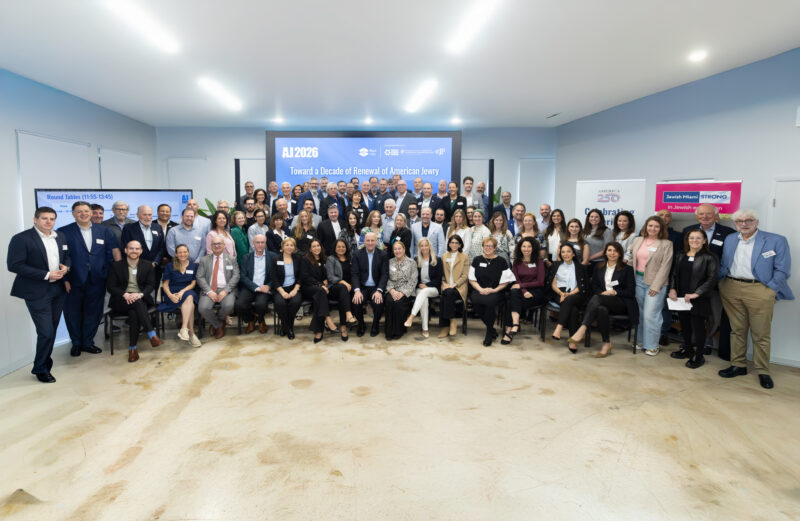
Participants in the American Jewry Un-Conference, organized by Reut USA, in Miami on March 4, 2026.




 Add EJP on Google
MIAMI — Last year, journalist Franklin Foer — a scion of one of American Jewry’s most prominent families — declared in an extended essay in The Atlantic that “the golden age of American Jews is coming to an end,” a prophecy that has since been repeated by a wide array of Jewish leaders and public intellectuals.
Gidi Grinstein, the founder and president of the Reut USA think tank, is not so sure, or at least believes that it is not the end of the story.
While “our history teaches that [growing polarization and heightened antisemitism] are very concerning trends, we are better and bigger than surrendering to pessimism,” Grinstein said in his opening remarks at Wednesday’s American Jewry Un-Conference, subtitled “Toward a Decade of Renewal of American Jewry,” held in Miami.
Instead, “we believe that another golden era may lie ahead,” he said. “The current crisis is also an opportunity for community growth. We’re here to build a mindset and identify the avenues that will make a great future feasible.”
The event, which coincides with the 250th anniversary of American independence, was deemed an “un-conference” because there was no hierarchy between the speakers and the attendees, who were also experts in the Jewish world and who voiced their opinions during panels. It gathered over 100 American Jewish leaders and philanthropists to develop concrete steps to combat this generation’s biggest issues.
Last July’s un-conference, held in New York, came up with an 11-point agenda consisting of pivotal issues, with the goal of revitalizing the American Jewish community by 2054 — 400 years after the first Jews from Brazil set foot on what was then New Amsterdam.
But the first un-conference was “not ambitious enough,” Grinstein told eJewishPhilanthropy at this year’s event, because attendees weren’t given steps to take to combat the issues. This year would be different. This year, attendees would have a plan.
The event, which cost around $60,000 to run, was a partnership between Reut USA, the Weitzman National Museum of American Jewish History and the Greater Miami Jewish Federation, as well as eJP, the media partner for the conference. Attendees didn’t pay to attend; panelists weren’t paid; and no one — except special guest, doyen of American Jewish history Jonathan Sarna — was allowed to speak for over four minutes. The goal: 250 new ideas to nudge the Jewish world forward.
“Funding our ideas will require a lot of money, but we are the wealthiest generation in Jewish history,” Grinstein told the crowd. “Our challenge is to bring forward good ideas and the leaders.”
Israeli President Issac Herzog addressed the event virtually, sending greetings from war-torn Israel. “As a people, our strength lies not in military power at all,” Herzog said. “It is the inner resources of our nation, our creativity, our connection, our belief in one another.”
Many issues already firmly in the Jewish communal zeitgeist came up repeatedly during panels — particularly the high cost of tuition for formal Jewish education and the importance of better welcoming interfaith families. But other, more novel ideas, were also floated, including: training college students to attain positions in student governments; giving firm “nos” to funders when programs won’t push the community forward; being willing to shutter programs that are failing; investing in technology, data and research that are difficult to raise money for, but can advance the community; not simply sending people to Israel but setting expectations for them once they return; and uplifting Israeli voices living in the Diaspora to serve as a bridge between communities.
Mark Penn, president and managing partner of The Stagwell Group, called for attendees to take back the media to “reclaim the young people” who were stolen by TikTok, offering Bari Weiss, who started her career as a pro-Israel activist at Columbia University and was recently named editor-in-chief of CBS, as an example of a success.
After an attendee recommended rebranding Israel away from the focus on democracy and instead focusing on the country’s agriculture technology, Brooke Goldstein, executive director and founder of The Lawfare Project, recommended instead focusing the Jewish community’s effort on speaking out on the threat of Islam to America. “We learned this Passover, every generation Amalek is coming,” she said, misquoting both the Haggadah and the Torah to compare Arab Israelis to the Jews’ eternal biblical enemy, which they are ordered by God to kill, including women, children and livestock, soon after saying that Jews love human and civil rights. “Why? Because Moshe Rabbeinu did not extinguish every last ember [of Amalek].” (On Passover, Jews recite the liturgical poem “Vehi She’amda,” which refers generally to an enemy rising up to destroy the Jews every generation, not only the Amalekites; and traditionally, King Saul is remembered for his failure to kill all Amalekites despite being ordered to by God, not Moses.)
Sarna, who wasn’t able to attend in person but appeared via Zoom, discussed another difficult period in the American Jewish story, the interwar period. During that time, Henry Ford went on an antisemitic crusade in the United States, new technologies undermined traditional Shabbat observance, and the American government effectively shut down Jewish immigration. It was the worst of times, but it was also a time of great innovation in the Jewish world. Synagogues became community centers as country clubs rejected Jewish members, Sarna said. The labor movement brought America five-day work weeks, offering Jews Shabbat off, allowing them to further integrate into the wider workforce. Day schools were created. The Joint Distribution Committee, which was established before World War I, expanded during the interwar period and allowed Jews of all backgrounds to support the Jewish community living in what would become Israel.
Innovative ideas often come from the fringes and are often criticized at first, Sarna said, but “innovation could come from anywhere.” In the darkest periods come sparks, he said, adding: “Don’t give up.”
Today’s “next generation of Jewish leaders [were] created on campuses,” Sarna said. There has also been an influx of people converting to Judaism post-Oct. 7. As people rush to join the Jewish community, they need to be embraced. “We need to not leave them dripping at the mikveh,” Sarna said, referring to the ritual immersion that marks the formal end of the conversion process.
At numerous times during the gathering, there were even calls for American Jews to flood into Miami, a trend of migration occurring as many Jews are choosing the city over traditional Jewish hubs like New York and California. Scott Kaufman, CEO, Miami Federation, who opened the un-conference, joked that the city was “like Tel Aviv, only more Zionist.”
There were appeals from the floor to invest in Jewish-owned and Israeli businesses. “The reason why every single person [is at this un-conference] is because of our economic success,” Brian Spivak, founder and CEO of Barzel Media, said. “Philanthropy does not exist without economic success, without investing in Jewish businesses, without investing in Israel.”
Ethan Bazak, an undergraduate student at Florida International University, recommended that the Jewish community invest in teaching young leaders how to manage money. “My generation has a hard time understanding money,” he said. “I don’t think it’s something new. The wealth inheritance that’s about to happen for my generation is so grand, and the knowledge of money and understanding of how things work is becoming more grand.”
Reut USA did not intend to include the entirety of American Jewry in the future-imagining event, focusing on the community’s core center and excluding the extremes on the right and left, Grinstein said.
The invite-only event included attendees from numerous Jewish federations, organizations and institutions of higher learning, but there were no representatives from organizations that specifically cater to more marginalized groups within the Jewish community, such as Jews of color or the LGBTQ community.
“It’s a point we need to improve on,” Grinstein acknowledged. “We could have had more diverse voices, but we are only having people who are invested in the community, so if you are out there throwing stones at the building, it’s not for you.”
Perhaps surprisingly, Zionism and antisemitism were not core topics at the event because they are the two issues that “sap the energy out of the room they consume,” Grinstein said. “If we were to start with these topics, we’re going nowhere. It’s going to be impossible to talk about education, leadership, institutional renewal, all these non-sexy things that are really the determinants of the long-term well-being of the community.”
In the coming days, Reut USA plans to send action items to attendees including the need to push for American Jewish studies at the college level; throwing distinctly Jewish celebrations for America’s 250th anniversary; developing curriculum for schools and camps about the resiliency of Jewish Americans; seeing polarization as an issue of national security to American Jewry; focusing on “purple issues” that overlap political parties in the center; and investing in community relations with other minority communities.
Attendee Enrico Ravenna, executive director of the Jewish Federation of Arkansas, said he is returning to his home community emboldened. He began his position six months ago and was excited to “learn from the best in the business” at the un-conference, he told eJP.
At the event, Ravenna recommended funders invest in smaller Jewish communities because they are often the only Jews whom non-Jews meet in their cities and states. Additionally, Jewish leaders in small communities are, practically by definition, experts at cross-cultural relationships because they have no other choice. This year, on July 4, Ravenna said he plans to further his friendships across cultures by partnering with other communities for Independence Day celebrations. Prior to accepting the job at the Arkansas federation, he didn’t know a single Jew lived in the state. Today, he wants the world to know that the Arkansas Jewish community dates back to the mid-19th century.
Jessie Dowsakul, CEO of the Columbia (S.C.) Jewish Federation, a similarly small federation, said she wished there were similar events for a cohort of young Jewish leaders. “When you talk to someone in their 30s and 40s, they’re hungry,” she told eJP.
Last year’s un-conference skewed older, Kaufman, the Miami federation CEO, told eJP, but more young leaders are entering the conversation as large donors who are used to doing things a certain way are learning they need to listen to other voices.
“The secret weapon of Jewish Miami is [people in their] 20s and 30s,” he said. There are “a zillion” talented young Jews who are “wired” to be involved in the Jewish community.
Kaufman wished there were more senior management from the biggest foundations present at the un-conference, but there may have been a scheduling conflict due to the Jewish Funders Network Conference in San Diego later this month.
Having an event like this, which brings everyone together for partnerships, was important, he said, because often, leaders “start from zero.” Post-conference, he has a list of experts he plans to reach out to for support.
The final panel concluded with attorney Kathy Manning, a former Jewish Federations of North America board chair and former United States representative from North Carolina, leading the audience in the Shehecheyanu blessing. It was her way of concluding a monumental event, she said.
In 2054, when people look back on this post-Oct. 7 moment, “the question will not be whether we faced a setback” in the years after the attacks, Caryl Stern, executive director of the LionTree Foundation, said at the event. “The question is going to be, did we use it as a turning point. Renewal is not guaranteed, but it is available. And it’s our responsibility to choose it.”
Reut USA provided eJewishPhilanthropy’s travel and accommodations for the conference.
Related News
HIGHER EDUCATION
As Jewish donors reconsider academia, Jan Koum doubles down, endowing Israel studies at Stanford

MAJOR GIFTS
Center for Jewish History celebrates 25 years with a $25M matching grant
ADVANCING A VISION
N.Y. federation donates $1M toward building shared-society center named for peace activist killed on 10/7
EXIT INTERVIEW
Elizabeth Sokolsky, longtime EVP of Birthright Israel, to retire next year
CLOSING WORDS
In AZM address, Cosgrove links communal ‘orthodoxy’ on Israel to rising anti-Zionism among young Jews