WHAT YOU SHOULD KNOW
After a year of playing, Tzomet Games compares its simulations to real-world Jewish leaders’ rhetoric
Screenshot/
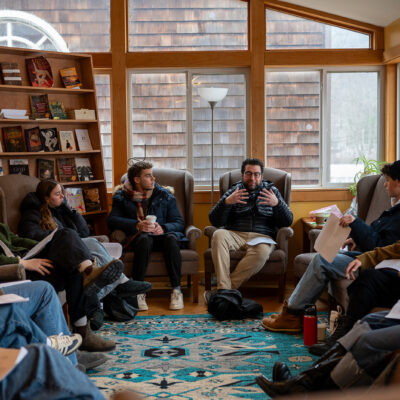
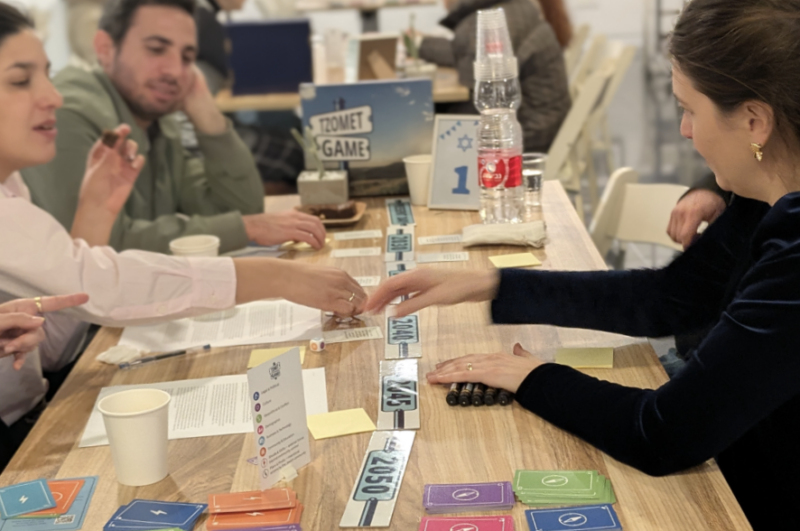
Leaders build a 2025–2050 timeline using the Tzomet Game in a photo featured in the Tzomet Games 2026 strategic analysis report.




 Add EJP on Google
For more than a year, hundreds of Jewish professionals across the United States and around the world have been playing a game forcing them to consider: What will American Jewry look like in 2050?
Launched last May, Tzomet Games — the brainchild of Jewish entrepreneur and philanthropist Phil Siegel — aimed to inspire its players to think beyond solving today’s crisis or even devising a short-term strategy, and to make long-term plans to advance a desired future — something few Jewish organizations do on a regular basis.
“Some of the organizations that we ran the game with asked, ‘OK, this is great, but how does this help us build our three-year work plan?’” Barak Sella, an American Israeli educator, researcher and activist who serves as a consultant for Tzomet Games, told eJewishPhilanthropy. “And I had to push back and say, ‘Look, this is not about a three-year work plan. You don’t need to play the Tzomet Game to build a three-year strategic work plan. You can hire any consultant, any expert, any strategist to help you with that. What the game is doing is talking about a longer-term goal and a longer-term perspective, which work plans do not address.”
The game presents groups of players with one of four scenarios that imagine American Jewish life in 2050, written by author Dara Horn. Over the course of the roughly two-hour game, they draw cards detailing different possible developments. In some cases, they would choose which of those developments would lead the American Jewish community to their selected future and when they would have happened, and in other cases, a development would be forced upon the players to grapple with. At the end of the game, the players would have constructed a 25-year timeline that is meant to lead coherently from today to whatever future they selected.
Beyond giving participants an opportunity to think strategically in the moment, from the start, Siegel planned to document the games meticulously, allowing his team to examine the participants’ decision-making process. Tzomet Games is now releasing its report based on its first year of operation, examining both what key topics emerged from the future-focused games and how that compares to what contemporary Jewish leaders are speaking about in their public remarks.
To make the comparison, Sella and Siegel examined 15 public, transcribed speeches by leading American Jewish figures, such as Eric Fingerhut, president and CEO of Jewish Federations of North America, speaking JFNA General Assembly; Ted Deutch, CEO of the American Jewish Committee, at the AJC Global Forum 2025; Jonathan Greenblatt, CEO of the Anti-Defamation League, at the ADL’s Never Is Now summit; and Bret Stephens, New York Times columnist and editor-in-chief of Sapir, delivering this year’s State of World Jewry Address.
“Our data validates that, on some issues, the leaders actually get it,” Sella said.
In the game, antisemitism was a key feature in much of the discussions about the Jewish future, even in the positive scenarios; it is also a common topic in the real-world speeches. Jewish education was also regularly highlighted in both, as were improving Israel-Diaspora relations, increasing engagement, institutional reform and maintaining bipartisan support for Israel.
On other issues, Jewish leaders did not address topics that were found to be hugely significant in imagining the future of American Jewry, chiefly demographics. Though they routinely came up in the games — and are, in reality, a major force in Jewish communal dynamics — migration patterns, birthrates, conversions and in vitro fertilization were not mentioned in any of the 15 public speeches.
“Corporations use really, really complicated data sets to predict: If there is a high schooler in Madison, Wis., where is he going to be when he’s 30, and which city is he going to live in, and what are going to be his spending patterns so I can know where I have to place my next retail outlet. If we look at our Jewish history, migration in the U.S. had a huge impact on how our community was formed,” Sella said.
“Migration to the suburbs post-World War II was maybe one of the most impactful events that shaped Jewish life. Not thinking now about potential Jewish migration in the U.S. and how Jewish life is going to be different in 25 years is a missed opportunity. We should be thinking and we should be making bold decisions around where Jews are going to be and make investments that reflect those demographic trends,” Sella said.
American Jewish leaders also did not regularly discuss geopolitical issues — the two-state solution, the Middle East and great-power competition — despite these having a profound influence on American Jewish life.
Artificial intelligence, though it was discussed in some speeches, was also a blindspot in the public remarks, Sella said. Where it did come up, it was primarily about concern over how these new systems can be used.
“This might seem like a banal insight because if you open any news site everything is about AI, but if you look at the major Jewish speeches in the last year, AI is actually not central to them at all and if it is mentioned in some way it’s usually in a defensive manner as a threat,” he said. “But in the game simulations, AI is imagined as something much more diverse, as something that is a threat, but is also the major tool and major pathway for a thriving community.”
According to Sella, this disparity matters because a better grasp of how AI can be used effectively could give a massive leg up for Jewish communities. He compared it to other areas in which Jewish groups were slow to embrace new, world-changing technology, and then had to rush to catch up.
“If you could go back 20 years in the past to 2006 and tell all the major Jewish leaders, ‘Look, there’s something new. It’s called social media. You don’t really understand it yet. It’s a bit scary. You might not think that it’s going to change our lives or maybe you do, but you don’t understand how, but it’s going to change everything about how we communicate, how we understand each other, how society is built and works. And you should invest 50% of your resources now in shaping your strategy around social media,” he said. “The data [from the games] show that it is similar with AI. The players are looking at AI as something extremely central. AI is going to upend, potentially, our economic system. That is also going to influence the Jewish community in ways that it’s hard to understand.”
As the speeches needed to be both publicly available and transcribed, Sella acknowledged that this significantly limited the pool of speakers: 13 of the 15 speakers are men; and none of them is Sephardi, Haredi, LGBTQ or a Jew of color. This lack of representation is significant as the demographics of the American Jewish community now include more of all of those groups.
“I was looking for speeches that were documented fully and transcribed. … And I also wanted people who represent large Jewish constituencies,” Sella said. “I was looking specifically for speeches that explicitly address the priorities for the Jewish future, and unfortunately there weren’t a lot of speeches that fit that criteria so firmly, not only talking about the crisis that we’re in or the spiritual crisis, but talking about, ‘Here’s what the Jews should be doing in the next 10 years.’”
Sella noted that the speeches are an imperfect indicator of Jewish communal priorities. People can speak repeatedly about things that they are not effectively addressing and omit areas that their organizations are focused on. But they do offer general insight into what leaders care about and what they think their audiences care about, he said.
Going forward, Sella said that Tzomet Games now plans to expand in two directions: getting more people to play the current game through a digital version and creating bespoke versions for specific communities and organizations.
“Our goal in Tzomet Games is not to lay out the vision for the Jewish future. We’re not trying to be the next Herzl,” Sella said. “What we are trying to do is give the Jewish community the tools to bring forward the next Herzl and to make sure that the Jewish community is ready to support that vector in any way that we can.”