Seeds of change
Adamah gets 1,100 volunteers to ring in New Year with environmental work in NYC
This marks the group's first time participating in Climate Week NYC as it gains experience hosting large events
Courtesy/Adamah
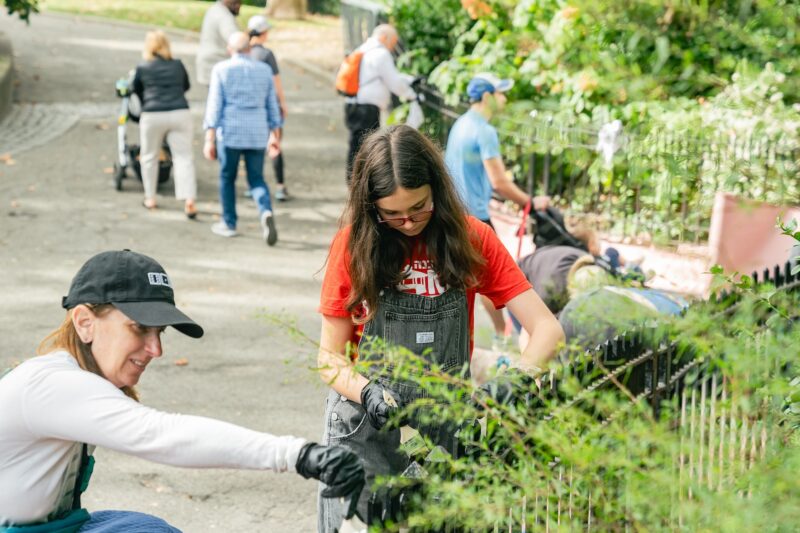
Participants in Adamah's Rooted program clean up in a park in New York City as part of the city's Climate Week on Sept. 21, 2025.




 Add EJP on Google
There was a time when American chestnut trees blanketed over 8 million acres of America providing birds, deer and humans with the sweetest, butteriest nuts loaded with fiber and antioxidants. Often towering over 100 feet, the tree’s lightweight, durable, rot-resistant wood was used to make fences and furniture. But in the early 20th century, an alien fungus infiltrated America, transported overseas on trade ships from Asia, destroying billions of the superpowered trees.
Today, an estimated 430 million still exist, but blight halts most from reaching more than an inch in diameter.
Last month, on a near-perfect day — 71 degrees — a group of 40-plus volunteers gathered at the Science Museum of Long Island to help four new American chestnuts take root. Brawny men dug holes while women wheelbarrowed compost. Young children dropped root bulbs into their new homes as elders guided them from the sidelines.
It was “a spiritual moment,” Mindy Germain, the site captain told eJewishPhilanthropy. “We just wanted to get it right and give these trees every opportunity to succeed.”
Her contingent planted over 170 native trees and shrubs on Sept. 21, as part of “Rooted: A Jewish Day of Service for the Earth,” an event organized by Adamah NY, which was part of the larger Climate Week NYC. Over 1,100 participants brought in the Jewish New Year by cleaning, planting, weeding and clearing trails across New York City, Westchester County and Long Island.
“It wasn’t just about teaching people that caring for the earth is important and sacred,” Germain said. “It was giving that connection with their own hands.”
Although Climate Week NYC has run since 2009, this was Adamah’s inaugural event tied to the initiative because the group was waiting for the timing to be right. Adamah launched two-and-a-half years ago, a merger between Jewish environmental organizations Hazon and Pearlstone, with the New York hub established soon after. Since then, its staff has grown to six, and the organization has gained experience running smaller events and connecting with partners, all leading to this larger event.
Rooted made “a statement about opening the year clean and with intentionality,” Shahar Sadeh, director of Adamah NY, told eJP.
Many city dwellers believe that they need to journey upstate to connect with the earth, but “nature is all around us,” Sadeh said. “The Hudson River and the East River are nature and [so are] the trees that we’re taking care of.”
One of the goals for the day was to link Jewish advocates into the larger environmental activist movement. Adamah NY is part of a coalition that aims to increase the tree canopy in the city from 23.4% to 30% by 2035. Doing so will improve air quality and offset the effects of global warming. Adding trees to city streets also offers the opportunity to cultivate a literal “fruit forest,” Sadeh said. One she hopes will include apple trees, perfect for the Jewish new year.
Rooted was primarily funded by UJA-Federation of New York, which supported five large one-day initiatives to capitalize on the “Surge” of Jews into Jewish life post-Oct. 7. These programs included The Great Nosh food festival, held in June on Governor’s Island in Manhattan, and The Big Shabbat, a dinner set for next month at Temple Emanu-El’s Streicker Center and expected to draw 3,000 people.
“We make a lot of investments in combating antisemitism, but in addition to that we also have to invest in strengthening and building Jewish life,” Hana Gruenberg, managing director of the Jewish Life Department at the New York federation, told eJP. “We’ve never been a people that [has] been all about the combating and the anti. What are we fighting for if not to build Jewish community that will last beyond us, that will perpetuate our values, that will engage people [and] create meaning?”
While Gruenberg is not certain if the same grant will be offered next year for one-time programs, UJA-Federation of New York is dedicated to supporting Adamah NY. She was worried it would pour during Rooted, she said. “Thank God I was in charge of the weather. I really delivered on that,” Gruenberg joked.
Rooted participants volunteered at 23 sites across New York City, Westchester and Long Island. Participating organizations, including the Marlene Meyerson JCC Manhattan and the East Midwood Jewish Center, chose sites near their institutions, in order to connect to the land they used daily.
One educator from the Midwood Center was so excited to clean up Coney Island Creek that she rallied 100 people to help. Connections like this are “long-lasting, between a person and their green space,” Meira Silverstein, director of Rooted, told eJP.
Many site captains reached out to interfaith partners, allowing the event to serve multiple purposes. The events were also intergenerational, with five sites hosting Mini Rooted events, which were partnerships with PJ Library and the Manhattan-based Jewish music organization Tkiya. At these events for children 8 and under, families sang together, read stories and created seed balls, which organizers note are fun to make and even better to toss, allowing kids to help New York flourish.
Site locations were announced at the last minute due to security concerns. “Despite that and despite the fact that it was a day before Rosh Hashanah and many of the Jewish institutions were focusing on their High Holiday offerings and not focusing on bringing people to the parks, we had a really great turnout,” Sadeh said.On the Thursday of Climate Week NYC, Adamah also announced the launch of its Jewish Green Business Network, made up of entrepreneurs, investors and professionals dedicated to climate actions, planting seeds for future work together.
Related News

MAJOR GIFTS
Center for Jewish History celebrates 25 years with a $25M matching grant
EXCLUSIVE
Detroit-based philanthropists Nancy, James Grosfeld donate $8M to renovate JDC’s Israel campus

MAGICAL EXPERIENCE
Shefa launches psychedelics retreat for Jewish professionals suffering burnout

PRESIDENTIAL REBUKE
Israel’s Herzog: Mamdani ‘makes no effort’ to hide disdain for Israel, Jews must fight back

EXIT INTERVIEW
Elizabeth Sokolsky, longtime EVP of Birthright Israel, to retire next year