Jewish people’s parliament
A contentious World Zionist Congress kicks off in Jerusalem with slates expected to duke it out over budgets, positions and resolutions
Some 2,500 people from around the world arrive in Israel for the congress, which organizers and participants anticipate will be particularly heated
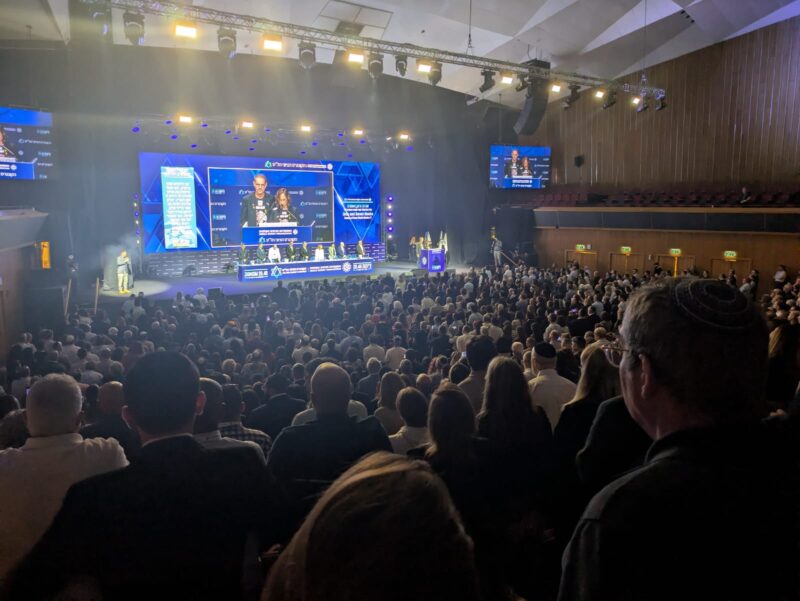
Judah Ari Gross/eJewishPhilanthropy
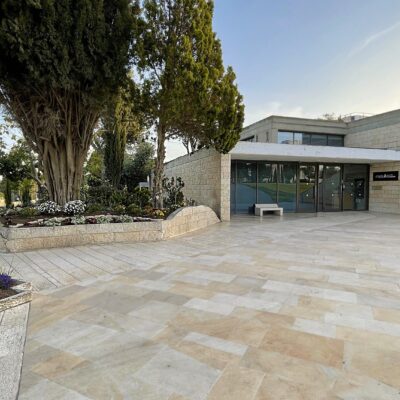
The 39th World Zionist Congress opens at in Jerusalem on Oct. 28, 2025.




 Add EJP on Google
The 39th World Zionist Congress kicks off in Jerusalem on Tuesday, with more than 2,500 people — voting delegates, observers and staff members — in attendance. Over the course of three days, the congress will debate and vote on the budgets, appointments, committee makeups and resolutions that will guide the so-called National Institutions over the next five years.
The congress and its executive body, the Zionist General Council, control a roughly $5 billion five-year budget, which will be voted on during the gathering. They will also select the leadership of the World Zionist Organization, which runs and supports Zionist programming around the world; Keren Kayemeth LeIsrael-Jewish National Fund, which controls more than 10% of the land of Israel and wields an accordingly massive budget; Keren HaYesod, a major international fundraising operation; and the Jewish Agency for Israel, which oversees Jewish immigration to Israel, leads international educational programs and supports social initiatives in Israel.
The delegates will vote on 19 constitutional amendments put forward by the parties and slates that make up the congress. These include lowering the age at which people can vote and serve as delegates to 17 (a potential boon for the high-birthrate Haredi parties), requiring gender parity among representatives (a focus for the centrist Yesh Atid party) and establishing a memorial day for Rabbi Ovadia Yosef (a proposal by the Sephardi Haredi Shas party), along with a number of more administrative changes to the World Zionist Organization constitution.
The 39th congress also opens in the pall of a controversial election period, which was marred by widespread cases of confirmed fraud, which were first reported by eJP, along with suspicions of further illicit activities and a resulting sense of disappointment and frustration by many of those involved.
The congress, which is being held in Jerusalem’s International Convention Center, Binyanei Ha’uma, opened on Tuesday with registration, welcoming remarks and initial committee meetings. The welcoming remarks included an address by Orna and Ronen Neutra, the parents of fallen soldier Omer Neutra, whose remains are still held in Gaza. On Tuesday evening, the congress will host a celebratory opening ceremony, which will be attended by Israeli President Isaac Herzog.
For the first time since the founding of the state, the prime minister of Israel, Benjamin Netanyahu, will not address the World Zionist Congress. Insiders credit this to both Netanyahu’s concern that he will be booed by delegates and the premier’s long-running dispute with the World Zionist Organization Chair Yaakov Hagoel, a member of Netanyahu’s Likud party who backs one of the prime minister’s rivals, Danny Danon.
On Wednesday morning, delegates will hold further committee meetings and roundtable discussions, followed by tours of different locations throughout the country.
On Thursday, the congress will hold its voting sessions. “Thursday is where people are going to, you know, kill each other,” Tova Dorfman, president of the World Zionist Organization, quipped to eJP, echoing similar statements by a number of people involved in the congress.
Whereas in previous congresses, different parties and groups would be more willing to reach across the aisle and collaborate on shared goals, organizers and participants told eJP that no such sense of camaraderie and shared purpose are expected this year.
Though right-wing and religious slates narrowly edged out their more liberal competitors in most of the elections this year, the World Zionist Congress is not built as a winner-take-all institution but as a far more complicated parliamentary body. In addition to the 543 delegates with full voting rights who serve in the congress — 209 from Israel, 155 from the United States and the rest from the rest of the world — there are hundreds of representatives from large, mainstream Zionist organizations who can serve as a bulwark against partisanship and political extremism. These organizations include Hadassah, B’nai Brith, the Women’s International Zionist Organization, Emunah and others. In the past, these representatives have not played dominant roles, but they are expected to be more involved in this year’s congress, according to insiders.
The 543 full-voting delegates come from a wide array of Jewish organizations, including the Orthodox, Conservative, Reform and Reconstructionist movements, as well as Israel-focused organizations, such as J Street, the Zionist Organization of America, New Jewish Narrative and the Israeli-American Coalition. Top leaders of these organizations and denominations will also participate as delegates.
After first joining the World Zionist Congress in 2015, Haredi slates have seen their numbers skyrocket, with the American parties — Eretz Hakodesh and Am Yisrael Chai — collectively holding 40 of the 155 American seats.
In addition to being the first gathering since the Oct. 7 terror attacks, this is the first full congress to be held in Jerusalem in a decade, as the prior one, five years ago, was held virtually due to the outbreak of the COVID-19 pandemic that year. To make up for that remote gathering, the congress held an “extraordinary” session in Jerusalem some two and a half years ago, though that focused primarily on resolutions and other largely symbolic matters.
The extraordinary congress, held at the height of Israel’s judicial overhaul protests, saw near-violent protests, as well as a filibuster by a right-wing party that prevented in-person voting on resolutions — much to the consternation of the hundreds of delegates who had flown to Israel specifically to vote in the congress. The incidents at the 2023 gathering remain fiercely debated by those who were in attendance (as evident from several of them being raised during the World Zionist Congress election debates hosted by eJewishPhilanthropy earlier this year.)
This year’s conference will also include a series of votes on resolutions — at least 26 have been proposed — but the real-world implications associated with passing a budget, making significant appointments and launching programs are expected to make the gathering even more heated and contentious than the 2023 gathering.
The 39th congress also opens in the pall of a controversial election period, which was marred by widespread cases of confirmed fraud, which were first reported by eJP, along with suspicions of further illicit activities and a resulting sense of disappointment and frustration by many of those involved.
The congress, which is being held in Jerusalem’s International Convention Center, Binyanei Ha’uma, opened on Tuesday with registration, welcoming remarks and initial committee meetings. The welcoming remarks included an address by Orna and Ronen Neutra, the parents of fallen soldier Omer Neutra, whose remains are still held in Gaza. On Tuesday evening, the congress will host a celebratory opening ceremony, which will be attended by Israeli President Isaac Herzog.
For the first time since the founding of the state, the prime minister of Israel, Benjamin Netanyahu, will not address the World Zionist Congress. Insiders credit this to both Netanyahu’s concern that he will be booed by delegates and the premier’s long-running dispute with the World Zionist Organization Chair Yaakov Hagoel, a member of Netanyahu’s Likud party who backs one of the prime minister’s rivals, Danny Danon.
On Wednesday morning, delegates will hold further committee meetings and roundtable discussions, followed by tours of different locations throughout the country.
On Thursday, the congress will hold its voting sessions. “Thursday is where people are going to, you know, kill each other,” Tova Dorfman, president of the World Zionist Organization, quipped to eJP, echoing similar statements by a number of people involved in the congress.
Whereas in previous congresses, different parties and groups would be more willing to reach across the aisle and collaborate on shared goals, organizers and participants told eJP that no such sense of camaraderie and shared purpose are expected this year.
In a bid to prevent a filibuster like the one that was used in the congress held two-and-a-half years ago — which forced an oral roll-call vote — the organizers of this year’s plenary have turned to technology, having the votes be held through an application on the delegates’ phones, which they must log into with a password to use. However, organizers anticipate that slates will nevertheless use whatever parliamentary tactics that they can to delay or scuttle votes they oppose.
For the progressive parties in the congress, which make up the minority, the focus will be on driving a wedge between the various right-wing parties — on issues like Haredi military service — and exploiting internal divisions within those parties in order to advance their agenda.
For instance, the Likud party is split between a faction that backs Netanyahu — represented by Israeli Culture Minister Miki Zohar, seeks to lead KKL-JNF — and one that backs Danon — represented by Hagoel. Insiders tell eJP that the progressive slates, led by WZO Vice Chair Yizhar Hess, head of the Conservative movement’s Mercaz Olami, will seek to exploit this division in order to get himself elected WZO chair, though it is far from clear if he will succeed in this.
Alongside the concerns about divisive votes on Thursday, Dorfman said there is still excitement about the turnout in the most recent elections — the largest ever and nearly double the level in 2020 — as well as the fact that this was the most democratic World Zionist Congress elections to date, with many countries switching from a model of senior leaders selecting delegates to direct elections.
This year also sees a large number of newly engaged young Jews — so-called “Oct. 8 Jews — who are getting involved for the first time.
“There are people who are here who had no clue what the WZO was before,” Dorfman said.
She wondered, however, if they represent an emerging position or if they are an exception. “Is that the dominant trend or is the dominant trend young people saying, ‘I don’t want to have anything to do with this stuff’?” Dorfman said.
This year’s congress will also see representatives from countries that have never before participated, including Azerbaijan, Belarus, Ecuador, Kazakhstan, Paraguay and Serbia. For the first time, Uganda — which in 1903 was floated by the congress as a potential homeland for the Jewish People — will have a representative, Rabbi Gershom Sizomu.
Related News
PRESIDENTIAL REBUKE
Israel’s Herzog: Mamdani ‘makes no effort’ to hide disdain for Israel, Jews must fight back
HIGHER EDUCATION
As Jewish donors reconsider academia, Jan Koum doubles down, endowing Israel studies at Stanford

MAGICAL EXPERIENCE
Shefa launches psychedelics retreat for Jewish professionals suffering burnout
EXIT INTERVIEW
Elizabeth Sokolsky, longtime EVP of Birthright Israel, to retire next year
EXCLUSIVE
Detroit-based philanthropists Nancy, James Grosfeld donate $8M to renovate JDC’s Israel campus