GET TO GIVE
Yael Foundation shows what happens when Russian-speaking Jews become the funders, not the fundees
courtesy
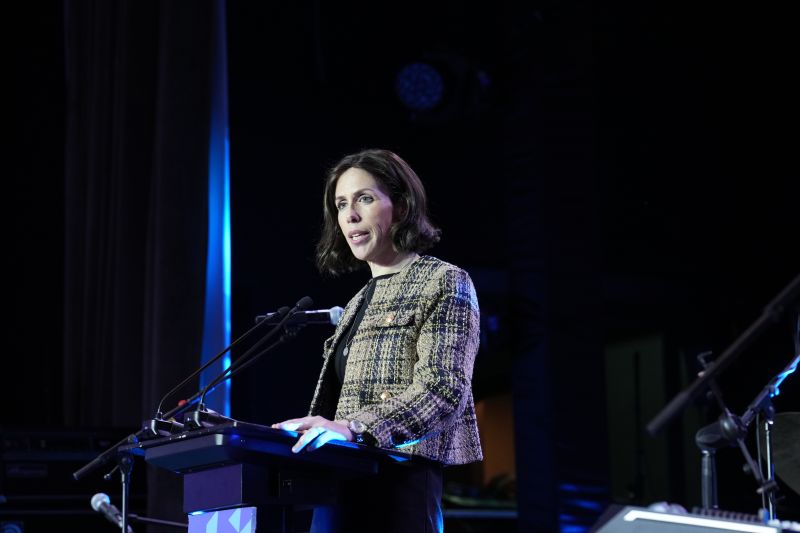
Chaya Yosovich speaks at the 2025 Yael Foundation conference in Cyprus.




 Add EJP on Google
VIENNA — At the plenary of the Yael Foundation’s three-day conference for Jewish educators from around the world, Chaya Yosovich, CEO of the foundation, surveyed the full room. “This is a rare opportunity to bring all of these people together,” she told eJewishPhilanthropy. One teacher from Argentina approached her afterward. “Everyone always tells us what we’re doing is so important, but you’re really showing it to us,” the teacher said, tears in her eyes. “You’re not just talking — you’re doing it.”
It was a refrain that echoed throughout last week’s conference, titled “Own Your Flame.” Yosovich explained that the foundation, which funds Jewish schools and educational programs all over the world, sees the gathering as an investment in its grantees — showing appreciation for educators’ hard, often-overlooked work; giving them the strength to continue passing on their dedication and passion for Jewish education.
Yosovich, who came to the Yael Foundation in late 2023, spent over a decade as CEO of the Shema Yisroel network of Jewish schools in the former Soviet Union — a significant part of the area that the Yael Foundation now supports. The foundation supports 130 schools in 45 countries around the world.
As a child, Yosovich attended Jewish summer camp in Moscow. There she encountered a yearning she’d never experienced before: Here were Jews who had fought for decades just to know they were Jewish.
“The passion they had, the hunger — it was beautiful to see,” Yosovich said. “They wanted something very, very strong inside, even when they didn’t know exactly what it was.”
That hunger was transformative not just for the FSU Jews themselves, but for those who came to help. “It affected everyone else around them that worked with them, that was there, that was trying to give and do,” Yosovich said. “Because if they are so hungry for it, maybe we also need to be something different. We have to look at it differently.”
Three decades later, the tables have turned. The Jews who were once on the receiving end of philanthropic rescue missions — the children and grandchildren of refuseniks, the products of underground Hebrew schools and smuggled prayer books — are now writing the checks.
The Yael Foundation’s founder, Uri Poliavich, embodies this journey, according to Yosovich. He left Ukraine at age 10 when his family made aliyah to Israel. But growing up Israeli, he lost the Jewish identity his parents had fought to preserve. “When he moved to Israel, there was nothing really there that explained to him that he’s Jewish,” Yosovich said.
It wasn’t until Poliavich returned to Kyiv after his army service — 15 years later — that something shifted for him. He visited a synagogue and “happened to bump into something,” according to Yosovich. “The whole part that he was missing when he was a child, he’s trying to give back now,” she said. “This identity — not knowing who he belongs to and where — that’s what drives the work.”
According to Yosovich, this journey from recipients of support to supporters shapes how the Poliaviches think about giving. Poliavich and his wife, Yael (for whom the foundation is named), are investing upwards of $42 million annually, driven by what Yosovich calls an “investor mindset” — a philanthropic model built on three principles: speed, strategic investment in communities and uncompromising excellence.
While traditional foundations may spend a year processing grant applications, the Yael Foundation moves in the span of days, assessing needs and making decisions based on relationships built through mandatory site visits. The foundation has visited schools everywhere from Estonia to Hong Kong.
The foundation also funds what others frequently don’t: general operating support. “Other foundations will give for programs or for specific things like cameras for security, but not, say, the security guard’s salary,” Yosovich said. “We say, ‘You don’t have money for salaries? We’ll give that.’ The money should go directly to where it’s needed, not to what looks good in a report.”
Teacher salaries, security personnel and operations. The unglamorous necessities that keep schools running but don’t merit donor plaques. “If a school needs something critical tomorrow morning, we do it right away,” Yosovich said.
For Yosovich, it’s about investing in identity-building. “If we invest in that school, and they have the infrastructure to invest in the next generation, then 10 years from now, that community is stronger. Maybe those kids move to Israel — we’d be very happy — but we have to be realistic. They’ll probably stay there. So we want to make sure our investment grows.”
“I tell the team, ‘If this were your money, where would you put it?’” Yosovich said. “We’re not donors. We’re investors hoping this is the right place, the right potential.”
The conference in Vienna culminated in an awards ceremony, presenting 12 prizes for categories including Jewish experience of the year, academic excellence, and innovator of the year. Among the judges: Natan Sharansky; Jewish Insider founding publisher and eJewishPhilanthropy publisher Max Neuberger; and Avital Chizhik-Goldschmidt, a journalist and co-founder of Manhattan’s Altneu Synagogue.
The foundation is investing heavily in preserving far-flung Jewish communities that are mostly overlooked by other Jewish funders: Estonia, Valencia, Hong Kong, and Singapore. A major investment to renovate Rome’s historic Jewish school with the Ronald S. Lauder Foundation is underway. And the Yael Foundation is building an entire Jewish campus in Cyprus that will serve 1,500 children — because thousands of Jewish families live there, many of them Israelis seeking an alternative beyond America and Israel.
According to Yosovich, these are strategic investments in Jewish continuity in places that understand what it means to be a minority community.
Chizhik-Goldschmidt brings the same lens to questions of community building and what actually works. The daughter of late-1970s Soviet immigrants to the United States, she married Rabbi Benjamin Goldschmidt, the son of Rabbi Pinchas Goldschmidt, Moscow’s former chief rabbi. Together, the couple founded the Altneu Synagogue on Manhattan’s Upper East Side, which has grown to 725 families in just over four years.
In a conversation with eJP, Chizhik-Goldschmidt reflected on the shared cultural DNA she and Yosovich identify in Russian Jewish philanthropy and community building.
“It’s so much sexier to donate money to advocacy and conferences,” Chizhik-Goldschmidt said. “But you know what actually works? Finding a good Hebrew teacher who’s going to teach kids to speak Hebrew and feel Jewish… But no one wants to fund that because it’s not a gala. You don’t get to post about it.”
Both women describe a persistence of identity across generations — even in those born in America. “I’m one of four daughters. Three of the four married Russian Jews,” Chizhik-Goldschmidt said. “We were all born in America. But I needed that in a partner. It’s such a strong identity — the perspective, the traumas.”
That identity carries with it an urgency about money shaped by financial instability, Chizhik-Goldschmidt said. “So they see that this happens, and their attitude is that you live once. Or, do you want to be the richest person in the cemetery?”
Yosovich sees this playing out in the Poliavichs’ approach. “We keep talking to them about making a proper foundation,” she said. “Their attitude is urgent, the money has to go out. They don’t want it sitting in investments and earning interest for some future distribution. This is the purpose of it.”
“The Poliavichs feel like the more they give, the more success they have. This is the purpose of why they’re working,” Yosovich said. “They say: this is what we want to achieve. We’ll work backwards from there. If profits drop, they’ll say, ‘We have to work harder, because we have to have money for that school.'”
Both women point to a common standard for excellence, which they trace to Soviet-era survival. Chizhik-Goldschmidt describes the type of intellectual warmth that generates a sense of belonging. “Everything we do has to be at such a high level,” she said. “We know how to talk to people, secular people, about the Torah. And when we give an answer, it better be a good enough answer that my babushka [grandmother] would accept.”
It’s the same high standard, Chizhik-Goldschmidt said, that drove the couple when their synagogue bought the Thomas Lamont mansion — a historic Tudor Revival townhouse on East 70th Street. “We could have bought an old movie theater,” Chizhik-Goldschmidt noted. “The Russians on our board leadership said, ‘No.’ Everything has to be something that everyone really wants to come to. That’s the shul.”
Yosovich saw this same standard guiding the Yael Foundation. When searching for a location for Yael’s summer camp program, the organization rejected multiple sites that already existed as camps. “Uri and Yael said, ‘This isn’t top standard. We want the kids to have the best place ever. If it doesn’t exist, we’ll build it.'”
In taking their initiatives to the world stage, both women are hoping to highlight what they see is a unique approach to community building and philanthropy. “I wish more Americans could see what schools look like outside of America and Israel,” Chizhik-Goldschmidt said. “We have these two massive communities, and they’re beautiful. But there’s a whole world out there. Old communities, neglected communities that are such an integral part of our Jewish story.”
A Yael Foundation pilot program pairing American and FSU schools revealed how much can be gained by American school leaders. “The American schools thought they’d be the ones doing the mentoring,” Yosovich said. “But they got so much from just learning and seeing. It was fascinating for them.”
Disclosure: The Yael Foundation provided eJewishPhilanthropy’s travel and accommodations for the conference.
Related News
PRESIDENTIAL REBUKE
Israel’s Herzog: Mamdani ‘makes no effort’ to hide disdain for Israel, Jews must fight back
HIGHER EDUCATION
As Jewish donors reconsider academia, Jan Koum doubles down, endowing Israel studies at Stanford
EXCLUSIVE
Detroit-based philanthropists Nancy, James Grosfeld donate $8M to renovate JDC’s Israel campus
ADVANCING A VISION
N.Y. federation donates $1M toward building shared-society center named for peace activist killed on 10/7

MAJOR GIFTS
Center for Jewish History celebrates 25 years with a $25M matching grant