Opinion
MAASEH AVOT SIMAN LEBANIM
What ancient Egypt’s Jewry can teach American Jewry




 Add EJP on Google
This week’s Torah portion, Parshat Bo, tells the final chapter of ancient Egyptian Jewry, the first Great Diaspora of the Jewish People. Its archetypal story is laid out in Genesis and Exodus and the details of its arc of rise and decline offer insights for American Jewry.
It was natural for the forebearers of the Israelites to gravitate from Canaan, which was a buffer zone between the great powers of the time, to Egypt. Egypt was a superpower whose wealth emanated from the Nile River. It mastered advanced technologies that allowed it to build a great army and awesome pyramids.
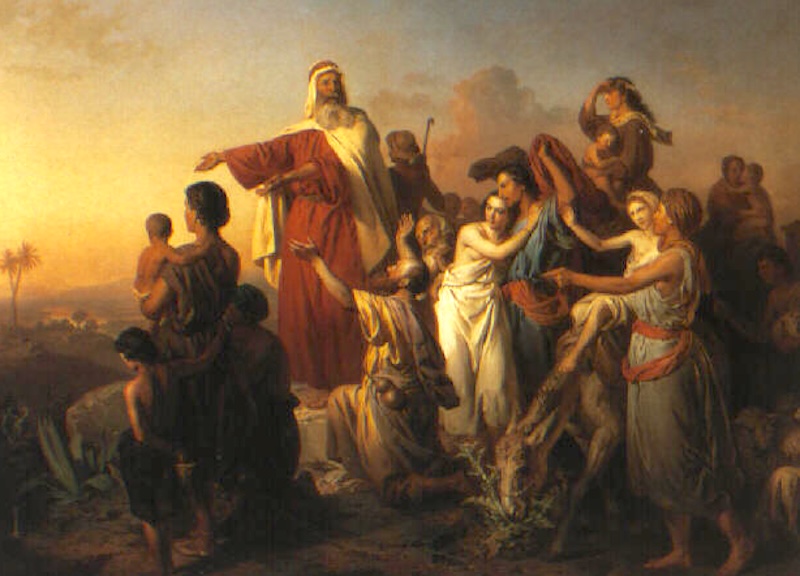
József Molnár/Wikimedia Commons
"Moses leading the Israelites out of Egypt" by József Molnár (1861)
Joseph arrives in Egypt as a slave and is then jailed due to a false accusation. From the bottom of the pit, he rises to power through his character and wisdom. He “figures out” the Egyptian system, becomes viceroy and is ultimately given authority over all of Egypt. In his service of Pharaoh, Joseph becomes the archetype of a “court Jew” whose power and influence emanate from the ruler themselves.
A few decades later, Joseph’s siblings arrive in Egypt because of the famine in Canaan. When they arrive, they cannot recognize their own brother because of his Egyptian appearance. After an elaborate scheme to test their values, Joseph reveals his identity, welcomes them to Egypt and settles them in Goshen, which is a fertile land that is in safe distance from the capital.
Joseph preserved his Hebrew identity within the assimilating Egyptian culture. While he works at Pharaoh’s side and lives as an Egyptian royal, he stays loyal to his family. He marries an Egyptian woman but raises his children as Hebrews. On his deathbed he foresees the exodus and asks to be buried in Canaan.
The peak of Joseph’s power is chronicled in Genesis. His family is comfortably settled in Goshen, where it prospers and multiplies. During the famine, which Joseph anticipated, he acquired on behalf of Pharaoh all the cattle and nearly the entire land of Egypt in exchange for food. And when Jacob passed away, Egypt’s leadership honored Joseph with a grand funeral procession to Hebron, some 500 kilometers away, which required a journey of a few weeks.
A few decades after Joseph’s death, a political shift erases past favor when “a new Pharaoh rose, who did not know Joseph.” According to historians, there was also religious tension between the monotheism of the Israelites and the idolatrous pagan outlook of the Egyptians; this challenged the power structure of Egypt, whose ruler was seen as a demi-god with divine powers. The Israelites were seen as a threat to the national order, one which had to be oppressed by forced labor and then infanticide.
After three generations of oppression, Moses, at 80, led some twenty 20% of the Israelites to rebel and depart, while the rest stayed in Egypt and assimilated with its culture. Meanwhile, the Exodus leads to the birth of a new society and nation, and its story became the formative event of the Jewish People.
The chapters of Genesis that describe this first Jewish Diaspora in Egypt foreshadow recurring dynamics and dilemmas that transcend that moment in Jewish history. Examples include the arrival of a powerless few and their rise to power and privilege; Joseph’s considerations of where to settle his family so it can flourish with distance from Egypt’s authority; the Israelites having distinct economic domains (here herders in a land of agrarians); suspicion of dual loyalty; anti-Jewish legislation, weaponization of law-enforcement against Jews and an attempt of their elimination; debate within families about how to survive under oppression. Pharaoh’s daughter becomes the first “righteous among the nations” when she breaks the law to save Moses. An Israelite who reports on Moses to the authorities represents the first “anti-Jewish Jew.” And when Moses clashes with Pharaoh and his priests, we see the first intellectual and civilizational clash between Jews and a dominant culture.
The Torah implies that diaspora life is a feature of Jewish existence. Genesis describes multiple journeys to Egypt or to Haran, sometimes for decades, and 2 ½ tribes even chose to settle outside the Land of Israel. In Deuteronomy, Moses refers to exile of the Jewish People as a permanent possibility if their society abandons the Torah. According to some readings, the corruption of society and ensuing exile are the probable scenarios.
Indeed, for 19 centuries — from the second to the 20th century CE — nearly all of Jewish life was outside Israel. For 673 years — from 538 BCE to 135 CE — there was Jewish existence in two major centers, Babylon and Jerusalem, as well as in other places across the Near East. And since 1948, a thriving Israel exists in parallel to a prosperous world Jewry, which is led by American Jewry.
All past Diaspora Jewish communities eventually declined. Theoretically, American Jewry will also decline over generations and even centuries. Meanwhile millions of Jews will continue to live in the U.S. for the foreseeable future, and they deserve a vision and leadership that will work to ensure their well-being in America.
At the same time, American Jewry is exceptional in a number of ways: the Constitution and Bill of Rights protect the foundational rights of Jews and the Federalist structure provides an unprecedented level of protection. In the past, concerned Jews would need to leave a country. In America, they can relocate within the U.S. from state to state.
The Interwar Period (the 1920s and 1930s) was a period of spiking antisemitism and Jew hatred in America, with more than 100 pro-Nazi organizations. At the same time, this was a period of tremendous growth for American Jewry, with the founding of what have become long-standing institutions (the Jewish Federations of North America, Hillel International, Yeshiva College and more). The engine of this remarkable communal response has been the decentralized web of institutions of American Jewry, which now includes over 150 federations, 170 Jewish community centers and 1,000 Chabad synagogues. In other words, the resilience of American Jewry is the bedrock of its longevity and potential long-term security and prosperity.
Gidi Grinstein is the founder and president of Reut USA, an Israeli think tank focused on renewal of American Jewry. He is also the founder and president of Tikkun Olam Makers, an Israeli and international humanitarian initiative, and is the author of Flexigidity: The Secret of Jewish Adaptability.